
Webinar or Talk
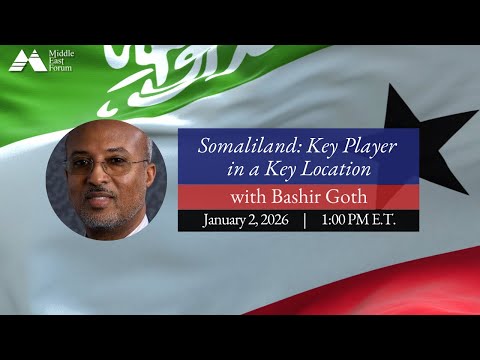
"Somaliland: Key Player in a Key Location" with Bashir Goth
 Watch on YouTube
Description
In this special Middle East Forum podcast, Lauri Regan speaks with Bashir Goth, Somaliland’s Representative to the United States, about Israel’s historic recognition of Somaliland and the geopolitical shockwaves it has sent through the Horn of Africa and the Red Sea region.
Goth describes the recognition as the culmination of Somaliland’s 35-year struggle for sovereignty, democratic governance, and security in one of the world’s most volatile regions. He explains why Israel’s decision shattered longstanding diplomatic taboos, forced Somaliland’s status onto the international agenda for the first time, and exposed the limitations of conventional thinking at the United Nations and other multilateral institutions.
The conversation explores the strategic implications of Israel–Somaliland ties, including Red Sea security, Houthi missile threats, Iranian influence, and growing great-power competition involving Turkey and China. Goth contrasts Somaliland’s record of elections, peaceful transfers of power, and counterterrorism with conditions in Mogadishu, arguing that resistance to recognition reflects institutional inertia rather than realities on the ground.
A wide-ranging Q&A examines prospects for U.S. recognition, security cooperation with Israel, the role of the UAE and Gulf states, relations with Puntland, and Somaliland’s path toward the Abraham Accords in an increasingly polarized region.
Transcript Automatic captions
Source: Automatic captions from YouTube, retrieved October 16, 2026. Automatic captions are machine generated and may misspell names and terms; check the video before quoting.
0:09 Good afternoon and welcome to a special Middle East forum podcast on Israel's recent recognition of Somaland's independence. My name is Lauri Rean and on behalf of MEF, I want to wish you all a very happy new year and thank you for your continued support of MEF's work. We have a lot to accomplish in 2026 and MEF will no doubt be leading a leading contributor to a strong US policy on the critical issues pertaining to US national security in the Middle East, North Africa and global Islamism. I'm pleased to introduce our speaker, Ambassador Bashier Goth, who is the Somaliand representative to the United States. He has decades of experience as a journalist, translator, media, and corporate communications adviser and diplomat. And we look forward to hearing his insights on this important and historic event. Ambassador Goth will speak for about 15 minutes followed by a 15-minute Q&A session. So, if you'd like to ask a question, please feel free to use the Q&A or the chat function at the bottom of your screens to enter your submission. We'll do our best to get to as many of your questions as possible.
1:06 And please do limit submissions to questions only. Today's podcast is being recorded and will be available for future viewing. So, please do share the link with those in your network who would be interested in learning more on this important topic. Welcome, Ambassador, and thanks so much for joining us this afternoon. Floor is Thank you very much Lori for for for hosting me and happy new year to you and all all your audience and to the people of Israel and Somali land. It's actually a great day. Uh we land we are this is a historic breakthrough for us. the recognition of Israel. We have been struggling for this for 35 years and you can imagine 35 years of waiting and patience and persistence and and and consistency building our country, our democracy, our elections. We we held during that time 10 elections and uh we had six transfers of power. Uh we had we prevented terrorism and piracy from our a a great model for democracy in a in a
2:11 very tough neighborhood. And uh we we were just knocking all doors and uh everybody was just giving us a you know uh you know was turning away from us and at this time to get uh the state of Israel to recognize somebody is uh is like you know shattering the the the the the glass ceiling. uh it's a great day and at the same time you even more than that even more than that you cannot imagine for example uh Somaliand Somaliand's case to be discussed in the United N Council despite the the the way it came okay that itself was a great achievement for Somaliand because for 35 years Somariland case was never discussed in any international organization whether it's the United Nations the African Union, the Arab League, anywhere. So just to see that Somali land case was discussed in the United
3:13 Nations uh as a outcome of of Israeli recognition of Somali land was uh was a was a marvelous day for the people of Somaliand. You have seen the celebrations of the people of Somaland in these treaties of of the cities of Somaland. So this is a great day uh for for the people of Somalia and I think a great day also for the people of Israel because we share a lot of history. U we we both struggle for survival for democracy and in Israel and Somali land for democracy building juicing a democratic and free society uh for for our countries uh and and both of us surrounded by by very very tough and sometimes hostile neighborhood. So the two stories actually echo each other and and it's a very great day for Somalan and and it's a very it's a great way to uh end the previous year and welcome the year 2026.
4:11 Terrific. Thank you. Thank you for that Basher. Um there's already a number of questions in the in the queue but um I I want to start by just asking you um why do you suppose that there was so much push back at the UN on Israel's recognition? I mean, especially by EU countries who were all so quick to embrace, you know, the fall of Assad and Syria's new president, Asharah, as well as the recognition of a non-existent Palestinian state at the UN. So, you know, wouldn't they realize how beneficial to all Western nations it would be for Israel to eventually have a presence at the, you know, a base on the Horn of Africa positioned strategically to prevent the Houthis from continuing to wreak havoc in the Red Sea, for instance? What are your thoughts on that? Yeah, I I think the only thing I can think about is uh international organizations are like clubs and clubs they always like the status quo. They cannot think outside the box. They cannot read the reality on the ground.
5:09 They like to be conventional. Okay. So they they cannot be unorthodox. They cannot be creative. And I think that's the whole thing. They just like to stay in the in the you know stay with the status quo and and and and assume everything is just you know you know as as as it happened always. Another thing could be for example it's it's a bit scary for many of the of of the people that that a country like Somaliand a small country in the horn of Africa survived 35 years without international help without having access to international financial institutions without international aid and assistance actually uh and has become a role model for democracy and and and free market economy in a in in that kind of a of a region. So how come that small country African country gen that successive story that could be kind of you know well they cannot do that without our help they cannot do that without international support how can they do that so I I think the whole
6:12 thing is a it's a mix of that okay very interesting um you know I'm going to sort of take a step back uh somebody asked in the in the questions can you please explain the difference between Somalia and Somali land so maybe give a little bit of background around for our viewers. So Maryland uh was a British colony uh from 1884 to 1960 26th June when we became independent. So we became independent on 26th June 1960. The other side or Somalia was an Italian colony and we had two colonial two different colonial systems.
6:52 when we became independent before them at least 5 days we have been recognized by almost 30 countries in the United Nations we got uh uh uh congratulatory cables from the United from the from the queen of England from the United States from many other other countries and as as I mentioned we have been recognized by 30 countries then 5 days after the other side became independent so there was a dream in the Somali speaking people of the Horn of Africa at that time which was uh under five different locations or or regions uh like the the Italian colonized Somalia, the British Somali protectorate and Djibouti which was the French Somali coast that time as well as the Somali region of Ethiopia and a Somali region in Kenya which was under British colony.
7:46 So that there was a dream that all these Somali speaking territories have to unite under one government, one flag and and make greater Somalia. So that was the dream of the people of our grand of our fathers and grandfathers that time. So it was not a bad dream in a way but it was unrealistic. So the this Somali land and then Somalia started to uh to start that kind of a greater Somalia union and that's why they merge in 196 July 1960 the day that the the Italian colonized part became independent but that merge has become actually a bad marriage from the beginning because there were two different systems to begin with two different the culture itself or the people's culture was even front and then uh they the the the it was a the the power sharing was unfair to Somali land from the beginning because the other side has taken the president and the prime minister and all
8:48 the key ministers and on top of that that unification was never ratified by the parliament of the two countries that it was never ratified so it was illegal and that was proven actually by a court in by military court in Mdisho One one year after our independence, the Somali land military officers, most of them were Sanh graduates tried to restore Somali land independence and tried to make a kuda to to to reclaim the independence but it was aborted and then they were court marshaled in uh on the and they were convicted for u national treason. The Somali landers hired a British lawyer for them and the British lawyer found that there's there was no treason because there was no union to begin with and then they were released. The government accepted that that there was no union and the union was never ratified. So it continued for a while for the five first nine years of
9:51 Somalian people thought okay we have civilian governments we have some kind of elections maybe we can continue and maybe things will change and things never change. In 1969 there was a coup dita by military government and then a military dictator who who has become a Soviet satrite and took so in and socialism as the system of the country and dictatorship that continued for almost 29 years. uh and then the Somalian people have have uh uh suffered oppression and uh at the end of the day uh there was a civil war and a devastating civil war and the government that have the military government has brutally uh bombarded the Somali land cities including the city of Haresa where they killed more than more than 50,000 people and sometimes even you know some reports say more than that more than half a million people have be have fled the for the cities of Somariland and went as refugees to to her to to Ethiopia and with that the
10:57 people start to struggle and liberate their country and then the liberation came in 1991 when the central government collapsed and some other insurgents also started in the on the other side and then that's the day the Somaland people came together for peaceful reconciliation and then when they settled peace then they said no more union and they reclaimed We reclaimed our independence in 1991 18 May. So coming May 18, we are going to celebrate the 35th anniversary of Somali land this time as a recognized country.
11:33 And as they say in Israel, Masletoough on that. Um so back back to Israel then and someone has asked this question. um they what is what do you think the prospects of Israel building a a base um in in Somali land to address the threats that are um posed in the straight of Bab al-Mandde which is where the Houthis have halted movement to Israel via the Red Sea um and other you know strategic uh advantages that Israel would would would acquire by by building a base there. And someone has asked actually that there are reports online suggesting that Israel already has constructed a massive military base in Somaland which I don't believe is true but can you address that please?
12:20 Uh now we have just a declaration of uh recognition uh you know mutual recognition between the two sides that has been done. uh we have yet uh to see for example Somalian president go to Jerusalem as as he has been invited by the by the Israeli prime minister to to to Jerusalem and probably when when he goes there there will be a an official diplomatic relations will be established between the two countries but then as two independent countries with with uh who recognize each other with diplomatic relations uh there's nothing that can stop us from having a security cooperation or security pact and that could be that could be that could mean anything. You know, we could have security cooperation with with Israel as as two independent u states, two sovereign states who have the right to uh to make agreements on on on all Um so I wanted to ask you also about the UAE um and where they come into the picture given that they seem to have developed a presence in southern Yemen.
13:22 Um could this presence do you see this presence as possibly playing a role in defeating the Houthis? But also the UAE recently announced its acceptance of Somali land passports. Is that in effect the same thing as as a step towards recognition by the UAE? UAE has historical relations with the with with the with Somali land and Somaliand people. And since we gained our independence, we had very very very good relations with an engagement with with the with the United Arab Emirates. You may know Burbra port which is a prime port in the in the whole of Africa has been uh expanded by DP taken over and expanded by DP world. DP West has a concession of 30 30 years on Berber port and they expanded it and they turned it into a maritime hub for the Horn of Africa and and Abu Dhabi as a government emirate of Abu Dhabi has also a military base in uh in Burbbora and uh they we have strong relations with them also but both econom
14:25 economical relations and cultural and and and political relations and security relations. So uh uh that that's what that that's actually this the only Arab country that actually dared and had the audacity to spend that much money $400 million to expand the port of Barbara and to engage with Somali land as an as a kind of an independent entity and accepted our passports to be used by Somaliand citizens to travel to to uh to to the United Arab Emirates. and yeah we had we have a very good relations with Okay. Thank you. Um it also is is it advantage for Israel um to do this as a counterbalance to Turkey which is use Somalia as a base for movement into Africa and there's rumors that Turkey also uses Somalia for ballistic missile testing. So um where does Turkey um play a role in this at all? I think uh there is a a power struggle or power uh rivalry on the whole of Africa. on the
15:29 heart of Africa, it has been it has been actually described by a British um writer long time ago as the cockpit of the world because even during the cold war uh there was a huge power power struggle in the whole of Africa between the you know you know and in in the competing powers that time the Soviet Soviet block and the freedom block led by the United States and today I can see a new power rivalry power emerging on in the in the horn of Africa. On one side is China and Turkey.
16:05 Turkey actually they have this kind of as I see it and watching it for a long time. Turkey want to wants to revive the Ottoman Empire and this is part of their of their project to to revive the Ottoman Empire in the Middle East and and and the areas that Turkey Ottoman Empire had an influence in the old days. So Turkey almost owns Somalia now. They own the resources. They know they own all the facilities, important facilities like the airports and the ports. And as you said, they are they have the largest military base outside Turkey in Somalia.
16:44 And as you just mentioned it, they have also established a base uh for for their satellites and and and and missiles. So China and Turkey are on one side and probably some other countries also like Somalia which is a failed state. It's not even a government without the African Union forces uh safeguarding uh the and and and probing the the the weak government there it will collapse in a day just like Afghanistan. So that but let us say that Somalia is also one of that and Djibouti but facing that or challenging that on the other side is democratic countries like the United States. Israel is now is now in the region while with with the with establishing relations with Somaliand and Somali land and the United Arab Emirates. So I can see these two blocks facing each other in a very strategic very critical uh region of of the wheel.
17:45 And where do you see the other Arab uh the Gulf nations the Saudi Arabia uh are there other nations Arab nations that you see developing relationships with? If I look actually from what we have be we have been looking over the last few one week after after the state of Israel's recognition of Somali land uh you can see even Saudi Arabia is is is becoming u you know like a member of the other side of of the of the other block the Chinese and and Turkish block I'm not sure if that's their foreign policy but it looks like that but Egypt is already there Egypt is already with Turkey and China in the Africa.
18:27 Okay. Um and then someone asked about the prospects of um US recognition, but you know, President Trump said he'd have to look into it more, but I my guess is that it's more likely that that Netanyahu spoke to him prior to making this announcement. And more importantly, once the Trump administration realizes the strategic asset that Somali land presents, it seems to me like a no-brainer. What are your thoughts on US recognition? I think given to the statement of the of the deputy ambassador of the U of the US ambassador in the United Nations sec security council when uh when the United States supported uh the state of Israel's sovereign right to practice their diplomatic uh you know policy the way they like and he means that the recognition of Somaliand that was very encouraging number one that was really really very encouraging and supports the give it legitimacy to the to the to the recognition of Israel to Somali land.
19:27 And secondly, President Trump said, I study everything and I study hard and then at the end of the day, I make a good decision and I hope that he will make a good decision. I'm I'm really sure. Uh I cannot be sure but I I am I'm very hopeful that the president of the United States will take a right decision uh on on the case of Somali land which is the reality which is it will be on the side of democracy. It will be on the side of the strategic strategic importance of Somali land for for for a free world like the United States. And already we have very good u uh security relations with the United States as African.
20:11 They come there, they train our forces and they visit Somali land on you know almost every every month even as Netanyahu was announcing the recognition of Somali land. The African military officers were there in Argiza on the Uh and and are there someone has asked have any other nations expressed openness to diplomatic relations or at the least consular relations? Uh I think it's not appropriate for me now to name countries but yes we are few countries in the pipeline. That's good news. Um what are the relations someone has asked between Somaliand and the semi-autonomous region of Puntland?
20:48 We have recently signed a cooperation with Puntland. So there's a cooperation between Puntland and Somali land on counterterrorism and that that's a good thing and it it was the first time that a federal member state of Somalia has actually recognized the right of the of the people of Somali land for self-determination and that was in the agreement and that's a that's a very very positive and a very important step and uh just one somebody did ask if Somali land will join the Abraham Accords. What are your thoughts on that?
21:26 Absolutely. Uh that that there's no doubt about that because even when the Abraham Accords were started two years after that, we started approaching and meeting and and having discussions with Abraham Accords. So in a way we were part or or an un an official unofficial member of the of the Abrahamic Accords. We used to call that we are the name actually for this because we were unrecognized country and then when they asked us you are not yet a recognized state in the world how can you join the Abraham Abrahamic Accords and then we said well we can call it Abrahamic Accords plus so that could be Somalia than any other country which could be which which you know which can trade that uh I got that from uh you know OPEC countries the oil producing countries you They had OPEC and OPEC plus. Okay.
22:18 So we were in that plus area but now we will be fully fully member of the Abrahamic Accords where and and will come aboard very soon. It sounds like great news as well. Um someone has asked Islam is the constitutionally established religion of Somali land. What role does Sharia law play in making government policy? Islam is the is the yeah state religion of Somali land like any other Muslim country in the world. Okay. Uh it's our religion. It's our faith and that that's true. But the government uh the the the government um and we have we have also different other other constitution uh and the government system so my democratic government system and our Sharia or it's not Sharia actually or Islamic faith they don't contradict each and and and and there's no problem with that we were always democratic if you look at the history of Somali land one of the first writers
23:21 torians who wrote about Somaliand during the British British days the a gentleman who have become an authority on the history of Somali people I am Lewis but he wrote the first book about the people of Somali land he called it the title of the book is pastoral democracy and that's who we were all the time we were Muslim countries but we were democratic and free country all the time so there is no contradiction between the two uh I'm going to ask you whether what your thoughts are on the strategic significance of this recognition by Israel visav the its conflict with Iran or its war with Iran. Does this do you see this providing Israel with further advantages to confront the Islamic Republic of Iran? uh that's uh a grand geopolitics and that actually will uh will fall under the power struggle going on uh in the region and yes I mean there there are two powers facing each other uh when is democratic and free and you know against tyranny and terror and the other side is probably riding
24:23 dictatorship and and and and hedgemony of the of the of the region. So uh uh we put our lot at Somali land okay in on the side of freedom and democracy and that's where we will stay and that's where we're we will we will have our our future with. Thank you. Um someone has asked a a question about whether there are any Jews that uh live in Somali land and what their status is there. Well uh there are many foreigners in Somali land and you know you you can't you know it's not written on the face of the people that this religion of the people are not written on the face of people. Okay. So there could be many Jews in in in Somali land as foreigners and and holding different passports. But if you if you go back a little back to the history, we have a historical uh you know records that the Jewish people had you know presence in Somali land for a long time and they had also in the coastal cities of Berbbor and Za and uh yes that has been documented and written and some of the of the buildings actually in which
25:25 some of these uh Jewish people live are still is still intact although they are now kind of in ruins but they are still And I think some of the Israeli journalist journalists who visited this week Somali land have visited some of these places in Barbara. I saw the pictures on on on the internet and they still exist. Yes. And we had these historical relations and above that when we became independent in 1960 Israel was the first country that recognizes Somalia. So there's a moral obligation also and we have also we shared a history of uh uh two countries that were born out of trauma.
26:07 So yes there we we share a lot of story with with Israel. Thank you. Um, Bashier, you you touched on China, but does Russia play a role in the region and um, you know, either what are relations between Somali land and and Russia or or Somalia and and Russia? I know they have relations with with with Somalia and uh they they have some kind of agreements with Somalia but they don't have any relations with us and they have no presence in Somalia.
26:41 Are there concerns of nefarious uh players seeking influence in Somali Until now, until now we we didn't see anything like that. But we see any various actions by China doing. China is actually always interfering in our internal affairs. uh because we have established relations with Taiwan that like-minded country a democratic country and and like five years ago almost now six years ago we established a diplomatic relations with Taiwan and China is not happy about that and in the beginning they tried to put pressure on our on our on our government. uh but you know that did not work and then after that they are they are actually uh in full cooperation with Somalia in every field you can imagine and and they are also adamant that Somali land has to be broken has to be destroyed so that they can bring it bring it back to the to the union. They actually see Somali land as Taiwan and as they believe Taiwan is part of of China and they believe in this single China policy they
27:44 promote the same kind of thing for Somalia and they help them in in different ways that they can sabotage the independence of Somalia. It's very interesting. So we've wound down uh we are running out of time and we've uh gone through all of the questions of our our viewers and I thank you all for them. They were all excellent questions. Asher, I can't thank you enough for joining us this afternoon. I know you're traveling and this is such a timely topic. So, we really appreciate you taking the time for us. I want to uh also remind everybody to please join us next Monday, this coming Monday for our next weekly podcast on Canada and Islamism. A warning. Um and again, I wish everybody a very happy, healthy new year. and uh look forward to your support for MEF's work and for all of the great work by Shir that you know all we're looking forward to watching all good things with Somali land in the coming year. So thank you all very much.
28:41 Thank you very much Gloria and thank you thank you to everybody and all your audience and happy new year again for your audience and for the great people of Israel and Somaland. Thank you very Thank you.