
Webinar or Talk
Former Soviet Central Asia and the Palestinian-Israeli Conflict with Ran Ichay
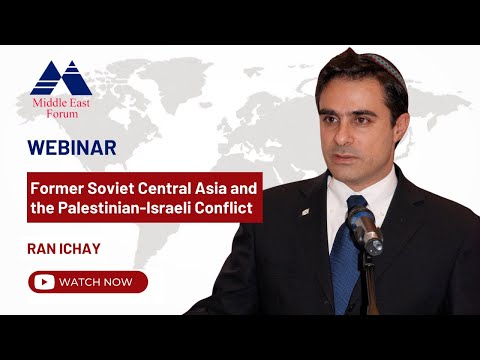 Watch on YouTube
Description
The collapse of the Soviet Union spawned many states, some of them newly independent and Muslim-majority countries, such as the “stans,” with no historical baggage regarding the Palestinian-Israeli conflict. Hence, they represent an opportunity and challenge for the two sides. How have things worked out over the past thirty-plus years? What are current trends? What are the future implications of these states for the conflict?
Ran Ichay is the director of the Jerusalem Center for Applied Research. He served in the Israeli government in 1995-2019, including in the prime minister's office, director general of the Jerusalem ministry, and as ambassador to Kazakhstan. Mr. Ichay holds a BA and a MA from Bar Ilan University.
Transcript Automatic captions
Source: Automatic captions from YouTube, retrieved October 26, 2026. Automatic captions are machine generated and may misspell names and terms; check the video before quoting.
0:07 So, good afternoon and welcome to the Middle East Forums webinar and podcast series featuring talks from the Middle East forums project. I am Alexi of Israel Victory Project and I will be moderating this discussion today. By the way, sorry for my uniform, but I'm during a reserve service from the very morning of October 7th. The format will be a 15minute lecture followed by 15 minutes of Q&A from myself and the audience. Should you wish to ask a question, please use the Q&A box located at the bottom of your screen to type your question. And now I am pleased to introduce our guest today, Mr. Rani Shai.
0:56 He was he's the director of the Jerusalem Center for for Applied Research and he served in the Israeli government from 1995 until 2019, including in the Prime Minister's office and he was a director general of the Jerusalem Ministry and Ambassador to Kazakhstan. Mr. Ishai holds a BA and MAA from Barolan University and our topic today is former Soviet Central Asia and the Palestinian Israel conflict.
1:32 So Ran please the stage is yours. Thank you very much. Good evening everybody or uh something between good morning and good afternoon for many of you I guess. Well, the background concerning the middle Asia, Central Asia countries is that they are uh for us as Israelis, but I think it's relevant for all for for the rest of the world. They are what we say what we call a um white paper tabulasa something that is not nothing is written there and we can write there whatever whatever we we think necessary in terms of uh mainly international relations. They inherited um the uh I would say the Soviet legacy towards the world on one hand but on the other hand they had nothing to do with it in particular and most of the most of the senior diplomats and most of the of the foreign ministries ministers I'm sorry in the Soviet Union were Russian
2:36 you can mention Natal Varad Naz that was a foreign minister u towards the end of the of the of the Soviet union and in Kazak terms Kazim Jumar Tukayv who is today the president of Kazakhstan was a senior diplomat but not too high level. So when Kazakhstan and other central Asian countries became independent, they actually were I would say free to observe and to decide how they react or how they treat, how they relate to each and every country, each and every reason region. And it was of course very very comfortable for us as Israelis because we did not enjoy very good relations with Soviet Union and the whole Eastern block. And suddenly we had dozens of countries if I if I also uh if I also include other East European countries, newly created countries, not dozens but but between 12 and 20
3:39 countries depend how how and when you count. And we were able to uh we were able to deal with them on a fairly I would say fairly new basis. And we had also we had also an advantage that u about a million Israelis were Russian speaking including many in senior or central positions former central positions in in the Soviet republics. So it was quite it was quite new to us because we were used to be um attacked and condemned by these by these countries by by this this area and suddenly we had a new fresh ground to try and work on. I can give you an example when I the the second Lebanon war ended at um on the on August 14th 2006. Two weeks later, only two weeks later, I arrived in Kazakhstan and met in a couple of days, I met with the first first with Tokay who was foreign
4:43 minister to present the uh copy of my credentials. The first sentence uh he said to me and it was only two weeks after after a long war not easy war and I would say um quite controversial mainly towards the end. The first thing he said to me the first sentence he said to me is between both our countries there are no contradictions. Now uh this was not truth of course but because there are until today contradictions not severe ones but there are but the fact that he decided that he chose this sentence as the first sentence to uh to express to the new ambassador meant a lot and also couple of hours later this afternoon I met with the that afternoon I met with with president and actually he said the same and uh it meant and I know from my predecessor. I knew that that during the more than month more than a month of war, if you lived in Kazakhstan and
5:47 didn't listen to news, didn't absorb news from from outside, you didn't know that there was war in the Middle East. Meaning that for Kazakhstan, there are other more important issues than the Israeli Arab conflict in the Middle East towards Israel and towards the Arabs. And this reflects or reflected at least at the time some other central Asian countries. This is very important and this is the basis that until today relatively good relations between Israel and Central Asian countries, some better, some less but this is the base um on which we build so to speak until today uh our work our activities in Central Asia.
6:35 I divide when I when I speak about the Israel's and and Central Asian countries concerning or or in the in the frame of Middle East conflict I divide it to two different I would say two different fields. There is the formal field and there there is the practical field on the ground. On the formal field they vote against us in any international forum they can. I mean whenever it necessary necessary it seems necessary in the uh in their view because that's what the Arab world demands they vote against us. They condemn us when when they think well when they when they find it u needed and they find it needed much much more frequently than we think than we do of course and they um they don't support any of our I would say of our positions uh with regards to the uh now it's not relevant but what used to be the
7:38 negotiations between Israelis and Palestinians concerning the final So officially formally they are not with us at all but on the ground as I said they uh in many most of the time in many occasions I would say they ignore almost completely. I'm I'm when I talk about Central Asian countries, I take Kazakhstan which I know better as a as the main example and what relates to Kaz what relates to Kazakhstan relates also to other Central Asian countries in different in various degrees because Tajikistan is not Usbakistan and both of them are not Kiza is not Kazakhstan. I would say I think that I think Kazakhstan today and I take Azarbaijan aside it's not a central Asian country it's a caucasian country even though there are some similar uh aspects in the in Israel's relation towards and Kazakhstan not the same but Kazakhstan I would say from what I knew
8:40 and from what I know until today even if it is a little different it's been 15 years since I left there But I'm in touch. Uh Kazakhstan, I would say, is the more is the most um advanced Central Asian country in in in her relations with Israel. despite despite the need or the urge of the for of former president Nazarbay to be some kind of mediator. He saw himself and he saw his country as as someone who must have an international status not only local leader or national leader. So uh and he tried um I can say now that that he he um there was he did not suggest it directly but there was a suggestion that came to me indirectly.
9:32 Uh and I I cannot confirm for sure. I have no evidence that it came from him initially but undoubtedly it came from from people around him. I don't know if he knew about it to maybe mediate or be involved or host some kind of Palestinian Israelis forums or negotiations. And I thought it was not a good idea. Not because I do not trust him, but because I know that if you put your hand in the Israeli Palestinian negotiation, you end up fighting with both sides and mainly with us because we are to blame anyway. So I and I do not do not want to to spoil Israeli Kazakhstan relations on this uh on this altar of of Israeli Palestinian negotiation. I knew that there was no no point in it.
10:27 But um so what makes what makes these countries I would say um I would say even favorite of the state of Israel is that they see themselves and I heard it several times they see themselves or they saw themselves at the time and I don't think it I don't think it disappeared. They see themselves as as um followers of in history of followers of what happened to Israel. They told me several times, mainly Kazaks, but not only Kazaks, we go now, we walk now, we step now on the same route that you did some 50, 60, 70 years ago. You did well. We would like to do well as you did. Teach us, guide us. And I think this um it reflects the and and it shapes the uh quite unique central Asian uh attitude towards Israel.
11:23 There are these are Muslims, Muslim countries and they have some kind of not affection but some kind of of relation to Arab countries and other Muslim countries even though Islam there is absolutely not political. It's something that is more cultural. They drink alcohol for instance. Uh they don't observe, they don't practice the religion. uh there are efforts by Iran, by Saudi Arabia to uh and to uh enhance to strengthen Islam in these countries.
11:55 And once again, you see two countries, Iran and Saudi Arabia with completely different interests. They try to do as if so-called the same promoting Islam in in in Kazakhstan and other countries, but from different reasons. So it doesn't really work and it's not a main factor in in Kazak or other central Asia. Some of them more as I said I take Kazakhstan as the main example some other countries are different but once again it's not as as as important as strong and in other Muslim countries the Islam as as a state religion does not exist in not in Kazakhstan not in Usbakistan and and in other countries as well in some places more some places less important as a factor but not the main factor And it also it has influence. So I would say that um I would define the uniqueness of of of this of of this attitude as in on one
13:00 hand it was as I said it was a card blunch. It was something new that we could write on our story something we couldn't do in other uh with other countries when we were established 75 years ago. We couldn't because they had also they also already had their views towards Jews, towards Zionism and towards the newly established Israel. It did not exist in Central Asian countries when they were established in in the early 90s. It was a it was a blank. It was a um white empty page. We could write whatever we wanted. This is on one hand. On the other hand, there is the the law of the big numbers. Okay, they central Asian countries like any other countries has something between uh 15 to 20 uh even more sometimes embassies in other Arab and Muslim countries and one embassy in Israel and on the other hand they have 20 embass Arab and Muslim and even more embassies in their capitals and one Israeli embassy. It reflects
14:04 it's reflected in everything like you get you get uh what best case scenario you get 20 negative reports on a daily or weekly basis negative reports towards Israel and one positive. So it says something and of course it uh it means it means everything in international forums and also within the headquarters of the ministries of foreign affairs. So I not ignore that. And as I said, we have the official, the formal level, and we have the practical level. And I think the practical level uh reflects or comes out of this white page that I described where we wrote our own story and managed to write the or to shape a unique relations with these countries. And on the other hand, we have the official the formal level uh or the formal field on which you know like the rest of the world it's uh it's um influenced by the by the general international arena. I think I need to stop now because my 15
15:08 minutes are over and I would love to answer some questions. I hope I managed in short time to describe the picture as I see it. Thank you very much. very short but very interesting and uh very wide So I I would like to ask some questions from questions that we received from the audience. Um JR Pride is asking are there still ethnic Russians in former Soviet Central Asia and still oppo and and are they still opposing Israel?
15:48 I think in Kazakhstan there are the was the most uh the largest Russian minority in central Asian countries. Uh when Kazakhstan was uh established actually there were more Russians than Kazak Now it's different. Uh but I don't think well Kazakhstan is a country without Anti-semitism does not exist there. If there is something I would rather it will come from from uh from maybe from from Russians or Ukrainians that are there not from Kazaks. Kazaks they have nothing to do with it. So uh yes there is a large Russian minority in Kazakhstan are their trouble is much more with with local Kazak government.
16:34 They think they are they think they're discriminated. Uh so and they they don't have anything to do with us generally speaking. I I can tell you that I was I was walking in Kazakhstan with with my with Kipa on my head. Something I've never dared and it was forbidden to do by the security uh of in the embassy of uh of in Brussels where I served before. So this is something completely different. We felt safe in Kazakhstan. So I will continue this question.
17:09 How do you think today Kazakhstan and the whole this area are there independent from Russian concerning their relations to Israel? Um well generally speaking yes it depends on what basis what in what regard. For instance, I think politically they are independent. They can do whatever they want because Russia, it's not that Russia doesn't care what what what happens in Israel.
17:42 It's mainly now that Iran is involved and of course the war in Ukraine is in the background. It's not in the background, it's the ground. Uh but uh in other issues, I would say more technical issues, it's and it's not mainly it's not um specifically against Israel. When I came to K I I'll give you an example and you will sum it up. When I came to Kazakhstan, I was informed that there was a contract between between Kazakhstan and the British air industry, a huge contract of billions of dollars that was cancelled and it was cancelled probably by the Russians though it was it has nothing to do with Russia but it was canceled because Russia did not agree that something that strategic will go out of hands to a foreign country like Britain. Um in my time during my time in Kazakhstan we have a blooming in our um security export I would say to Kazakhstan and it was uh it was flourishing for uh for quite a time. I think it still goes on today but I don't
18:46 know. Uh but in any event at at a certain st at a certain st um stage we uh we were blocked. We were blocked probably by the Russians. We didn't know that for sure, of course, but we knew that there were two main uh streams in the Ministry of of Defense, a Russian pro-Russian one and a pro-Israeli one. And the pro-Israeli one was blooming until it was stopped. And I'm not that naive to think that there was, you know, some someday someone uh just woke up and decided to stop everything. So, yes, there is an influence, but I don't think it's political. I think it's more Thank you. Another question from Steven Orllo. What is the relationship of the states with Iran?
19:37 What is the Sunni Shia divide if if if exists there for example through Azerba Janis Shia the relationship with Iran is very stain and it benefits Israel. Does do those states also have these aspects? Uh first of all all the states that have shores in the on the Caspian Sea are involved with Iran. This is a strategic issue and they have I would say to dance or to step between the between the the the rain.
20:13 Um but uh it's it's something worth uh worth mentioning that even though they uh don't and I once again I speak with I'm talking about Kazakhstan but not only about Kazakhstan uh but with regards to other countries as well they do not not only they do not disconnect the relations or downgrade the relation with Israel. You can see the other way around. So it means that as uh as much as they need Iran, I think Iran needs them more with with its own interest in the Caspian Sea. So uh even Iran as a nonrationalist, I don't like this uh this term because they are rationalist with their own rationality, not our own. But uh even there even Iran knows what's more important to her at a certain stage at a certain point uh and uh knows where to push the uh the pedal and where to uh go a little backwards.
21:13 So it exists but it does not it does not influence the relations. So I'll continue this issue. you know, we all know about how Israel uses, you know, Zerbaan in relation to uh to Iran. Does Israel also does that with these states with the Central Asian Um I'm not that familiar with the situation to try and compare. Aaran is a unique Azeran is a very very unique case. I guess you know that that the Iranian the Iranian leader is not he's not Persian you know that he's he's aer Azeri so this is something this is something that is I would say this is a family problem or family issue between between Azeran and Iran I don't think other mainly central Asian countries who are not also not she but Sunni even though it has not great meaning in this regard as I said they're not religious
22:18 But the they're they're Sunni secular, not GI secular. I would say it is a little bit different. I don't think they have they have so many mutual and contra and contradictive interests in the um in the Caspian Sea that once again Israel does not play a major to our surprise. We're not used to it to be second, but we don't play a major role in this regard in these countries. And do you believe that today you know with uh you know I think that we definitely can agree that we forecast you know worse relationships with Russia between Israel and Russia. What do you think will be or can be the development on this background of relations between Israel and the central Asian states?
23:13 I think that I this is my view that as long as as Russia does not interfere and I don't predict for now any interf any any such interference I don't think it will I don't think it will influence because unless they have direct interest that we harm and for the time being it's the other way around unless one of these countries will have direct interest that is harmed by Israel they have no reason to change anything on the contrary So I think that as long as the situation goes like this I can you know I just went to uh just to see that I didn't miss anything and I I saw the the uh even the comments of the uh of of Tokyo for instance and his foreign minister after the uh October 7th attacks they condemned very very directly and very harshly the the attack against Israel and even when they tried to uh and I think it was very calculated when they tried to balance you know later like like other countries because we attacked
24:16 back and we're not we're not allowed to attack back. Uh so even then they were not that precise. They were not they said that you know that they they uh repeated the two-state solution and the need and the natural rights and everything. Nothing new. What was new is that we attack very very heavily in Gaza now and we were not condemned as harshly as you could have expected uh because I think they they preserved their unique uh their unique position not in favor of Israel but for the time being and for many years especially not against and this is something worth mentioning.
24:59 Do you believe that the major interests of these states that they see in Israel are economic and if yes in what field? Of course, I can I can point uh a very bright difference between my work as ambassador and my embassy to my envious colleagues mainly in Western European countries but others as well. I did not deal with the conflict. I did whatever I felt like and it was 90% and more economic on the on the other hand my my colleagues in other countries other European countries and Kazakhstan is is partly a European country you know in other European western European countries and others dealt most of the of their working day on with regard to the conflict. I I lived in heaven in this regard. So yes, there is a huge economic uh interest uh for these countries in Israel. They try to do their best to take advantage on it and to try and and make make the best
26:03 out of it. We felt it in Kazakhstan on a daily basis. I know it it goes on until today. I know it goes on in other countries as well. And uh I think it's it's once again it's it's one of the solid bases of the of the good relations of Israel with this country because they are very practical. They try to be they they fight they don't fight for their lives because they're 30 and more year old now and they they're more stabilized than they were but they're still young countries and they struggle to enhance they struggle to promote themselves and they know where they can do it with whom they can do it better. They try not to lose the Arabs as well. there is a very there is a huge Arab uh money that can that can contribute and and does yes but they try to use them both they don't take one on the account of of the other I would say and yes we work there economically quite freely and do you believe that they influence also our relationships with other Arab and Muslim countries for for better well uh I didn't think about it because
27:08 I never saw I never saw ties on this regard between between Central Asian countries and Arab countries. I wouldn't say that. I would say that they contribute in a way because it makes you know it makes a good atmosphere and it creates a good environment. But we have we have much more I would say direct and immediate interest mutual interest with other countries in our neighborhood uh that than than could be really heavily influenced by remote countries or central Asian countries. So I would say that it it contributes in a general on a general basis but I wouldn't say it has a direct uh a direct connection.
27:49 That's that's how I would think about So what is the major benefit that Israel can benefit from with uh with those Well, first of all, economically we export we export knowledge, we export science, we export products. Uh second, you know, there is it it is something strategic in our goals in our goals as a state as a state as an independent state to maintain good relations with many areas around the world. So I'm not talking about now about Benurion's second circle theory. It's not the case.
28:26 But you can say that it's something that goes out of it. You know the uh trying to widen the uh circle of of not of influence because we're not we don't seek to influence anyone but the circle of of connections, the circle of of of uh of good political relations with other countries. And not to not to forget, we have tens we still have probably tens of thousands of Jews in in Kazakhstan that we would like to take care of. And we have special relations with them, of course. And I and mainly economic also mainly economically also politically.
29:07 And um in some ways I think it eases our relations with Russia. Even though Russia with Russia it's once again it can help but it does not it does not shape with Russia it's something different. It can help as a background and it's something positive but um it has nothing to do with with what we have now with Russia which is influenced by completely other issues. But you believe that but but economically to do business with them helps to do business with Russia.
29:44 Yes, of course. Not only with Russia, not only with Russia. It's it's you know it one one one step leads to another with other countries as well. And sometimes I can tell you that I was I was a guest in a when I still served there I was a guest in a in a weapon uh I wouldn't say festival but something you know event outside of Astana I think there were 12 companies 11 or 12 foreign companies presenting their uh their products uh out of which seven or eight were Israelis. Now it was a it was a regional uh event, regional affair and many others saw it and it was in Kazakhstan and we demonstrated what we know what we knew what we still know I hope to do and of course it helped us it helps us uh you know marketing our products. So uh not only in Russian terms I think if Russian Russians was certainly there and if they were there they were not happy with what we had to
30:45 suggest but other countries bought it. So um yes yes yes we we gain from it. Ran thank you very much for this very interesting and very informative talk. We have come to the close of our webinar. Thank you again for and thank you all the guests for joining us today. For our viewers and listeners please join us Wednesday at 3 pm Eastern for an update with Ashley Perry on Israel Insider webinar. Thank you all for [clears throat] joining us and I hope have a wonderful day and Ron. Thank you again. Have a good night.
31:20 Thank you. Thank you for inviting me. Good evening everybody.