
Conference or Roundtable
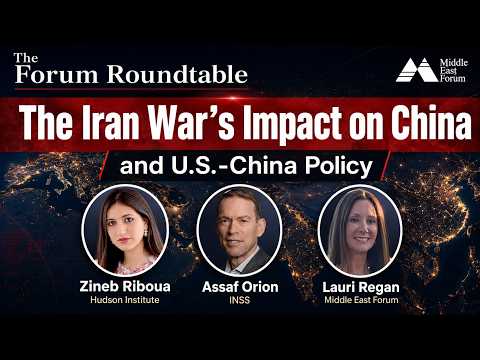
Forum Roundtable: How the Iran War Is Reshaping China’s Middle East Strategy
 Watch on YouTube
Description
China’s ambitions in the Middle East are colliding with a new regional reality: Iran has been weakened, Gulf states are recalculating, and Washington is using the moment to reassert leverage across multiple theaters.
In this month’s Forum Roundtable, Lauri Regan is joined by Zineb Riboua of the Hudson Institute and Brigadier General (Res.) Assaf Orion of the Washington Institute and the Institute for National Security Studies to examine how the Iran war has affected China’s global ambitions, its relationship with Tehran, and its broader competition with the United States.
The panel breaks down China’s long-standing use of Iran as a strategic asset, from discounted oil and sanctions evasion to proxy warfare and regional diplomacy. They also assess why Beijing’s ability to play both sides in the Gulf may be reaching new limits as Iran targets regional infrastructure and Gulf states continue to look to Washington, not China, for security.
The discussion also turns to Israel-China relations, the future of the Belt and Road Initiative, U.S.-China competition in Latin America and the Indo-Pacific, and the stakes surrounding President Trump’s expected meeting with Xi Jinping. Together, the panelists explore whether the war has strengthened American deterrence, disrupted China’s strategic assumptions, and opened a new phase in the contest over Taiwan, energy, trade, and regional power.
Featuring: Lauri Regan; Zineb Riboua; Assaf Orion.
Transcript Automatic captions
Source: Automatic captions from YouTube, retrieved October 14, 2026. Automatic captions are machine generated and may misspell names and terms; check the video before quoting.
0:02 Good morning and welcome to the Middle East Forum's monthly special podcast series, The Forum Round Table. My name is Lori Rean and I'm privileged to host these important panel discussions with the world's leading experts on timely and critical foreign policy and national security issues of the day. Thank you all for joining and for your continued support of the work that the Middle East forum is doing. It's your support that allows everyone affiliated with MEF to be so impactful in the development of policy that keeps America and our allies strong and secure. This month's round table will feature a discussion about the way in which the Iran war has impacted both China's global ambitions as well as the Trump administration's foreign policy surrounding the China file and the threats that the people's republic poses to the US national security. While there are some in the foreign policy world who claim that the war with the Islamic Republic will be beneficial to China and its broader standing in the region, the war has actually resulted in not just economic and energy issues for the PRC. Its global ambitions have been severely impacted as well. Whether this was part of President Trump's grand scheme to diminish China's standing as a superpower, its belt and road initiative, and its ability to project
1:05 threatening power in the Indo-Pacific isn't clear. But what is clear is that Operations Epic Fury and Luring Lying have had a detrimental impact on China. With Trump's visit to Beijing on the horizon, questions loom over how the war has impacted the upcoming negotiations from tariffs and trade to human rights and Taiwan. Joining us to break down these important geopolitical issues are are Zanb Verbboa, a research fellow with the Hudson Institute Center for Peace and Security in the Middle East and Brigadier General in the Reserves, Assaf Orion, the Liz and Moni Vuven International Fellow with the Washington Institute and senior researcher at the Institute for National Security Studies.
1:45 Today's podcast is being recorded and will be available for future viewing. So, please do share the recording far and wide. Welcome Zanv and Assaf and thanks so much for joining us today. U Zanv, I'm going to start off with you and I'm going to ask you to give an overview of China's relationship with Iran prior to the Iran war. You've written that quote, "China has spent years and billions of dollars building Iran into a structural asset. And you've described President Xi as having spent decades cultivating the Islamic Republic as the armed underwriter of Chinese influence in the Middle East. Can you share what you mean by structural asset?
2:18 in particular, please describe what China was looking for from Iran and what Iran received from China, as I believe their symbiosis went beyond just the sale of discounted oil in exchange for weapons given the 2021 China um signed this 25-year comprehensive strategic partnership with Iran. Um and that involved a lot of other things. So, what were China's strategic and long-term goals in Iran? And were they aimed at empowering China or at curbing American power and influence as well? And um Zab also I if you can share your thoughts on the meeting between Iran's foreign minister and China's counterpart that took place uh on Tuesday in Beijing.
2:58 Uh well first of all thank you very much Lori. Uh and uh it's a pleasure to be on a panel with Assaf. Um uh and I think it's a very important topic given yes that uh there's an important visit happening right now. um the the Iranian foreign minister visiting uh China right before the the Putin uh sorry the Trump Xiinping summit um and I think that first of all on on your question regarding um China's relationship with Iran well I think that it was it goes without saying that oil has always been uh especially important when we think about u China's industrial capacity it's it's um its ambition to be uh absolutely absolutely dominant in manufacturing and so on and you cannot really do that without energy. So the uh cooperation with Iran has been for a very long time really centered around that but also uh with Gulf countries as well. However, the advantage with Iran was that you're dealing with a heavily sanctioned country. Um and therefore um the uh uh
4:02 China was receiving oil uh with a discount which was absolutely I think a an a big advantage that China had over European uh and other competitors um in in the industrial side. Uh but obviously Iran given its uh I would say very aggressive posture having proxies across um the Middle East um it goes without saying that for China having a good relationship with Iran means also having access to those type of channels. And it was very for example noticeable how uh China was involved in discussions with the Houthis at the UN level. uh how uh China um invited Hamas and Fatah uh after October 7th, but also every single um mistake you you the United States was doing in the Middle East gave China I think um a better position uh to be uh I would say a mediator, an interlocator and it happened for example um uh when the Saudi Iran normalization deal
5:06 happened. Uh why? because uh the US administration at the time was not really tackling the Houthis um and other proxies as it as it should have been. So obviously Gulf countries started hching um towards China as a more of a reliable channel. And so in many ways um the proximity towards Iran gave um China I would say a diplomatic um aspect uh that was a diplomatic um advantage that that that was uh at first um not very noticeable. Uh so there is the oil, the energy, obviously the dipl diplomacy side, but also there's something very interesting that happened um where um we we've seen how China was for example very involved in uh in back in Russia and its invasion of Ukraine. Um and it has the advantage of uh knowing exactly what type of weapon systems uh NATO was using, Ukraine was using. um having the type of um I would say uh intelligence
6:11 gathering and it's the same thing that happened uh in the blockade of the Red Sea um that the Houthis were conducting after October 7th. Um there was uh the anti-ship ballistic missiles. They definitely came for from China for the Houthis uh and so on. So on the military side, I think it gave uh China, that proximity to Iran gave China, I think a better sense of uh what the United States is capable of, but also what Israel is capable of. Um and I would say that there was also a shift in China's Middle East policy. There was a big raprom that happened between Israel um and China. Maybe Rapushma is not the right word but more of a there was there were discussions and so on. But then uh after October 7th it seemed that China made the bet against Israel. Um especially when it came uh to to Hezbollah uh and other and other proxies. Um and it was very noticeable
7:13 in how uh China for example changed uh its ambassadors uh to Israel. um uh really took a harsher stance against Israel at the UN level and other levels. Um and and so I think that China uh uh over time uh really shifted toward really shielding Iran diplomatically speaking and talking about nuclear rights that Iran uh should have. And I think that uh especially now with Operation Epic Fury and and really the um humiliation of the IRGC at the military level and how much Iran has been uh especially aggressive towards Gulf countries, China really did not rush to condemn Iran's uh aggression against uh Gulf countries that it deals with. It did not say that uh especially because the Iranians have been hitting um dalination facilities, oil facilities um and other facilities um that were especially hurting Gulf countries and China did not
8:16 did not condemn that and I think that they even vetoed um or uh vetoed a resolution. So it is right now choosing its relationship with Iran over its relationship with the Gulf countries. Uh at least on the diplomatic side and the political one. Um so on many levels I would say that uh obviously the investments that you mentioned um I think that for the 25 year co uh cooperation agreement I think the the deal was about 400 um uh 400 billion dollars uh something of this sort. But I I think that the estimate of how much they invested is more 150. Um and and a lot of the arrangements that Iran and China does is more of a barter um arrangements uh because of the sanctions and so on. And here is where it's interesting. Um the uh China was also using Iran as a way to um really learn about how to circumvent sanctions.
9:16 sanctuaries are very important when you're thinking about invading any other country or annexing um uh and and especially when it comes to to Taiwan. And there's something that I believe China learned um is to not make the same mistakes as Putin and to make sure that you have uh some sort of um uh some sort of way to protect yourself from the heavy sanctions that come from the west and and and Iran was very uh useful to that. A lot of uh the shadow banking happened thanks to China. Uh the front companies are based in Hong Kong. Uh the TAR refineries and so on. And it and what I think was interesting last week was the fact that the United States moved towards designating several Chinese entities and uh and the reaction of China was that they will not comply.
10:06 Um and and and here and I think that this tells us first of all that um the United States will have to make a decision whether to escalate and it seems that they are uh per Rubio's statements yesterday. Um but it also seems that this is a real battle uh when it comes to how much uh Iran was useful to China in that in that sense um and how much China is able to push back or not. Uh so a brief summary uh of your very complicated question. Thank you. Yes, I my questions tend to be a little deep so I appreciate all of the information that you just provided.
10:43 Um Assaf, by way of further background, can you spend a few minutes discussing the relationship that China had with Israel in the leadup to October 7th and how that relationship has changed over the years, including since 107 and both operations Rising Lion and Waring Lion? Um, INSS actually issued a a lengthy report that indicated that Chinese investment in Israel was actually waning prior to 107, although the deterioration in that bilateral relationship perhaps became worse post 107 and Zanb has touched a bit on on this, but please share a bit about the relationship and for instance, was Israel part of China's belt and road initiative and now that the relationship has changed, is there Chinese infrastructure in Israel that will be impacted by current events? And has China played a role in excuse me Israel's national strategic and/or economic calculations? Um so from Israel's perspective, what are your what are your thoughts?
11:40 Well, I need to um add, you know, some nuance because uh uh there's an often uh quest for simplicity and China does not lend itself to simplicity. Uh it's uh it's usually complex. it's usually uh wrought with contradictions and uh we need to uh we need to follow the nuance. So from an historical point of view I can generalize and say that Israel's relations with China were always conducted under the uh umbrella or the overcast of the great power competition. the US China relations are the uh definitive uh shaping factor of those. So uh from the Korea war we were under the uh cold war uh paradigm.
12:36 uh from the opening up in in the 70s, Israel started uh its uh cooperation with China even before diplomatic ties um in 92 and the US actually encouraged Israel to support China's defense needs after its defeat in Vietnam in 79. Uh then uh after uh the uh Taiwan straight uh crisis of uh 95 and 96 uh came the famous crisis of the Falcon and Harpy systems export. Uh and that was the watershed moment after a big crisis between the US and Israel uh that uh uh defense exports to to China From then on in uh we had in the early 2000s uh some new beginnings because there was a big freeze after those
13:42 uh the last or yes the uh last uh decade let's say 2011 12 13 under the championship of prime minister Netanyahu it was all about you know developing with China the innovative partnerships he called it a marriage made in heaven and so on and it lasted I think until in the culmination point was 2017 when in March Israel signed a comprehensive innovative partnership with China. And in December came the uh first uh Trump administration national security strategy which defined China is the number one threat to America and one number one challenge and put uh um technology at the heart of this. Since uh 2017 and onwards uh you could follow the trajectories of investments of
14:46 incoming uh uh tourists of a lot of things projects as you said and so on. Uh you could see the the peak around 20189 and since then a decline with three consecutive blows uh coming one after each other. The first is the really the US pressure under the great power competition. The second is co in 2020. And the third is our wars since uh October 7th in which China uh did what it usually does, taking a step back, being very cautious and siding up with the Arabs and Muslims. Uh that didn't play well in the Israeli public. And I think if you follow our data and you can uh I recommend uh the uh data uh uh uploads of the Diane and Gilford Glazer Center for China Israel Policy in at the INSS. You could see that we're I
15:52 think in an all-time low uh in tourists, in investment, in in uh exchanges, in uh all of these uh we fell from something like 150 70,000 tourists uh or entries per year uh to about 7,000. Many of those are uh laborers, Chinese laborers working in Israel. And uh right now I think we're trying to climb out of that uh pitch and uh or ditch and say we we need to uh start uh salvaging whatever can be saved. Uh we understand that China has no allies. Uh we don't think that China is an ally to Iran. It supports it. But at the same time, Saudi Arabia and the UAE are more important partners of China in the Middle East. Uh, China took advantage of Iran and the sanction. Uh, it it does
16:58 not support it in any grand way. Its diplomacy is generally performative. And I think the the main thing to understand here as as our colleague uh in the Rand Corporation wrote about 10 years ago, China in the Middle East is a economic uh political lightweight and military featherweight. And uh we don't see any military relevance. I don't think that anyone in the Middle East looks at China as a relevant security guarantor but they are definitely a relevant partner for economy. So if I need to sum up what China does in in uh in the context of war its relevance to the war running or the conduct and so on is very low almost non-existent.
17:56 uh you can uh hear the diplomacy chatter very performative by the way even the Iran Saudi Arabia agreement most of it was already concluded by Oman and Iraq and uh and China just provided the host uh service because Saudi Arabia wanted to poke uh America in the eye and say you need to listen to me. Uh that that was an attentiongrabbing uh pitch. So uh China now may be relevant to the conclusion of the conflict and you hear the secretary of the treasury talking about maybe they will convince Iran to open homos but China will be certainly relevant in the aftermath and since this campaign was much about eroding Iran's industrial capability China would be the first goto uh when Iran needs to uh to build up or rebuild and guess what uh they will be proposing cheap oil.
19:01 Thank you, Assaf. Um I'm actually going to ask you to go into that in a little bit more in depth in in a couple minutes, but Zanb um at the end of March, you wrote a column addressing point by point an article that was published in the Financial Times that argued that the war with Iran ultimately advantages Beijing, positioning it to reap substantial economic and diplomatic gains from the conflict. Um today we still see some people making that argument but um you know especially as the ceasefire continues during which it appears that China is helping to reconstitute Iran's missile program and and defenses as pointed out um and we will get into that. I'd like you though, Zette, to please share some of the insights that you provided in that column, including why you've concluded that the Iran war will definitely not cement China's superpower status and how Operation Epic Fury is strengthening deterrence and positioning America for a long-term focus on the Indo-acific.
19:53 Well, um I I was mainly responding to um to a few claims that um that this operation will cement uh yes uh China's uh status as a superpower in the region. And it seems that first of all it was false because a lot of the claim rested on on a few uh variables and one of them was the elevation of Petro Yuan. Um and I think that there is a misunderstanding of uh the pro pet yuan argument because while it's true that Iran really settles uh it's all sales through as I said earlier shadow banking um uh with front companies and small regional banks. Uh the problem is that the it's a financial infrastructure of a sanctioned state um that is out of the dollar system. So it's not really a credible monetary alternative. Um the other problem with that argument was that the rent renb accounts for um 8.5% of global foreign exchange. Uh the the US dollar is 89.2%.
21:00 Um and the yuan what is most important what is I think most important is that it's not it's not yet fully convertible which means that um Gulf Gulf states will have to anchor their fiscal system on a currency they cannot fully trade um on global markets uh and and there were discussions about um whether Saudi Arabia and the UAE were were interested and so on and and and it didn't uh go through uh also it's important to mention that you know the 200 50 billion in US treasury uh are with GCC sovereign world funds that are being managed uh uh with um more than 6 trillion overall. So a lot of it is uh is is dollar dominated. So it was it was really an argument about what about um how really China can um can use the operation so that it can gain um by putting together some structural mechanisms that anchor that anchor its um uh its influence but
22:03 also uh its status and it seems to me that especially on the financial side that's very unlikely. The other part was really about um uh about other commodities that you know China uh really does not need a lot of the commodities that come from just straight of horm uh reserves and so on. But the thing is it's it having access to reserves does not necessarily mean um that um um it means that you can absorb a an economic shock. it cannot necessarily mean that you can transform that uh into something you can uh use as a security guarantee to other states. uh because one of the claims was that um China can use for example some of it its commodities uh give it uh to Vietnam and and Cambodia and some other countries um and and it seems that it it didn't happen really uh and and even if it did that's not enough to to say that it's um uh it's a superpower move um uh especially on this side. So on several levels, I I saw that
23:09 the argument really rested on on variables that were um just really shaky. Uh and and one of the other arguments was really about access to energy and um uh Turkmanistan's gas and so on. But but the Turk but the thing is um the Chinese already pay a premium on Turkish on Turkman gas um compared to what they get uh from Russia. And what is most important now is that uh Turkmanistan is actually uh diversifying meaning uh that is uh going to uh have more leverage over its negotiations uh with the Chinese and it will come at a higher cost. So in many ways um I saw the energy question the financial one uh really shaky and I think that what is interesting right now is I think I think there are two ways where China can make um uh can make moves and and but but both of them really necessitate for uh necessitate that the United States and
24:11 Israel lose in their operation. Uh I think it's it's the only way for China to make uh spec big bigger moves and uh and what was interesting while the operation was ongoing at least for the United States was that the United States used the operation to get closer to other countries. Uh and also a lot of the weapon systems that the Iranians were using were coming from China. So uh and a lot of them were not really um uh sophisticated and did not really perform well. uh Japan already saw that and they made a huge move in changing their um their legislation and and right now they're discussing uh having uh negotiations with other countries so that they can uh export uh some of their um some of their uh uh systems not really I think more of defense ones uh but that's I think a very uh important um development that means that you know China actually is not really benefiting from this because it's empower empowering precisely uh US allies and
25:14 there are other deals that were made between Indonesia and the United States um the Philippines as well um and and and that's and these things are are quite important um as well as other countries um uh especially the UAE and Bahrain doubling down on their relationship with the United States. every single country in the Gulf right now is collaborating and working very closely with Sentcom. Uh meaning that uh there's already a basis for a greater cooperation with the United States and not less. So in many ways we can see that um especially in in in the Middle East that the um that we're tilting more towards more cooperation with the United States than with China. Obviously there is a problem um uh with with where Europe is standing. Uh but I think that's a different uh question due to the involvement or of other um I would say issues such as Greenland and so on that that also um uh are part of that.
26:18 Thank you. Thank you Zenv. Um Assaf, let's go back to to the point that we were talking about. Now, Trump has threatened to levy a 50% tar tariff on any country that's caught supplying Iran with weapons, but we do know that the US has captured an Iranian container ship in the Gulf of Oman that was returning from a Chinese port loaded with um sodium uh percllorate. So, and that's a a chemical precursor for rocket fuel. Trump seemed satisfied when Xi told him that Beijing was not in fact um supplying Iran with weapons and even posted on truth social that China has agreed not to send weapons to Iran.
26:53 President G will give a big give me a big fat hug when I get there in a few weeks. We are working together smartly and very well. Um but I is this all just a matter of semantics and how one defines weapons because um you know putting aside this chemical shipment, US intelligence agencies have also looked into whether China has been shipping shoulder uh shoulder fired missiles to Iran. We know that Chinese cargo planes have landed in Tyrron since the ceasefire. And you wrote a column in March entitled how China could shorten Iran's path to um military recovery after the war. And you stated in that article that after the war, China could quickly offset the achievements of the USIsraeli war against Iran's military industries. So the war is far from over, but it seems that what you had described may already be happening during the ceasefire. So what are your thoughts on how to if possible prevent China from helping Iran to recover and rebuild? And in this context, do you think that the ceasefire was a mistake because of the role that China is playing?
27:50 Well, a ceasefire is part of uh managing a campaign when you need to alternate between the kinetic operational parts and the negotiation and diplomacy and it's kosher. It's it's a legitimate uh choice. uh the the this question pertains more to to the campaign design and to matching endways and means aligning them uh and synchronizing them uh well um about the the reconstruction it is connected to uh in fact the horizon of this campaign if you're seeking to degrade and and roll back Iran's industrial capability for many years or what you're trying to buy here is time and deprive them of uh resources because they will need to rebuild instead of uh funding other uh competing projects like the ballistic or the nuclear or the proxy. So all these are legitimate and and logical uh
28:54 objectives. uh uh surely if there is uh uh a mega player like China uh which can build back uh better uh so to speak the the Iranian industry let's say in 3 years in instead of 30 years well that's uh that affects the strategic impact and the strategic purpose of the campaign because if you're uh um uh defining long-term objectives objectives and and China can affect the long term. It immediately puts them into the uh into the equation even if during the campaign they had nothing to say.
29:38 Second is the question of how they helped Iran during the campaign. And what we uh read are uh support of uh of uh targeting information through miser vision and and AI uh interpretation of satellite imagery. Uh I think uh there was one uh report about uh leasing or selling uh a satellite and giving it to Iranian use. This also helps uh targeting and may be behind uh the successful Iranian targeting of US assets uh in the Middle East including in Saudi Arabia and in other places about sodium perlorate actually it's a long uh long ago it's uh after uh June 25 when when the industries were indeed uh uh impacted uh China was and is supplying this kind of material. This is
30:42 not helpful but it's it's a dual use material. So if if uh you go for the definitions, it's not a weapon. Uh we also saw some reports about engines for Shahid 136 drones. It's a it's a German model uh produced in China. very useful to uh uh to install on on the drones and allow them to fly out and hit the US forces, Israel and and the neighborhood. Uh and there were some indicators like what you mentioned of man pads of uh uh surfaceto-air missiles shoulder launched. Um and I think uh it was even mentioned by the president uh in one of his uh uh tweets saying if they do that and so on. So I would say it looks like there are uh intelligence indicators but they're not uh at the stage where it's
31:45 out in the open and as an open offense and China systematically uh denies that and is historically cautious in not doing blunt uh violations of of weapons exports. At the same time, sanctions and tariffs are not a one-hand clapping because China has shown that if uh Trump threatens with tariffs, uh China can have a a serious chokeold on rare earth minerals and and so on. And uh I I think that the the president was impressed by that uh by that move and took uh took a step back.
32:31 And um we will know soon I think when when uh when they meet if the visit is is on time. How does this thing and this is the the big play not Iran. Iran is a sideshow for China. Yeah. And I think also for President Trump's China policy, it's most about commerce. It's about trade. It's about economy. It's somewhat about technology less than it's been before. And we'll need to follow all of these to understand the actual balance of power between the great powers.
33:07 Thank you, Assaf. And that's actually a good segue um into my next question for Zanb. Um, Zanb, do you believe that Trump's strategy of overthrowing the Maduro regime in Venezuela and seizing control of that country's oil exports is related to his initiation of Operation Epic Fury and executed intentionally in that sequence as part of a larger strategy to weaken China, get it to leave the Middle East, stop it from continuing to enable the Islamic Republic's projection of terror. Um, and as Trump cuts it off from its two largest crude oil suppliers, uh, pretty much simultaneously, it could that have been a a goal? You wrote an article saying that Operation Epic, uh, Fury is just the opening act of the Indo-Pacific century as and you stated um, very interesting ideas in that column. Uh, I urge the audience to read that. Um but you you do you you conclude that the orientation of the Middle East will determine whether the United States can prevail in the defining confrontation on this of the century a Chinese move against Taiwan.
34:10 So um if this is all a grand scheme on Trump's part, why do you believe he agreed to the ceasefire that China so desperately sought to mediate if China would be the beneficiary of the war I I wouldn't frame it that way. I think my my main point was that, you know, it's very hard obviously to know what Trump is thinking and and uh and and sometimes, you know, he he says things and then contradicts himself right away because uh a lot of his statements, they're not just to Americans, but also to Iranians and sometimes to the market and to uh and to Wall Street. Uh and so this is something I I I try to take into consideration. However, um it's it's it was interesting to me how he has been moving on different fronts and in different theaters. And in each one of them, it seems that the goal was to reassert American dominance, which by de facto denies uh China a lot of the leverage it had. Uh let's not forget that just a few years ago, Venezuela wanted to annex Guana. Um Latin America was uh was especially embedded with
35:14 China. China had a special interest in the pandemic canal. So there were a series of things that China was doing in Latin America um that the United States sees as part of its um you know part of the western hemisphere but also part of its neighborhood um um the closest one. And it was interesting how uh with after the Venezuela um um uh operation the capture of Maduro, right after he he met with a Chinese delegation uh that I think that it empowered actually Trump to go with operation epic fury because of how successful the Venezuela operation was. I think that Trump is much more of an in he's much more um in an instive person. is um uh I don't think that he thinks uh like I do, but I can definitely see uh how a lot of the um uh a lot of the uh I would say the the moves he's making in different theaters uh are matching together. Why?
36:12 because I think that China and and I think that's very important uh at least from my perspective operates in different theaters and in a lot of the challenges and a lot of the competition which with the United States is on is multi-dommain it's on AI on technology on trade and but it's also on uh making uh the most sophisticated drones um uh on chip building and other things uh and and also it's about um having leverage over a theater um instead of the other. Why? Because if you have a good position in the Middle East and you have a very great position with Gulf countries, uh if you can uh maintain a good relationship with Iran and its proxies as well, well, if you invade Taiwan, you can at least have uh the Middle East in your um in your pocket. Why? Because they will be much more reluctant uh to comply with the sanctions. They will try to be neutral. And that's a win for China. uh China does not mean does not need really the world uh to uh to be on
37:15 its side but it needs to make it complicated enough for the United States to coers others uh to follow uh a lot of its uh operations. Um and this is how I've been really thinking about the um um the Middle East angle for China but also uh given what it's been doing in Africa as well. Um, and it seems that for the United States, the I mean, Rubio actually said it very explicitly that they will not allow China or Russia to be in Latin America. Um, and the fact that more companies today are involved in technology and AI in Gulf countries than before is also a sign that there is a battle here on AI infrastructure and that the United States is very um keen on not only having energy dominance but also in having technology and AI dominance. So a lot of I think of these things are interconnected. Um uh and therefore um yes this is why I wrote that. Thank you for for that. Zeb uh
38:18 South Zeb has has brought up the Gulf nations and I want to ask you to just elaborate a bit on China's relationships with those nations since part of its buildup of power and influence in the Middle East was developing um contacts with the Gulf. For a period of time, it did seem as if China had influence and and Zanb mentioned the Saudi Iranian uh normalization that China mediated in 2023. It was hailed as a victory for Chinese diplomacy and and a sign that America's chief geopolitical rival had emerged as a major power broker in the region. But all of that changed with this war and it's it's shown the limits of Chinese powers as we've been discussing. But it's also placed China in an awkward position as it provides Iran with these the satellite imagery and the military components and intelligence that it's using to actually that Iran's using to actually attack Gulf infrastructure. Um, so I'm not sure how China maintains its neutrality. But, um, it's also imports. Well, the Gulf nations combined supply over three times that amount. Um, given these statistics,
39:21 why would China risk its relationship with the Gulf states who are being targeted in Iran by Iran with the help of of China? Um and again going back to the meeting between the two foreign ministers in in Beijing yesterday, uh do you think that um that was one of the goals that China was trying to get Iran to uh back off a bit because of what's going on with the Gulf as well? Well, um the interesting part of your question is the premise that if uh China is supporting Iran, it's risking its relations with the Arabs. And what what we see historically is that China can play it all, can play both. They they can do Iran and Israel. They can do Saudi Arabia and Iran while those are enemies. They can do the Gulf in Iran.
40:15 they do everything. Why? Because they don't really commit uh to uh uh to any player. China doesn't have allies. It has plethora of of partners and uh it it's like a supermarket for everyone. So in this sense, the the real question is what u uh the the Gulf States are looking for. What's the merchandise here? Now, as long as Saudi Arabia is dealing with vision 2030 and Gulf States are looking at how to uh uh transfer from uh oil economies to to the next level of uh AI and high-tech and space and all those futuristic uh uh issues. So, China is very promising. It has a lot to offer. It's a technologically advanced. Uh it it's it
41:19 gives good uh um you know uh return for money and uh it's a more or less reli reliable partner. They they they're great doing business with. How do I know? I'm looking at US uh companies trying to uh to make business with to do business with China. However, when there is a war in the Middle East, a real face are u you know suddenly disclosed. Well, uh who do you call when you have trouble? And the and and the answer is the US of America and not China.
42:02 If you call China on security issues, you'll get to a call center and uh you never get out. uh how can they help uh when when they don't reprimand Iran for attacking when usually when there are shipping issues in Homos or in Babil Mandeb what is the Chinese approach find an agreement an arrangement for their own ships make their own ships immune to such problems they reach out to the Houthis they cut a deal this doesn't help Saudi Arabia sitting under a shower of uh uh drones or missiles. This doesn't help the UAE.
42:45 So I think in in this sense, China is very relevant for the future. If the future is uh supposed to be uh uh successful economy uh in uh in the question of national security it's only the US and uh in the case of the UAE also Israel has come to its help very clearly you know in in the time of trouble you know who your friends are but uh as long as as I can um it's true that America did some conditioning said, "If you do want my my security guarantees, my advanced weapons, your AI uh enterprises need to be with me and not with China. I don't want Huawei in your uh uh in your uh cellular uh phones. I don't want want Huawei in your data banks or data centers and and so on." So I think China
43:48 uh travels very well in in this space, understands the tension between war and peace. It doesn't compete on the war business. Nobody really buys Chinese weapons unless they can't get the equivalent from America as we've seen in armed drones. And usually when uh when there is war, China sits on the on the sideways and says, "Oh, you need to stop. We call everybody uh uh to be more peaceful, to be more reasonable, to uh uh to resolve the the conflict by negotiations." Yes, great diplomacy. And uh and I think the the analysis or the assessment that the Saudi Iran agreement was a great show of Chinese diplomacy. No, it was just fanfare and performative diplomacy. It was a done deal between Saudi Arabia and Iran. They just went there for for the
44:52 Thank you. So I'm going to throw in a quick followup on this. Um there is a uh resolution that's going to the UN uh security council that I think puts China in a very difficult situation. It China and Russia vetoed the last one. This is a resolution that the US along with many of the Gulf nations including Saudi Arabia, Bahrain, Kuwait and Qatar um all drafted uh to reopen the straight of Hermuz. How do you see China voting on this? You know it's got to choose between Iran and the Gulf nations. Now uh when uh China faces either or questions, it usually takes the middle or both.
45:32 So between black and white, they take gray. They can uh uh they can abstain. They can insist on some uh even on Syria, they insisted on some clauses uh about the Easter Turkiststan Islamist movement. they find a way out and not and not to corner their partners. So I I trust the Chinese diplomacy to find a way out and not an eitheror. Okay. Thank you. So Zanab, I want to turn back to you to discuss China's belt and road initiatives in the Western Hemisphere and its great power competition with the US and Latin America. Um it's, you know, it seems like China's influence in that region is receding as well. And um despite China's intimidation and harassment of Panama flagged vessels, for instance, Trump chased China out of the Panama Canal zone ports and now working to eject uh China from Peru's uh Chanai mega port.
46:30 Um Peru also turned away China's military hospital ship. There's Bolivia um is imposing controls on China's operations there. uh Chile, Colombia, Mexico, there all seem to be some rejecting some of Beijing's um advances. Honduras is seeking to restore diplomatic ties with Taiwan and Argentina and Peru have opted for US u made F-16 fighter jets rather than purchasing Beijing's uh JF17s. So um what are your thoughts? can you know your insights on the changes that are occurring in the Western Hemisphere more broadly as Trump asserts what some are calling the Donro doctrine and the impact that this um globally will have on China and Iran as well.
47:17 Yeah. Um first of all I I actually totally agree with what Assaf was portraying on on the Gulf country side. I consume a lot of Arab media and I speak to people all the time and that's exactly how they feel about it. Um and and and I think the biggest change that is happening in Latin America but also in the Middle East is that for a very long time, you know, these countries want to do business. They want innovation. They want things that u were not were not available to them. And and sometimes when they need a contract, a public contract, you find Chinese companies and no American company or no European company. And so they have to go with it because the Chinese are present and they make it cheaper. uh but it seems that you can see some some projects of course I'm not uh an expert on Latin America but you can see perhaps uh in the Middle East there are big initiatives happening like pack silica the India Middle East corridor um the elevation of the Abraham course to the point where we have now Kazakhstan uh that is going to be uh a part of it um
48:21 uh big deals happening between Morocco and the United States uh all of it means means that the United States this time is not just coming with conditions, it's coming with alternatives. I think that is changing a lot. The fact that um for example on data centers on on other uh on on different deals especially related to technology, the United States really let uh China dominate the market. Uh but now I think that because of a a good energy policy as well, you can see how that is transforming the region. Um and and I think that this is a very big development especially when it comes to the built on road initiative. You know a lot of these countries all they wanted was actually development. They wanted to have a better um uh human development index and they can't really do it without certain things. And I think that this is a big play of the Trump administration. Obviously not very visible. Um but they as I said earlier while operation epic fury is ongoing they're watching on who is um
49:23 disappointed by China or China is not really there and they go uh and and and that has been I think um a good thing from from the United States side but also I have to say that Israel also benefited from this um in a sense that you know it's a country that had been surrounded by proxies uh constantly under international pressure um and and it had no choice but to win and um innovate at an incredible pace um and and their innovations are are really just showing um they're demonstrating themselves. we don't need uh to talk about them because they show themselves in the ground. Um that has you know the and I think that it has been very much dismissed that actually um Israel's um uh uh absolute mastery of the battlefield and of the military aspect of it is what makes it actually attractive to a lot of countries. Um and and and the UAE had to uh as well as Bahrain and Morocco and others, they had
50:26 to fight very hard to explain why the relationship with Israel matters. Well, now that the missiles and the drones are coming to them uh from Iran, as as I've also said, Israel is there and others aren't. So the relationships that United States was um was cultivating and towards better and more regional integration are also demonstrating themselves and I think that's very important when we're thinking about countering China in the Middle East and the best way to do that is to precisely create an environment where US allies collaborate with each other instead of fighting each other. Um obviously there are still big problems with Turkey, Pakistan and uh and others. There are still militias uh in Iraq. Syria is not um is not fully stable. But I think that the region is moving towards recognizing Iran as the biggest threat ever. Um and I've been seeing and hearing that in uh
51:28 places like Al Arabia and other and other media and I was I was shocked. It was the first time that um that they designate Iran as a as the biggest threat. Obviously they they would do that but um but I think this time is much more aggressive than than before. Thanks Zab. Um Assaf I want to um obviously we have to touch on Trump's scheduled meeting with uh President Xi in Beijing on May 14th and 15th assuming that it goes forward. um as the trip was planned, you know, prior to the war and it had to be postponed mid-March due to the war. I'm wondering what you believe will be on the table for discussions and how the war has sidetracked other issues that might have been discussed like trade and human rights um you know AI, economic and other concerns. Do you believe the G's calculus will change now that it seems like the blockade is going to be going on for some time and he may view the US as being bogged down um overextended in a quagmire that benefits his negotiation status. How do you see this playing out?
52:31 Well uh China looking at those uh at these conflicts both uh in the Middle East and Ukraine. I think it it takes to point you know it follows and and take notes of uh of a lot of what it's seeing on the operational level. So, China looks at many things and sees Taiwan. And I think we need to we need to remember that uh when uh Trump is coming uh against the backdrop of those two wars behind them, uh China will surely tell him that chi that Taiwan is first on the list. It's the most important thing. It's it's a cornerstone of of the US China relations from the three memoranda uh time. Uh and uh uh it it may uh condition every uh request that uh uh the US raises with issues like arm sales to Taiwan or things things uh uh
53:38 like that. Uh surely um Trump will come with with trade issues, will come with tariff issues, will come with with a trade deficit. Uh we'll try to address some technology Uh there there is uh I think quite a push and pull in the US policy environment around uh chips. you know, selling the second best Nvidia uh chips or not, but very indicative, you know, is is to go and read the National Security Strategy from uh 2025.
54:17 You actually had to wait until page 19 uh to find the first mention of of uh of China because the first part was all about the Western Hemisphere. But when you look at the problems of the western hemisphere, most of these are behaviors usually attributed to China. So you read, you know, between the lines that the administration is trying to be uh uh clear about the problem but polite. So no, not antagonizing uh anyone before the visit and before the big fat hug. Uh so I I think uh uh America already started telling China can can you help in with Homos uh and China will cannot miss it but exact a price uh for that. I think the the rare earth minerals are a leverage uh which may outsmart the tariffs. So
55:21 America needs to be uh attentive uh to to what's uh what's going on uh next. And uh in general I I think everybody will be looking at how uh America stands by its allies uh in this case in East Asia uh to uh to test the metal of of the US alliances. with NATO it doesn't look so uh so good and the uh the Indo-Pacific is is standing by to uh to watch and see.
55:56 Thank thanks Assaf. We have time for um I'm going to throw out one question for for both of you. Um and generally, you know, we've talked about Zanv has talked about that um Chinese economic dependence in the in the Middle East and investments there. Um it's supply chains are now being interrupted and we've we've kind of gotten into this, but I saw a tweet a couple weeks ago by um Gordon Chang and I I loved it. He he posted that um pointing out that the US rivals eventually collapsed economically starting with the Soviet Union and including Japan from the 1980s and now China's looking to follow suit with its GDP tanking. Um can you both just quickly give us your thoughts on whether you see um this war possibly tanking China's economy and what that could mean. Zenette, we'll start with you and we'll end with us off.
56:49 Yeah. on on tanking China's economy. I I wouldn't say so. I think China is pretty resilient. They have um they have um different strategic reserves for different commodities. And so I but I think that it's definitely a shock and it's going to uh to impact the whole globe, not just China. However, I would like to refer to my colleague Dr. Tom Dusterberg and he wrote a really an an I think one of the best reports I've read on Chinese economy because he knows it very well. Uh and the title is how how the Chinese economy works, how it harms its people. Um and uh the market oriented economies and how to counter it. and he was basically just outlining the different problems that Xiinping is facing, but also how a lot of uh Chipping's own policy um favors investments in projects that seek to undermine the West uh leadership in in technology and other uh sovereign um uh other sovereign uh projects and and and I think he presents he presents the case
57:53 very well as how it is impacting local municipalities, how it's triggering different issues within China. Uh how the economic growth will have to be revisited. So um there there's also the problem of uh demographic decline in in China itself. So China has enough problems I would say um to deal with. Um and so whatever happens I think in the straight of hormones and uh and also elsewhere will be much more of a shock that can be can try to be absorbed. However, what I have to say is that there's going to be definitely um I think a a race uh when it comes to the Middle East. the the United States is very aggressive today in securing big contracts uh on technology on on weapon systems on other related things uh in the Middle East uh that it sees that it has uh gave the ground to China to proliferate even more and that might impact China on the long run. uh remains to be seen but um but but these things
58:57 are are are I think very important when we think about uh securing supply chains pack silica initiatives and uh and also if the India Middle East corridor at least if even just some part of it from Jordan to Israel or elsewhere uh um takes um takes shape uh I think that we will see a sort of um counter to to Chinese projects that will impact um um I think um uh China. Assaf, do you have any final thoughts you'd like to add to that?
59:33 Yeah, I I think that China is neither the u you know unlimited colossus, unstoppable and and uh eventually victorious. Uh neither on the verge of collapse. And uh humbly I we we may uh uh quote Churchill uh with a riddle wrapped in a mystery inside an enigma. There's a lot we don't know about China. Uh this war will have unexpected uh uh implications and and effects and repercussions. Uh when you play with one strait like Homos, you create all sorts of precedents and inspirations about other straits. And China is very straight uh aware both of Malika and and other places. The whole concept of the uh belt and road beside excesses you know uh uh uh superfluous uh um production was supposed to circumvent uh choke points like Malika
1:00:39 and and and the rest of them. So I think China has to take the shock of a a yet again disrupted uh world economy uh when uh the exports of China are still very important in its GDP. It's uh the the dual circulation and the domestic consumption don't lift off so uh so well as as they hoped. So I think we we need to uh understand uh China looking at as a at a complex situation, looking at America investing more in the Middle East than it originally uh intended, but at the same time accumulating operational experience, which China doesn't have since 79.
1:01:30 uh and at the same time purges in uh in the uh military uh uh top which tells you things about uh potential decision making, potential experience, potential battlefield uh readiness and and so on. So all of us speculating about China must admit that we need to keep on monitoring, keep on asking ourselves questions and hoping that uh we'll know eventually what happens.
1:02:04 I can't thank you both enough. This was a terrific informative hour. We could have spent many hours discussing this. Zanb, I see you on TV all the time discussing these issues. Assaf, I've been following all of your work. I hope that everybody in the audience follows both of you. You are very insightful and thank you so much for joining. Thank you to the audience for joining as well. Thank you very much. Thank you Lori. Thank you Assaf.