
Webinar or Talk
"Why You should Stop Fighting Antisemitism" with Joel Finkelstein
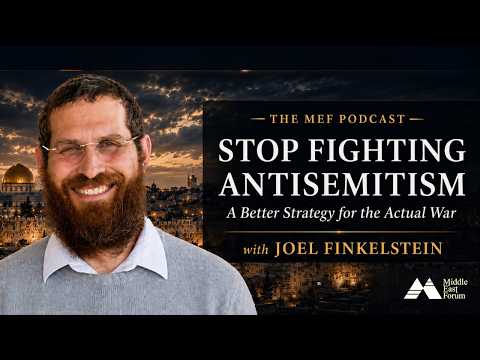 Watch on YouTube
Description
In this episode of the Middle East Forum Podcast, guest host Michael Rubin speaks with Joel Finkelstein, co-founder and director of the Network Contagion Research Institute, about how foreign adversaries exploit social media, antisemitism, and political unrest to manipulate Americans.
Drawing on NCRI’s investigations, Finkelstein explains how networks linked to China, Iran, Cuba, and Venezuela fund activist organizations, coordinate disruptive protests, influence online narratives, and use anti-Zionism as a decoy for broader attacks on the United States and Western institutions.
The discussion also explores TikTok’s algorithm, the evidence used to identify foreign influence operations, the limitations of government agencies, and why uncovering supply chains and rapidly communicating the truth may be more effective than traditional campaigns against hate.
Subscribe to the Middle East Forum for weekly conversations about the forces shaping the Middle East, the United States, and the wider world.
Transcript Automatic captions
Source: Automatic captions from YouTube, retrieved October 13, 2026. Automatic captions are machine generated and may misspell names and terms; check the video before quoting.
0:01 Good afternoon. This is Michael Rubin. I'm the director of policy analysis at the Middle East Forum, but today I'm going to be subbing for Lori Rean and moderating this wonderful podcast we have with Joel Finkelstein. Dr. Finkelestein is a Princeton trained psychologist and co-founder and founding director of the network contagent research institute where he leads affiliated research labs at Ruckers University, the University of Maryland and University of Miami. Basically, what Joel does is study and analyze hate and extremism online. NCRI's research has been cited by Congress, referenced by the US Supreme Court, and adopted by the British government. And so I'm thrilled that we can have Joel with us today. And without further ado, Joel will speak for about 15 minutes, and then in the chat, write down any questions you have and then I'll moderate those questions.
1:03 Thank you, Joe. Great. Well, first of all, it's an honor to be here. I'm a big fan of the Middle East forum and uh it's real a pleasure to be on the podcast. So uh it's it's true. My name is Joel Pinklestein. I am a psychologist, nurse scientist by training and around 2016 2017 when I was doing research on basic principles of addiction, learning, consciousness, I soon came to realize that the same networks that dominate our brains and predict behavior appear to be operant in social media. And we are uh we think of ourselves as people who make up our own minds and come up with our own ideas. In fact, we're more like, you know, these days, we're more like neurons in social media's brain. And the way that that that plays out is often not well controlled because we can't control we can't tell how we're being controlled.
1:48 Uh the information networks that we have have gotten so complex that it's really hard to understand where our own motivations are coming from. And in that kind of environment, the term for that in network science is is uh information disorder. When you have that kind of information disorder, you it's really disorienting. And around 2016, 2017, I saw people that I thought were very intelligent. These were not dumb people. These are people I respected. And they began emitting slogans and and slurs and be acting in ways that to me seem politically unrecognizable. Now, if that's happening to my colleagues at Princeton and a department that prides itself on independent thinking, most of these people came from like Bell Labs, brilliant people. Then it's happening everywhere. And if this happened to you by respect who are now who are now chowing down on political ideology and m mouthing the words without really thinking about it then it's going to happen everywhere. I realized 2016 2017 we wouldn't be able to study this stuff in peace. Thought that the way this was accelerating was going to be something that would come to consumer lives. So I began studying network contagions not in the brain the replication of mindless behaviors activities and and networks
2:51 that that further further disorder that take advantage disorder. I want to understand how that was playing out online. And so I began the NCRI with uh colleagues of mine in physics engineering and the idea was to create our own kind of bell labs of thinking around these problems that then the problems that we're trying to image have this in common. They're often produced through supply chains and one of the things that happens with information disorder is that you have opportunities in this chaotic environment to sew distrust to to facilitate and further disorder in ways that are are quite easy. So hostile nations or hostile groups have a tremendous advantage and it's kind of a form of a bot mentality quickly. It's very similar to what happened during the during the beginning of the printing press and during that time you saw a massive increase in the a change of transformation in in information technology and that led to revolutions. It read it led to inquisitions and censorship. It led to protesters, right, the Protestants, and it led to entrepreneurs, ideological
3:53 entrepreneurs, all of whom used anti-semitism to further their their goals and and and seized on that in order to organize and orchestrate mob mentality. So, I found something really similar happening here. And what I noticed was that a lot of the forces that take aim at America and at Western values, they're often organizing in ways that use anti-semitism and and and they use anti-semitism in ways that that kind of focus on Zionism as a problem. Here's a good example of that. You have what happened with October 7th where you had protests all over the country. We we studied a lot of these protests and these protests were organized by groups such as the answer coalition, the people's forum, a set of 501c3s, doing large scale analysis with these kinds of Bell Labs techniques that we use, the machine learning, the large language modeling, the network graphing.
4:43 We realize that there's really just a dense core of organizations who are largely responsible for organizing the most violent spirit of these events and popularizing those in ways that were captivating popular perception. So a deep dive into that network showed that the this group was shutting down bridges. They were instigating violent confrontations with law enforcement. They were shutting down roads. They were shutting down airports. They were shutting down ports. The port authority in the Department of Homeland Security began to call the NCRI asking where is this coming from? Who are these people?
5:15 Why is it that when we when they're arrested there's lawyers with them and they're immediately let out? It turns out that group was received these groups were receiving a totals of hundreds of millions of dollars come to find out um from Neville Roy Singham who is a former formerly the head of thought works an organization sold to the to the to the to a Chinese company and and now works in with the CCP in Shanghai. I'm sorry to interrupt could you just speak a little bit slower for some of our audience? Sure. I'm happy to slow that down a bit. So we found that these these not for-profit organizations that were organizing the most violent spear tip of these of the protest after October 7th were in fact funded by a well characterized by the New York Times Chinese asset known as Neville Roy Singum who is married to a person named Jod Evans who's the head of an organization called Code Pink. So the hundreds of millions of dollars are coming into American nonprofits. People are getting tax deductions for supporting the organizations who are shutting down our bridges. And they're doing all of that simultaneously in a in a fashion that appears decentralized,
6:19 organized online. And it has the chilling capability of shutting down simultaneously large swaths of American infrastructure run by a purported Chinese asset pouring hundreds of millions of dollars into these organizations. This morning, the Department of Justice announced that a a a grand jury was being was being put up to to find evidence about Singap this morning. This came out of SDNY. NCI's work went before Congress, went before the Department of Justice, went before uh Senate at the time, Senator Rubio and Graham, who both wrote letters to the Department of Justice about this. We came to testify in front of the Senate and Congressman twice. These investigation methods what they did was they looked past the anti-semitism, past the anti-inism and right into the supply chain. How is this happening? And and the less and what happened is when we realized how it's happening, you realize the anti-semit anti-mitism antinism that's a window dressing. That's a Trojan horse that's being used to tell you what this is not about. It's a successful decoy to convince people that this is about some other people and that
7:23 it's happening somewhere else. That's completely unbelievable. These organizations are working with Cuba. They're working with Venezuela. They're working with China. We have evidence that they're working directly with senior IRGC and Iranian information assets across South America. They're doing that to import toxic ideologies, anti-American ideas. They're reaching out to educators. They have news organizations. They're they're fermenting violence, literally violence against law enforcement officials and others. They were the spear tip of the violence that took shape at Colombia during the during the the peak of the October 7th protests. So these are staged events by foreign actors who impersonate Americans who can't tell who they are anymore because of because of information disorder and they channel that using anti-semitism into into the into the into the public imagination. So that's the decoy right now when we fight that and by the way the same thing was true with Tik Tok and NCR's work was pivotal in showing the CCP's role in manipulating the algorithm on Tik Tok.
8:24 This was done in peerreview evidence cited by Congress, cited by the Senate, cited by the Supreme Court. The fundamental foundational research that proved that the CCP was manipulating the algorithm of Tik Tok showed that this algorithm was being manipulated in order to create anti-american ideas and furthermore to develop pro-Chinese ideas. Right? So we were able to prove this using the tools of information science and network science. And again, initially when people saw what was happening on TikTok after October 7th, the screaming was about anti-ionism. The screaming was about anti-semitism.
9:02 That's the decoy in our social analysis of the of the algorithm and its impact on people. We discovered that that use of Tik Tok was the single strongest predictor for pro-Chinese, pro-CCCP attitudes in America by a wide margin. in its entirety what we find is that each time each time this happens you have anti-semitism or anti-inism showing up as a decoy and in fact what's happening is meant to undermine western civilization. So the problem is that there's a moral inversion that takes shape here in our imaginations. there's a moral inversion that that creates the grounds for support for the DSAs for for the for the singums for for the Tik Toks of the world that allows us that that uses the language of justice, human rights and anti-hate rhetoric. So we're also finding in a research that is problematic to use that in response to this when we talk when Jews talk about anti-semitism. Fighting hate accelerates this problem because when we talk about
10:05 fighting the hatreds that are behind this then we enter into a discourse that is very similar to the discourse being used by the social justice organizations that are supporting this by the injustice cries about genocide aparttheid. These labels are have a discourse of uh that has been perverted that has made fighting them on that basis actually that it's it's actually harming the cause because what so what we found is the truth is is actually the best offensive weapon here. Scaled investigation and speed is everything.
10:38 When we understand how these problems are happening, we no longer need to say this is the hateful person, that's the hateful person. the facts and the explanation of how we are being manipulated, how it is that these things are happening becomes the most important currency and surfacing that faster than adversarial narratives can distort it is going to be the key to being able to win in the modern information age. Everything that pushes back on the basis of hatred is now a distraction. the the shrill voices that cry out for special treatment. When when people hear that from any group, it creates in the appearance of self-interest. And when that self-interest is being used, it's being used to weaponize these problems against Jews and other people. It's being promoted as, oh, this is about Zionism. This is about Jews. So, in summary, I know we're at 11:15. We're at the at the peak here. I want to point out three things that that that first that the the anti-semitism anti-ionism components of these problems are decoys and we should whenever we see that we
11:39 need to be looking past them for supply chains to the fundamental problems that are undermining rights for everybody and undermining western civilizations a pessimistic self humanity in fighting hate on that basis is counterproductive. Our data shows that when we do it actually empowers the narratives about about think who a hateful person is rather than what what rather than what is right and what is wrong. It turns the conversation towards mob mentality. Who is the good person versus who is the bad person. And finally, the last point I want to make is that when we're using truth as our offense, then and then and we we turn towards explanation and and speed, then it gives us the ability to to actually build systems that can actually fight against the underlying problems that are that are currently gripping public imagination and actually constricting the ability of of Jews and other vulnerable communities to live freely.
12:38 Thank you so much, Joel. There's a few questions which have come in and again um if you can speak slower for people that aren't necessarily native English speakers. One of the first questions there there is is when we're talking about evidence, especially evidence of foreign actors behind this sort of thing. What actually does evidence look like in your line of work? Well, it's it's often the case that we look for one of one of a few things. One, we look for instructive relationships. We look for what's called narrative convergence. When somebody speaks up a narrative or has a meeting with the head of state and suddenly begins emer, you know, coming forth with you know, forthcoming narratives from that from state media uh that are that are sympathetic to states. There's ways in which when when that occurs, you have evidence of narrative convergence and you can use large language modeling to show this. We've done that in the case with the department with DSA and with other groups. But there's also, you
13:40 know, forensicial analysis about the relationship between payment structures and the use of that kind of influence. So there's both forensic financial analysis that looks at financial relationships and there's also narrative analysis that looks at how narratives and coordination especially evidence of coordination can emerge in identifying who's acting on behaval force. Okay. There were a couple questions that came in again just generally about terminology. Can you explain what you mean by supply chains and how do we fight this supply chain?
14:15 Yeah. So let's let's take an example. You guys probably saw what happened recently in Cuba where Hassan [ __ ] um and several other influencers from Code Pink and elsewhere came down to the island for a sort of you know for a rally and it turns out that that rally was organized by the Singum by this Singum fellow who we mentioned at at the top of the of the hour here and you know that the the Singum network was working I'm not kidding with senior Iranian assets throughout Latin America. They were raising money through sanctioned Iran to put on these events and they're taking US influencers all for a tax deduction who go back to the US with full of of protest activities that are in support of Cuba, full of protest activities that are are, you know, that are anti-US, that are pro-Iranian. Um, and when and and because people like Hassan Per are coming, more people see these high-profile events than even watch the Super Bowl. Something similar happened in New York. Do you guys remember the the vigil for the Ayatollah Kamini that took place in New York
15:17 several months ago? We did an analysis of the people who were showing up for that vigil. It appears that many of them were called numerous times by of sanctioned media outlets in Iran, including Press TV, leaked records of the call logs of these OFAC sanctioned Iranian media outlets showed numerous hundreds of phone calls to the organizers of these events. the the phone calls that took place took place regularly before protest activity in the United States during the subsequents rally protests that took shape again 20 million views of these of these events on social media. We find behind them literally Iranian assets who are organizing the protests and listing themselves stupidly as as points of contact for permitting and for flyers.
16:05 These are literally staged events coordinated with our enemies making putting hundreds of millions of views to create the impression that with that there is dissent and false conflict in Western civilization exacerbating that tendency to create a theatrical performance a mockery of our democracy beneath us. Okay. There is a very specific question with regard to Neville Roy Singum. He's an American. So what's the Chinese connection? Neville Roy Singham has been seen. He works at in with Maku Media in Shanghai and which is a a a a CCP intelligence in and marketing firm that whose job is to launder the Chinese reputation in the global south. He he attends events with extraordinarily seniormost CCP political officials to further that purpose. his after his his company Thought Works was sold, it's known that a lot of the assets that that he received then went into organizations who are currently
17:08 undermining the US and they're involved in things like I don't know these data center protests which appear pretty important for things like AI and other national security issues. So when you have someone like Sam, who by the way is tied not just to the Chinese, but we have a lot of the people that work in his organizations seemingly as mercenary forces for a a number of hostile different hostile regimes. They're pharaoh violations every which way across these organizations.
17:41 So, with the evidence the evidence for that, you know, I I I'll leave to the DOJ and to the uh to the uh to the grand jury that has been summoned to fight to investigate these issues. But the idea that there's coordin that there's there's no coordination on these on these efforts is is beyond the pale. It's it's it's you'd have to be insane to think that there's not coordination occurring at a massive scale in order to facilitate what's happening here. Okay. A more philosophical question which G Stybo asks is what view of the world and of ourselves must we cultivate to be aware to parse and to combat this hatefilled warfare. I think that's wonderful. It's a really great question.
18:23 I think it's that that is at the heart of this and I really believe that we need a new sensibility about human autonomy. It's actually not a new sensibility. It's a very old sensibility that we should have about a kind of precaution that we need to take in order to shore up our own autonomy, our own mental and and spiritual autonomy. And that means that more of our efforts, you know, so many of our efforts to become more fully autonomous people have been [ __ ] in the past several years by the growth of social media, by COVID.
18:57 You we have kids spending 10 hours a day on this thing, right? And that creates not just a supply problem from entrepreneurs who seek to manipulate people, but a demand problem from people who have become attached to a spectacle and lack agency in their own lives. We will have to deal with both sides of that equation if we are going to have a successful go at it. So I think we'll need a set of policies that address human agency that redress some of the most significant retardations that have occurred to us over the past several years and focus clinically on the problems that our lack of agency has created and and seek to to redress those you know not by virtue not by dent of entitlement but by dent of Okay. There is one question which I'll answer. It was just factual. What is OFAC? That's the US Treasury Department's Office of Financial Asset Control, uh, which basically keeps track of terror financing and so forth.
19:59 Maurice Schneder has a question. We talk so much about the problem of anti-Zion, anti-ionism, anti-semitism, but we hardly ever talk about a solution. What should we do against all that? What is it that has already been done? Yeah, it's a great question. I I would start by saying that when I originally had signed up to do this talk, what I had originally asked that it be called, you know, somewhat jokingly but somewhat not was was, you know, that I I I said, can we re can we call this thing Dr.
20:33 Strange hate or how I learned to stop fighting anti-semitism and love the truth? the truth, this hardto-reach thing that explains how it is we've been manipulated, what it is that has happened to our children over the past 15 years because of social media, the deep, deep x-ray of the problems that we have. That's the thing we need to unveil. There are secrets in how we have come to these state of affairs that require our investigation, that require us getting at the truth. To do that requires that we be cold, we be rational, not reactive. That we that we take that we take aim at unveiling what's happening not just to us but to everybody. That we have we have a capacity to share intelligence and resources to manage those problems directly as they're happening. And that isn't about fighting anti-semitism. And it's not about it's not about fighting anti-ionism. It's about survival. It's about cold level intelligence and survival. Okay. And so the the campaigns that we have now are feeding the problem. When we when we agitate in shal ways, we are making this problem worse.
21:38 We're not making it better. We're not being rational. We're not showing that we can be that that these problems are overcomeable. We're showing that that they need to be screamed at in order to be managed. Okay. I'm reserving all the questions about which books of your work you recommend until the very last question. This isn't the very last question yet, but Lisa Bernard asks, "How hip to these SCOPs are US intelligence agencies as well as propaganda analysts in academ." so not nearly uh they're not nearly hip enough to them. The the uh I I love the Department of Justice. I love the FBI.
22:17 Nice people, but they tend to think very much in boxes in terms of what legal tools they have and how they can be applied. when they try to apply those legal tools, they often end up in conflict with other agencies. The bureaucracy that has that has that has pervaded our approaches to manage these problems has created a stiltifying effect on our imagination and has created a huge amount of inhibition in being able to manage them effectively and fluidly. So the approach that's really needed is really the one that NCRI, Middle East forum and a few other organizations are taking, which is be responsible for everything. get all of the facts. Lead the lead the horses to water from the bottom up. Make sure when you to provide this intelligence to the public in order to create a narrative that's understandable so that people can understand what's happening and a social proof using the evidence about the strength of that narrative and simultaneously create opportunities for law enforcement, for lawmakers and for others to take action. And that's why I cited our work initially on Singum and in the CCB and or or Tik Tok and the
23:22 CCP. These were major laws and major hearings that have been passed based on surfacing the truth based on doing the detective work and surfacing the truth. Okay. There's some other questions out there. one with regard to Iran, but that's something that you can actually look at the Middle East forum observer for G or you can reach out to me directly since I'm one of the Middle East forums Iran watcher. There's other questions about the utility of some of the legacy Jewish groups that have been fighting this and why they haven't been successful. But quite honestly, we're basically out of time. And what I want to do as promised is for you to end.
24:03 You've you've interested a lot of people. This has been fascinating, Joel. It's been outside the balwick for many in our audience, certainly from our permanent staff because you're doing the research and we're happy to promote it. But for people that want to do further reading, what what citations would you recommend of from yourself or others? Well, I mean, I would go to our website, That's like iglooscar.io. And there's certainly, you know, a huge body of reports that you can read on on the work that we've done there. It's very it's very pluralistic. People accuse us of being ADHD, but we're simply trying to showcase the value of the thinking we have on the plurality of information threats because I think when people have that confidence that we have the methods, we have the ability to solve these problems, then they realize that all these problems are are difficult.
24:58 That's all they are, right? And that's manageable. So, I would start there. I think it's a good way to get background. I I would say in terms of in terms of the reading I do, I I'm not a good I'm really not a good resource for this because admittedly I'm I'm my head is usually in the primary literature. So I'm not somebody who spends a lot of time reading other people's books because we're so busy on the investigation side of this. So but uh there there are some good resources out there. Um I know that I know the Middle East forum is one of them for sure. Okay, thank you so much for joining us Joel and I want to thank the audience as well. We bring you these podcasts on a weekly basis. It's always fascinating for me. Usually I'm a lurker in the audience today because our host is unavailable. I'm the I'm the host. But I look forward to welcoming you again at some point hearing updates on your work.
25:49 It truly is a cutting edge edge topic. And for everyone else, pay attention to the Middle East Forum Observer, the daily output which I edit, as well as some of the reports that are coming out. But we're now publishing up to a 100 pieces a month. Um and we are perfectly I mean through different mechanisms you can get summaries. You can cultivate what you want to see. And so um we should have something there for everyone. I'm off to Libya soon to further our direct research. And I always just want to thank our supporters who makes um my job at the Middle East forum possible, pursuing such on the ground work and cutting edge work that Joel's pursuing so that we can basically not simply sit in Washington and discuss what everyone else is doing, but actually go out and do it ourselves. That's why I want to applaud even though you're not Middle East forum. I want to applaud. Whenever I see the cutting edge firsterson research, I'm thrilled and so thank you so much Joel.
26:47 Thank you guys. It's really great Thank you. And with that, we will end and we will send the summary out as several people have asked. Thank you.