
Webinar or Talk
The Normalization of Saudi-Israeli Relations with Rob Satloff
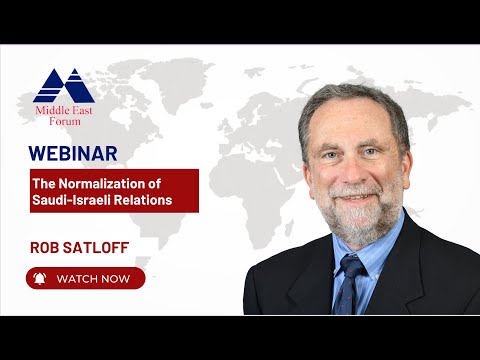 Watch on YouTube
Description
U.S. diplomats are quietly working on a Saudi-Israel peace agreement that could dramatically transform the Middle East, effectively ending the Arab state conflict with Israel and binding Riyadh into a new alliance with Washington. What do each of the three parties want from the other? What are the main obstacles to a deal? What repercussions might an agreement have for such issues as Saudi domestic transformation, the Iran nuclear menace, and great power competition in the region?
Robert Satloff is the Segal Executive Director of The Washington Institute for Near East Policy. He specializes on Arab-Israeli relations, political Islam, and U.S. public diplomacy. He has written on Jordanian political history and the role of Arabs who saved Jews during the Holocaust. Mr. Satloff holds a BA from Duke University, an MA from Harvard University, and a PhD from Oxford University.
Transcript Automatic captions
Source: Automatic captions from YouTube, retrieved October 27, 2026. Automatic captions are machine generated and may misspell names and terms; check the video before quoting.
0:07 speaker webinar series and podcast my name is Dexter van zyl and I will be moderating the discussion today we are pleased to have with us Mr Robert satloff the Siegel executive director of the Washington Institute for neary's legalizes on arab-israeli relations political Islam and U.S public diplomacy today he will discuss the normalization of Saudi Israeli relations Mr South often speak for 15 minutes followed by 15 minutes of q a from the if you wish to ask a question please use the Q a button located at the bottom bottom of your screen and type your and with that I will turn the discussion over to Mr Savage hello Dexter and hello everyone at the Middle East Forum I'm delighted to be able to speak with you today um uh today we're talking about a hot button high profile political issue um an issue I know um is uh on the top of the agenda or
1:10 high on the agenda uh in the Biden administration's Middle East policy and it's a it's a very high issue in the Israeli National Security establishment we're going to talk today about the prospects for a Saudi Israel uh normalization or as the middle easterners prefer to call it these days an integration cooperation agreement what that means what are the uh prospects and what are the obstacles to achieving uh this breakthrough for those of you who um I'll just say at the outset if for those of you who want to take an even deeper dive than what today's discussion will allow uh this is the topic of a um of an in-depth report that I did a couple of months ago you can get it at the the website of the Washington Institute uh www.washingtoninstitute.org Saudi normalization with Israel domestic transformation and U.S policy and that's really what I'd like to to begin with um this is a three-way negotiation uh we
2:17 talk about Saudi Israel but it's really at its core a three-way Prospect between the United States Saudi Arabia and Israel with the United States negotiating with each of the other parties as much as those parties are negotiating with each other that's a very important fundamental point to understand it is even more of a trilateral inherently trilateral deal if it happens then then any of the previous Arab Israeli peace agreements it is more of a trilateral deal than the Egypt Israel Accords it is more of a trilateral deal than the Jordan Israel Accords and more certainly than either the uh the Oslo Accords or even the Abraham Accords which had a a vitally strong element of the U.S role here the U.S is pivotal um uh not all the parties enter this
3:20 with the same uh set of priorities eagerness or enthusiasm that's because for Saudi Arabia one has to begin uh with the real story The Big Picture story being the issue of domestic transformation transformation is a big word but in this case it's accurate it is the desire the goal of transforming Saudi Arabia from a country wholly reliant on petrochemicals for its National welfare for its wealth for its to a diversified country that is trying to prepare itself for the 22nd century remember it is about any day month year to have a leader um a young um uh Muhammad bin Salman um the first truly generational leap in Saudi leadership history in the modern
4:25 era of this country and he um almost surely is thinking about um uh not a time frame of five years ten years but he's thinking of himself the rest of his Natural Life which could be another 50 years taking us toward the end of the 21st century and I think he is thinking of this massive dramatic fundamental transformation uh to prepare Saudi Arabia for what is necessary to be a successful thriving country far into the future this is involving uh dramatic domestic change social change cultural change economic change you've heard of course of some of the changes having to do with women's role in society but it goes far broader than just that uh opening up Saudi Arabia to a hope for millions of international tourists and
5:29 I'm not talking about the type that are just going to to mecca for the Hajj I'm talking about the type that are coming to play golf um go to beaches um see natural wonders real old-fashioned Global tourism and what that will do to such a to a country that is uh uh you know historically closed to these sorts of things it will transform relations on the business level transform relations and an Intercultural even religious level all these issues will Saudi Arabia become the center of a regional business stealing this away from Dubai will Saudi Arabia become a place where non-muslims can have organized communal prayer something which hasn't existed um um in in in a very long time in Saudi Arabia these these are fundamental issues that the Saudis are now grappling with it's in this context that one needs to look at the prospect for this U.S
6:33 Saudi Israel deal and here my view is while a deal for Saudi Arabia is useful and beneficial it is not urgent and necessary and that's a big difference it's useful and beneficial but not urgent and necessary MBS Mohammed bin Salman the Crown Prince has shall we say a lot of fish to fry domestically this is just one of them it would be useful it would be useful in terms reputationally to dramatically change the image of Saudi Arabia from um the very negative image of recent years from the very negative image that goes back to even before 9 11 to a um hand in hand with the Jewish state it would be beneficial in terms of the security benefits we'll talk about that in a minute beneficial uh technologically economically it's all beneficial but it's not necessarily the top priority
7:37 um uh and it's really um uh what the negotiation about is what benefits can be provided to Saudi Arabia by the United States and Israel to raise it up the priority ladder and that's because it is a higher priority for this government and indeed any government of Israel would view this as the ultimate affirmation of acceptance of the Jewish state in the Arab and Muslim worlds if the guy if the custodian of the two holy mosques were to certify the legitimacy final and irrevocable of the Jewish state in the Middle East that would be the affirmation of Israel's um uh you know belonging um it would to many people uh be viewed as the end of the interstate Arab Israel conflict the conflict that has um that was born in 1948 with the invasion of the new state of Israel by
8:39 six Arab countries it has been whittled down over time with peace between um with Egypt uh Jordan then um uh UAE Morocco Bahrain Etc but formal peace with Saudi Arabia would bring an end to the interstate conflict and for many people it would relegate the israeli-palestinian conflict the intrastate conflict over the determination of control geography demography west of the Jordan River they would relegate that to a manageable um uh uh problem that Israelis and Palestinians would have to sort out but not one that many people would view as not one that would infect um Israel's broader station in the Middle East and for these reasons this is an extraordinarily high priority for this government um why is the United States interested
9:42 in this uh why is Joe Biden interested and I believe that the president of the United States really does um see this as an important policy objective he gets the benefits to Israel he gets the benefits um and I I think down deep he appreciates how much this would mean to it to um for Israel to be accepted not just by Saudi Arabia but the Saudis there they have an interest if they make this deal to bring along other Arab and Muslim states to validate their own um I think he gets what that means for Israel but there are also important benefits to the United States that would come with this um one would be in terms of a clear uh delineation of the limits of the Saudi Chinese relationship Saudi Arabia we should remember today is a rising Global I'm actor it has more than a trillion dollar economy it has the fastest growth
10:45 of any G20 States putting limits on the Saudi China relationship especially limits in the country and Technology sphere is an important Advantage for the United secondly it would open up a much closer relationship with um this leading OPEC producer to align America's interests and Saudi interests in the world of energy production ensuring consistent Supply which is a major objective of the United States and um I also am quite sure that the Administration has in its desiderata important Saudi moves on issues of Human Rights legal rights with four Saudi citizens and foreigners inside Saudi Arabia rights having to do with free speech free movement Etc
11:48 uh uh this is important in and of itself and this would be important for the um uh if it wants to win the sort of votes it needs from some of the um uh the people on Capitol Hill who have serious concerns about Saudi Arabia this is the context so what is the deal that they're talking about what is Saudi Arabia looking for from the United States um essentially um uh four things three and a half um uh one is a U.S Saudi defense guarantee preferably via treaty if it can be achieved but if it can't be achieved with acquiring the 67 votes necessary for a treaty there are second best options of um defense agreements memoranda of understanding that could be um and and uh supported by votes of sense of sense of the Congress votes of both the house and the Senate that would
12:50 have a lower threshold than the 67 needed for treaty the Saudis are looking for a firm clear and strong statement of defense support in the event of external um obviously no one defines uh specifically who the external aggressor would be but there is a clear understanding that we're all talking about Iran um what else are the Saudis looking for the Saudis are looking for um a a statutory agreement on a fast-track provision of U.S military goods unlike the current system um where U.S military hardware can be held up in any one of a number of points along the way especially by holds the Saudis are looking for a system where once deals are made they are implemented uh third there will be a Saudis are looking for a free trade agreement with the United States there's
13:52 been mutual benefits here there's some obstacles but this is negotiable and the fourth uh an area where many people have some uh some legitimate concerns the Saudis are looking for American partnership to develop their natural deposits and to develop a civilian nuclear energy program that would be useful domestically so that they can continue so they can do two things one that they can be a source of um uh of enriched uranium for Global um uh for Global uranium supplies there's a market out there very few countries can fill it and two they can use this to speed up the process of moving domestic consumption of energy from petrochemicals and thereby extend the life of their export market for petrochemicals this is what they're looking for some of this is highly controversial some of this is highly difficult politically
14:56 and there are you know some in Congress who will Who will say no who will say no to a defense treaty um we Israel doesn't have a defense treaty very few countries in the world have defense treaties with the United States and there will be a lot of pushback in some Quarters on a defense treaty and and that's why you know options short of the Japan model of a defense treaty are something I know the administration is also looking at some will some on both ends Progressive left hard right will uh we'll think twice about wanting to embrace in such a deep and clear um uh um a non-democratic country with a um uh you know a questionable human rights record and issues that need to be addressed on a whole range of topics but the leaderships of all three countries are pursuing this this is
15:59 where we are today I think the bite Administration is serious um it is soberly looking at all these um I think it knows what the obstacles are domestically um uh uh and I think it is doing its best both for American National reasons and because it recognizes I think the Strategic benefits to Israel um that it is pursuing this now a key aspect of this and I know we're going to go to questions in just a moment a key aspect of all of this will be what role does the Palestinian issue play in these um my view will just remind everyone when the Emirates made their Abraham Accords deal there was of course a Palestinian aspect to this this was a commitment by the government of Israel um uh um uh to forswear any moves toward annexation of uh of occupied territories for three years a date which by the way is moving is is coming Upon Us in just a
17:03 couple of months um or just a month in September um I'm sure that the Saudis will want will have their own Palestinian related desiderata I don't think the Israelis will succeed with just um uh uh uh recycling what they sold to the Emirates three years ago um the Saudis will have both substantive and symbolic desires they will want to obviously do better than the Emirates I don't think the Saudis have a yet a clear idea of what they're looking for but I am quite convinced that between what the Saudis want and what the administration wants this will be too far for the current Israeli government in its current makeup with its current composition including Minister bengvir Minister smotrich and others this will be too far for this current government to swallow this will pose a question for prime
18:11 minister Netanyahu will he break his current government to achieve a Saudi Israel integration cooperation agreement will the opposition will Benny Gantz and or your ear lapid support Netanyahu either from outside the government providing the votes to support or from inside the government creating a national Unity government to achieve the historic goal of an israel-saudi peace normalization integration agreement these are Big unknowns my instinct is probably yes but I think there's a lot of bargaining to happen even among Israelis let alone Saudi Israel U.S Saudi U.S Israel lots of moving parts I think there's a reasonable chance this can um it's by no means as uh you know a
19:14 term that we we put aside 20 years ago by no means a slam dunk um but I think there's a reasonable more than 50 50 chance that by the end of 2024 or at the latest by Spring by the end of 2023 rather or by the latest the end of the first quarter of 2024 we do have this breakthrough and this would be for all the parties Saudi Arabia Israel the United States and in some respects for Palestinian Institute I'll stop thank you so much and I think an apology might be in order in my opening I call you Mr satloff and one of the people in the question said it's Dr satba so I apologize no apologies necessary I can't write prescriptions or do operations okay now one of the questions that I I have is what are the Saudis going to do in reference to the Palestinians what type of pressure are they going to put
20:16 on the Palestinians and how effective will they be what what can they do so if your question is what are the Saudis likely to ask on behalf of the Palestinians what was your question what what is Saudi Arabia what type of pressure in Saudi Arabia gonna apply and be able to apply on the Palestinian Elites uh to basically come to grips with uh Israel's existence in Victory what are they going to do well look I think that um uh the the the the the major pressure that Saudi Arabia has is its ability to do a deal um uh on its own directly um they are the uh the independent variable the Palestinians here are the dependent variable um uh I think what um uh if the Saudis can line up for um uh support from the jordanians and they're the jordanian's main interest is to ensure that the Saudis have no desire
21:20 um uh to impinge on Jordanian prerogative in Jerusalem and I think parenthetically in my view the Saudis have no interest or desire um to impinge on Jordanian um uh uh uh uh the Jordanian role in holy sites in Jerusalem um uh I think for the Saudis this would only bring headaches and no advantage because I think the Saudis have no interest in deepening their engagement in the Palestinian issue and any role in Jerusalem of course would throw them right in the middle of the Palestinian issue um uh the Saudis I think are perfectly happy being the custodians of um mosque one and mosque II they don't need also to be custodian of mosque III um uh um so if the jordanians are fully um I think the pal I think the if that's the case um then I think the the Saudis are in very good position to impose their views
22:22 on Palestinians now they will want to to get significant benefits for Palestinians if only to to suppress any critique that the Saudis are doing a totally separate deal with the Israelis and I think there are important benefits they will secure for Palestinians both on the symbolic level in terms of not just annexation but perhaps an Israeli commitment to the idea of eventual Palestinian statehood um uh in some shape or form um um two very specifics having to do with um not just economics but also Palestinian control of of certain um long delayed redeployed areas in the West Bank most Arabs do not care about the actual details of the of the implementation of the Oslo Accords
23:27 um most Arabs the further way you get from from the israeli-palestinian conflict are more interested in the the symbolic issues um um and I believe that Saudis will have that as a high priority for them okay now Carrie Hildebrand uh our Hildebrand excuse me says beyond the requisite sound bites to what extent do the Saudis actually concerned with Palestinian welfare is this all just you know symbolic or is there any real legitimate concern on their behalf so look I I think um I think it's important to not to be crass or dismissive about this um uh Arabs all over the Middle East do have an interest in the welfare of Palestinians they may not wake up in the morning and care you know who governs Janine who governs Nobles but there is a a human connection that does animate people around the Middle East including
24:30 in Saudi Arabia there is deep disdain for the Palestinian leadership which is widely viewed as as feckless corrupt continually missing the boat on Israeli offers of um eminently reasonable uh political diplomatic compromises so I think there's you know I there's a one has to approach this in a nuanced fashion which I think is what manifests is what motivates even Saudi leaders which is yes there's a interest people do care about Palestinians people don't care much about to the leader or this or that Palestinian institution um uh people of you know one has to recall also Saudi Arabia has a long record of being out in front and offering diplomatic Solutions um to the to this conflict and there's a desire to validate those Decades of of diplomatic efforts so the Saudis are
25:36 not going to want to run away from the Saudi peace initiative even if they're not going to insist on its implementation either they want to validate their historic what they view as their historic leadership on this um while all while all the while you know they're not going to insist on what the terms of that original piece initiative held okay now there is a question from uh a poster by the name of Eric that talked about uh says that Biden campaigned uh saying that MBs is a pariah and he wanted to make him a pariah if I remember the phrasing and he's also been establishing relationships with Iran can the the Biden Administration actually play a role in given the things that Joseph by Joe Biden has said about MBS can he actually play a role as a broker in this field um it's essential without which there will be no deal um uh and I don't mean that um uh I mean that in multiple ways this
26:41 is an inherently American deal with each of the parties it's certainly an American deal with Saudi Arabia with the Saudis want most of all we provide yes the Israelis will provide greater access we provide a lot of that even without a deal the real benefits will be coming from the United States secondly um uh Lindsey Graham had a very important Insight that he related to the Saudi leadership on a recent trip which um uh this Republican senator from South urged the Saudis do a deal with Joe that's because your um uh the largest number of Skeptics and critics of Saudi Arabia in the United States Senate are on the left it's a Democratic president who can bring along um the vast number of those critics to accept a deal a Republican president
27:46 much much more difficult to bring along those critics and enough votes to get um a deal through into and with with all the con the controversial elements that I outlined earlier that was Lindsey Graham's advice it's the right advice and to the extent of my knowledge it's advice the Saudis appreciate understand and are healing a Democrat can get this deal through a lot more successfully than a republican is likely to be able to get this deal through okay I think we got time for one more question from an anonymous attendee uh they talk about the the Saudis wish to enrich her uranium themselves rather than buying it from another source like maybe South Korea uh you know you know why is it you know what what's the the upside if we do allow them to uh enrich their own uranium what what are the assurances that we won't have uh an Iranian problem down the road decades
28:50 from now or a decade from now uh and also uh yeah so why not just tell them to get the uranium from somewhere else 2015 I thought it was a bad deal poorly but it happened and that means that eight years ago the government of the United States of America certified the right of the Islamic Republic of Iran to enrich uranium the sorts of intrusive oversight and American you know participation at every step of the way which is what is being contemplated with the Saudis I find it difficult to imagine that we can you know deprive the Saudis of this right once we've already given it to the Islamic Republic of Iran and the Saudis want us every step of the way American guidelines American inspections American um and we should we should Define the
29:53 terms it can be for you know a long long period of time their their idea is to create a nuclear aramco yes eventually they will want to do this totally on their own no eventually it could be a long time from now and we should do what we can to put in lock-in safeguards oversight Etc that make sure that um you know that Independence is a long long time from now um they're going to do it they're going to do it with someone they're going to do it with the French they're going to do it with the Russians it's a hell of a lot better in my view that they do it with the United States okay uh there's one more question from Daniel pipes thank you so much Rob for the excellent presentation do you send Signet significant internal opposition in Saudi Arabia to a treaty with Israel it's a very good question uh uh actually it's a it opens up a whole other set of questions it's very difficult right now to sense internal
30:56 opposition to anything inside Saudi Arabia one would think that with some of the the fundamental domestic reforms that one would see a lot more domestic opposition it's very difficult to find it it's certainly not in the big cities you don't see it in Riyadh jittah elsewhere it might be out there in the hustings so to speak um and I think that the that the view about Israel is is similar to that what we do know is that uh public opinion polling including that done by my Institute shows that Saudis today um support uh contacts with Israel this is the question that that we've asked support contacts with Israel business contacts Sports culture at the same level today that Emirates do and the emiratis actually have a peace agreement with Israel so if the Saudis supported at the same level today one can infer that they would have an even greater support for that sort of open peaceful
32:01 set of relations if it were under the umbrella of a formal um uh Regional a formal peace agreement I want to thank you so much that was a really wonderful webinar we've come to the close of our webinar thank you so much Dr satloff for joining us today and also I want to thank the people who attended for our viewers please be on the lookout for our weekly webinar offerings email that will come out over the weekend thank you all for joining us and I hope you have a wonderful day thank you so much bye bye thank you