
Webinar or Talk
Israel and Civilization: The Fate of the Jewish Nation and the Destiny of the West with Josh Hammer
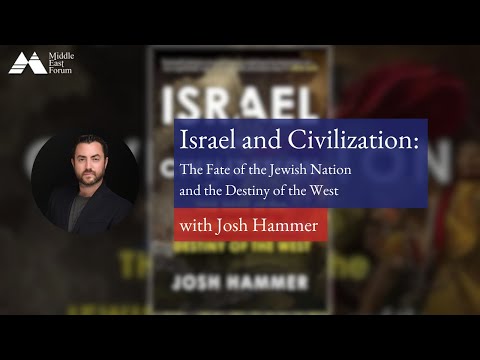 Watch on YouTube
Description
Rising antisemitism, multiculturalism, and postmodern relativism currently threaten the well being and security of Israel and the Jewish people. Josh Hammer argues that the West’s survival hinges on Israel’s strength and the Jewish people’s right to self-determination. From the trauma of October 7, 2023, to global anti-Israel sentiment, the stakes are clear: a proud Jewish heritage is vital to the West’s endurance. How does Israel stand as the West’s bulwark against Islamist terrorism and secular nihilism? What does a grand alliance of Jews and Christians mean for the future of civilization?
Josh Hammer is senior editor-at-large of Newsweek, and a fellow with the Edmund Burke Foundation and Palm Beach Freedom Institute. He hosts The Josh Hammer Show, a Newsweek podcast and syndicated radio program, and is a frequent pundit and essayist on political, legal, and cultural issues. He previously served as an editor at the Daily Wire, and his work has appeared in outlets including the Los Angeles Times, New York Post, Daily Mail, National Review, The Spectator, Townhall, Fortune, Fox Business, the Jerusalem Post, the Times of Israel, The Forward, Jewish Telegraphic Agency, and Jewish Journal. Josh holds a degree in economics from Duke University and a J.D. from the University of Chicago Law School.
Transcript Automatic captions
Source: Automatic captions from YouTube, retrieved October 18, 2026. Automatic captions are machine generated and may misspell names and terms; check the video before quoting.
0:09 All right. Hello, good afternoon and welcome to the Middle East Forums weekly podcast series. My name is Anav Kalam and I will be moderating today's discussion. We are pleased to be joined today by Mr. Josh Hammer who is a senior editor at Newsweek. He is the host of the Josh Hammer Show and he is the author most recently of Israel and Civilization: The Fate of the Jewish Nation and the Destiny of the West. Uh now, I was just able to finish this book pretty recently and I thought it was very well done. So, uh thank you for thank you for writing it, Josh. Um for our audience at home who is watching this in the future, this is a pre-recording session. So, please just note that we will not have a interactive Q&A discussion for this broadcast. Now, with that in mind, I want to bring on uh Mr. Josh Hammer. Thank you for taking the time to join us today.
1:05 It's my pleasure. Thanks for all that you and the Middle East form do. Yeah, absolutely. Now, uh I wanted to just kind of get right into it uh talking about your book here. Um, and I wanted to start by asking you about something that I first heard you say at uh the Middle East forums policy conference just a few months ago during your keynote address uh which was about the influence of Judeo-Christian values and norms in shaping uh the birth of the United States itself in many senses. Uh you mentioned for instance one of the original seals of the US bore the image of Moses uh crossing the Red Sea. You gave a few other examples. Now, uh, can you tell us more about this historical background of the Judeo-Christian values shaping the Western civilization? Can you tell us why the state of Israel is so important for both understanding this relationship and for defending and preserving it?
2:02 Sure. So, there's a lot to unpack there, so I'll try to do the best I can. So America was founded as a as not a neutral country between religion and irreligion as not a neutral country between theism and and atheism. It was it was really founded as a deeply biblically rooted in many ways an ecumenical Christian country and but an ecumenical Christian country where the Christian founding fathers really understood that the Hebrew Bible what what Christians call the Old Testament has a massive massive role to play in who we are and and frankly what we are.
2:37 So you you correctly alluded to this notion that both Thomas Jefferson and Benjamin Franklin famously wanted the National Seal of the United States to be Moses crossing the Red Sea and leading the Israelites across the there there are too many other anecdotes that we could possibly recite here. There there is the notion that that going as far back as as the Mayflower, Frank, if you want to go back that far, sailing across the Mayflower in 1620, Sir William Bradford, who was the captain of the Mayflower, he actually spoke about a thousand words of Hebrew because he actually was was a student of of of a English habraus by the name of Sir Henry Ainsworth. And there were there was actually talk on the Mayflower. This never became a thing, but there was some chatter. We now know from the historical record chatter that resuscitated in the 1780s during the constitutional period about possibly just ditching the English language is starting a fresh with Hebrew. This this is kind of all in line with with with Abraham Lincoln's vision famously alluded to in February 1861 where he refers to Americans as an almost chosen people. Lincoln, by the
3:40 way, a man of deep Christian faith himself who quoted the Hebrew Bible over and over and over again in his public speeches. In fact, uh, his second inaugural address, this very short 700word address that he gave just tragically about a month, month and a half or so before he was assassinated, considered by by rhetoric, people who study political rhetoric to be one of the finest pieces of political rhetoric and oration in American history. It has these famous moving stirring closing words about how we we with with malice for none, with charity for all, let us bind up the nation's wounds. And th this speech has a reference to to Hebrew scripture in virtually every other sentence, including that famous line about binding up the nation's wounds, which is just a reference to Psalms chapter 147, which is essentially a verbatim quote. So, uh, every everywhere you look, this is this is this is really part of who of who you are. Anyone anyone who's been to Philadelphia has seen that the Liberty Bell in Philadelphia is inscribed not with pagan sources such as Aristotle's Nicomeian ethics, rather the Liberty Bell in
4:42 Philadelphia has Leviticus chapter 25, thou shalt proclaim liberty throughout the land and to all the inhabitants thereof. So it was not even a debate that this story of the Israelites fleeing oppression in Pharaoh's Egypt and seeking freedom in in the promised land that this is a story that resonated with the pilgrims of the Mayflower. It resonated with the founding fathers. It resonated with Lincoln is it is it has always resonated with Americans going going back all the way to the nation's origin. So in the book Israel and civilization, I essentially start on October 7th and I look at the world's reaction to October 7th, this morally confused reaction. And to me, I see a civilization that is that is a drift that is at something of an inflection point and is at it's at at serious risk unless it recovers a sense of of its purpose and what it is and what it can and ought to be that is at risk of being subjugated by various hegemonic subjugationist forces. In the book, I identify at least three. I call them wokeism, neoliberal, excuse me, wokeism, global neoliberalism, and islamism.
5:44 Probably the the easiest to define of of all those, but we we can kind of get into what each of these specifically entails. But I guess for now, I'll just say that the point is that if Western civilization is going to ward off these forces, you have to understand what you actually are because only a people that understands what it is has any chance of having the confidence to withstand forces that very much want to kill you. And I argue in the book repeatedly that when we refer to the west and the United States being a shining beacon, this city on the hill type edifice, by the way, the hill in the phraseology city on the hill is referring to Jerusalem. It's not referring to to any other city but Jerusalem. But this entire notion of America being the city on the hill is ultimately rooted in in scripture. And I guess I would just briefly say because you know there's a lot in in your questions here, but when it comes to the contemporary capitalist state of Israel, it seems to me that the capitalist state of Israel is the canary in the coal mine, when it comes to literally all three of those subjugationist forces. So they they are the canary in the coal mine when it comes to wokeism when it
6:46 comes to the modern identitarian identity politics DEI diversity uh diversity equity and inclusion left uh the Jews and the and the Jewish state are very much the canary in the coal mine there. They are by definition the canary in the coal mine when it comes to Islamism. I think that point goes without need of any further explanation. And the the Jewish state is also the canary in the coal mine when it comes to what I refer to as global neoliberalism as this homogenizing force that we can root in the United Nations, the World Economic Forum that ultimately seeks to eradicate nothing less than, if we're being candid, the nation state itself.
7:23 And to me, there's actually, and I'll end with this, there's actually a real a real reason for that as well, which is why the globalists, for lack of a better term, tend to focus on the very particularist and nationalist Jewish state, which is one, Israel is a very nationalist enterprise and there's conscription military and all that. But the deeper reason why I think a lot of them feel a need to start with Israel is because Israel is actually many ways the world's first example of what we might refer to as a nation state. When King David unites the tribes of Jerusalem thousands of years ago, that is an act of uniting tribes with similar customs and language and background into a concrete nation with with defined discernable borders defined in that particular case by no one less than God himself. So if you care about the nation state, you have a particular reason to care about the capitalist state of Israel as well. But all this again to take it back to America is just deeply ingrained in who we are. And I think that if America I mean hold even holding for for now Israel aside just if America wants to be America we have to recover a sense of who we are only that will make us great again.
8:23 Thank you. Now uh you describe the west as uh not an eitheror but a combination of revelation and reason and you also name uh of course the three big threats as you just stated Islamism, wokeism and the neoliberal threat. this um this combination of revelation and reason. Do you think this is the only the only weapon we have to fight against these three threats or do you think it could be done independently in a society that values either reason or one that values just revelation?
8:57 I think you'd have a better chance of a society that is just with revelation. And I I think that it would be a massive mistake to just try to stick with with with a contextual valuesneutral reason without any sense of tethering. So you're you're right. The the traditional formulation of Western civilization is this this amalgamation of Greco Roman reason with with revelation Athens and Jerusalem as as the formulation often goes. This is certainly the definition given to us by the 20th century University of Chicago political scientist Leo Strauss. But in the book, I make a somewhat provocative claim or at least countercultural for today's day and age in the year 2025, which is that if you're if you're really going to be honest here and say that one of these is actually more important and not just more important, but really more defines and encapsulates who we actually are. I I would argue it's revelation. I think that I think that the Bible and and and the Judeo-Christian it really encapsulates who we are because I define Western civilization as actually beginning with the with the giving of God's word with God's original
10:00 revelation to Moses and the Israelites there at Mount Si that everything that we take for granted today is ultimately downstream of that. I mean there's too many examples to name just to give a couple of higher profile ones. you have nothing less than the golden rule of societal relations. This notion that I learned once upon a time in kindergarten that you should do unto others as you would like to be done to yourself. They don't really tell you where that comes from, at least in the public school where I where I went uh as as a kindergartener. That that's coming from Leviticus 19:1 18. This notion that you shall treat a stranger as your fellow. I mean, this is a biblical antecedent of the modern golden rule, one of the glues that holds civil society together.
10:38 Similarly, I I I argue in the book that Genesis 127, this the divine image imperative, we would say bellhim in Hebrew, this notion that man is made in God's image, male and female, he created them. Th this is the single most important ethical imperative for all of Western civilization. I mean, we we were just speaking about the the founding fathers, Thomas Jefferson writing in 1776 the Declaration of Independence, talking about we hold these truths to be self-evident that all men are created equal. Well, he wasn't writing that in a vacuum. You know, John Lock a century prior was not writing very similar things in a vacuum. They're writing this in a certain context, in a certain milu.
11:14 And that milu is the biblical heritage, the Judeo-Christian heritage, Western civilization at large. So, so many of the things that that hold us together today ultimately really do come from this. So, I do think that if you're going to put a thumb on the scale, the thumb on the scale, contrary to what a lot of modern culture would say, really ought to be on the scale of revelation. Now reason has a place to be sure but I think that reason unmed from revelation can go off the rails really really quickly. To just give a very provocative example you know VHimar era Germany into Nazi era Germany really thought that they were acting quite reasonably. In fact they had fancy academic terms for much of what they were doing here.
11:56 Lebanrom, if I have the German correctly, was essentially their their theory as to as to how to be compassionate when when it came to people that were inferior races of the Aryans. Well, you know, in this particular context that that Nazi era German reason ends up culminating in the train tracks lean to Awitz and Trebinka. So, so, so reason unmed from certain anchoring principles can go off the rails really, really, really quickly. So, there is a role for reason, but only contextualized within a certain exogenous framework. Right. Thank you. Now um your uh your position uh Israel as a battleground in a civilization clash between the west and the forces of Islamist barbarism as well as uh the woke ideology more more common in the west. Uh you reference at some point George Gilders's Israel test and uh suggest that support for Israel is a litmus test for supporting the west. Um, can you can you go more into detail on that on Yeah, it seems to me that if you understand what Western civilization is properly defined, then you really ought
13:00 to be a supporter of not just the capitalist state of Israel, but also the children of Israel, the Jewish people, because you ought to understand that it really is the Bible that that made the West and it is the Bible that made the West great in the first place. In the same way that you cannot discard the the the original recipients of the word of God, the Jewish people, so can you not necessarily just discard the canary and the coal mine, the place where this great story that that that that is the Bible actually happened, the state of Israel. So where you come down on whether on whether you support Israel to me is a proxy in many ways for for support for the United States, for the West. and kind of preview where I think you're probably going with your next few questions. You know, it's not an accident that a lot of these that these these these figures on the so-called right, people like Tucker Carlson, you know, it is not an it is not an accident that folks who fail what George Gilder would refer to as the Israel test often times don't necessarily seem to be huge fans even of Western civilization itself. I I mean, you know, Tucker recently giving a friendly interview,
14:02 shall we say, to the the president of Iran, the Ayatollah Kameese puppet. You know, that is not necessarily something that is easy to reconcile with someone who is a fan of Western civilization. So, it's not it's no surprise that someone like that fails what George Gilder would refer to as the Israel Yeah. Yeah. So nothing says uh America first like uh not pushing back on a single thing that the that Peskian said in that interview or having that interview alone for that matter. Uh but yes um just uh a couple of days ago you were uh you participated in a debate on Israel against Dave Smith uh at the uh Turning Point USA conference and uh I watched that. But I just finished it earlier this morning and I think you did uh I think you did fantastic. And now there's a lot of uh mixed responses on uh on the outcome of that debate, but being there in person, did you feel that they were more receptive to your arguments about Israel or did you sense that they were more sympathetic to Dave
15:04 Smith and kind of the woke right arguments just by kind of reading the Yeah, the crowd was definitely mixed. Look, I mean, we definitely both had our applause lines. I I will say that Dave Smith was the only one who was booed. He was booed at least twice. Once during my opening remarks and once when he had the utterly poor judgment to accuse people of not being able to credibly call themselves pro-life if they supported uh Israel's war. That was a massive unforced error to a largely pro-life Christian audience. And he was properly booed for for saying that. But he definitely had his supporters. My sense so Turning Point USA is a good proxy for kind of younger conservatives, right?
15:41 for millennial and Gen Z conservatives. Charlie has Charlie Kerthz has built an amazing organization for sure. You know, Charlie's a friend uh on a personal level. So, he gets a lot of credit for that. And I my general sense as to Gen Z millennial conservatives including the folks who are there at Turning Point USA is that you're looking a lot of folks especially activists who come to conferences like this who are often times not always but often times religious often times Christians and often times do have a a a natural sense of affinity for for Israel for the Jewish people for the holy land the holy sites but on the other on the other side of the spectrum they they grew up in this in in the aftermath and in the in the fallout of America's generally failed efforts in in wars such as Iraq and Afghanistan and Libya and so forth.
16:33 So they have this kind of interesting mix of opinions where they have like a natural instinctual affinity for for the Jews and or the Jewish state. Again, not not always, but like this is a general sentiment, right? And on the other hand, they have a general deep skepticism bordering at times on disdain of of America getting too involved in foreign affairs. So part of my job as a as someone who is you know a millennial myself, as some as someone who is who is a proud Jew, proud Zionist, but also uh you know a car carrying Trump voter, a conservative. I mean you my conservative bonafites are not really in doubt here.
17:09 So, so part of my job on that debate stage I is to make the case for an audience like this as to how you actually can support US relations, you can have a very similar foreign policy to frankly the commander-in-chief, the President Donald Trump himself in this case there and not go down the rabbit hole of the Tucker Carlson, Dave Smith, lunatic libertarian isolationism uh utopian ideology there. So, the crowd itself was was definitely mixed. But I will say I I will say this that that I felt like I achieved what was my number one aim in this debate which was to drive an unmistakable wedge between the ideological libertarianism and and isolationism of the Tucker Carlson Dave Smith wing and the Trump doctrine because certainly the way that these folks think of quote unquote America first is very very very different than how the commander-in-chief President Trump thinks of that same very term.
18:03 Absolutely. Now, uh speaking of this question of uh of foreign influence and this disdain for for any for any foreign involvement in any way, shape or form, um something that was brought up during the debate, you brought this up, and I'm very glad you did, was the uh double standard when it comes to so-called foreign agents operating inside the United States. And of course, Dave Dave Smith brought up Apac as as he does uh as though they're some sort of shadowy omnipotent international body of evil. And you and I might say that he's giving them a bit too much credit. But uh then you rightfully brought up uh groups like NYAK, the National Iranianamean Council, which it's really no secret now operates as the arm of the Islamic Republic inside the United States. Um and you could have gone on at length too, right?
18:53 You have CARE, the Council on American Islamic Relations, the Muslim Brotherhood. You've got IKNA, which is a South Asian front for Jam the Islamic here in the US. And the list is, you know, exhaustive. You know, Dave Smith kind of conceded and said, "Yeah, sure. I condemn CA as well if they're a foreign agent." Uh but then he just sort of brushes it off as though it's nothing, as though uh as though they have no real meaningful or harmful influence or any of those similar groups inside the United States while while uh it's just the Israeli or the pro-Israeli pro-Zionist lobbies that have all the influence. What uh what do you think explains that uh that blind spot? We'll yeah, blind spot is probably a little charitable, right? Look, I the problem with people like like like Dave Smith I I mean, let's just be very candid here for a second. I I mean Dave Smith is a D-List comedian who is now moonlighting as a single issue political commentator saying offensively stupid things. I mean this is not necessarily someone who has you know who has done the reading who who frankly cares who's intellectually curious to actually read and to and to learn. And I and I say all that because
19:56 I think I think facts are somewhat impervious to the way that a lot of these people think and talk about the world. You'll know I think one of the one of the more interesting exchanges in in our debate was when we kind of got this back and forth about how stupid the World War II catastrophists now look about how they warned about thousands of dead Americans and China and Russia swooping in. And he was like, "Don't blame me. I was just warning like what what what could come wrong?" And my response is no. Like the fact that you were so wrong and so easily anyone could see this. I mean, anyone who knows anything about how China and Russia operate at this current moment with Russia bogged down in Ukraine with China preoccupied with all their own problems, the real estate market at home and and whatnot there, anyone could have easily seen that there was no world in which the BRICS alliance, as Tucker once said, would come swooping to the Ador. This is actually a very easily foreseeable thing for anyone who knows, you know, how how the world works. I I I mean how these alliances work, the relative value or lack thereof of the Iranian regime in in that particular axis and so forth there.
20:57 So So that that was my base response is that no, you weren't just warning what could have happened there. You actually just said dumb things and you frankly just look stupid and then and no one should take you seriously. So that that that was kind of my point on that. But look to your to your specific point about why a lot of these people harp on about the pro-Israel lobby, Israel lobby, if you want to get really anti-semitic, the Jewish lobby. I mean, first of all, you know, the the notion that there is a unified Jewish lobby can be easily disproved by one data point alone, which the fact that Dave Smith and I had a debate, right? I mean, Dave Smith loves reminding people that he is a Jew allegedly. I mean, I I don't know.
21:33 I've I've never like bothered to ask for like the haklight like like Jewish legal curriculation of that or whatever. to be clear, not that we have cars that prove that, but I, you know, some people have their doubts, let's say, but regardless, I mean, he calls himself a Jew. He loves identifying as a Jew. So, the fact that Dave Smith and I had a debate on stage, you know, literally itself disproves the existence of a monolithic unified quote unquote Jewish lobby, as does the existence of J Street and so-called Jewish Voice for Peace and If Not Now, and all these stupid rapidly far far-left idiotic groups there. So, there there obviously is no such thing. But for folks who are coming at this again not from a place of facts and empiricism and not trying to actually observe what's happening and to conclude things based on your observations and to try to have an informed opinion for folks who are coming not from that starting point but for are coming from a starting point of ideology for ideological reasons.
22:23 They have to make their route to be a nefarious Israel lobby there because that then in turn will then try to kind of get what they actually want which for is an America you know head in the sand like an ostrich style ultra isolationist foreign policy that that that's where this is coming from. It's coming from ideological reasons for someone who is allegedly Jewish like Dave Smith. Maybe it's coming from some sort of deep resentment psychological reasons. Maybe his mother dropped him on his head as a child. I don't know. I'm not a shrink. I don't really need to get in the details there. The guy's a hot mess. But I mean that that that's frankly part of what I expect is going on here is it's just coming from a place of just ideology and not facts.
23:02 And uh speaking of not facts, uh one thing even when you present these facts very clearly to uh to Dave Smith, especially in this debate here, um you know, I thought you did a very good job of bringing up actual facts when he you know, his one of his other taglines is that people always do this. say attack me and not the argument and what do you do? You come up with actual facts. At one point you mentioned uh and I think this is a crucial fact that doesn't get uh mentioned enough. It's the figure from uh John Spencer at West Point who we had on our show as well. Um, and the ratio of civilian to combatant casualties, which uh I think was about 1 and a half civilians for every combatant in Gaza, which even dwarfs the already impressively low ratio of Americans in Mosul, which was about 2 and a half civilians for every combatant. And uh, you know, you brought that up and uh, it Dave Smith hears that figure and he kind of just says, "Yeah, okay, whatever." And then he continues to keep calling it a genocide and say things like Israel is targeting uh infants and children and
24:05 indiscriminately conducting operations. Uh it it is just so strange to watch in real time that uh just facts don't seem to matter when they're thrown at you and put in front of your face. Yeah, this happened to us. So Smith and I debated back in February as well. This this actually our second goound. We debate at Princeton in New Jersey back in February as part of a Steamboat Institute Campus Liberty Tour debate. And something very similar happened then. He was accusing Israel of the slaughtering children and genocide. And you know, I'm a lawyer background. I I I know a thing or two about the actual legal definition of genocide. So I actually started citing Geneva, you know, article this, like here's the actual definition of genocide. And I said that on stage at at Princeton back in February and and Smith basically responds if memory serves. And he says, "Yeah, but look at all the rubble. It's like like literally like look at the rubble. I mean, like, how at at a certain level, how do you argue with that? Right.
25:01 You can't bring up and that's actually why, by the way, you know, I've got a mixed reaction to my opening statement where, among other things, I took out the sheet of paper and read some of Dave Smith's tweets calling President Trump a a war criminal, whatever. If if we lived in I if we lived in a day and age where the only thing that mattered was facts and logic and history and law, I would never feel the need to do that. But here's the point. We don't we actually don't. You actually have to appeal to people's emotions. And this is a very very MAGA proTrump venue. I consider myself part of MAGA as well. I voted for Trump numerous times and so forth there. So this is actually the right venue with no less than Charlie Kirk as the moderator of this debate to try to drive home this point that what Smith and by extension Tucker and others are arguing is actually not only is it wildly inconsistent with the Trump doctrine of foreign policy, but is so offensive to a libertarian propagandist like Smith that he actually thinks Trump is a war criminal who should rot in jail. So that was actually the point that I was
26:03 getting at there was that uh but but again like if we lived in if we lived in like a nice kind of like like you know 19th century style Oxford debate where everyone was kind of pontificating and reasoning there there would be no need for this kind of pulling at the heartstrings there. But that that frankly is why I think that was necessary and I think ultimately somewhat effective. Yeah absolutely. I mean even today you're not going to get that sort of debate even in the Oxford Union. Uh you could uh you know you could you could have said uh you could have been on and on. You can make your case and state it with vigor and compassion and then they hold up a picture of a dead baby and they're like, "Oh, what about this?" And and uh that's all there is. You you've lost. You're the guy who who's pro dead babies and that's and that's all they understand. Um, now, uh, I sense we are running out of time here for this podcast, but, uh, before we go, I want to ask, apart from your new book that, uh, was just released, is there somewhere where you might direct our viewers and listeners if they would like to follow more of your work?
27:04 Yeah, sure. So, of course, thank you very much for having me. So, again, one final time, the book is Israel and Civilization, the fate of the Jewish nation and the destiny of the West. I have a show, the Josh Hammer Show, which is available everywhere. Podcasts are available, Apple, Spotify, and so forth. So, go ahead and check out the Josh Hammer Show. I write a weekly syndicated opinion column that goes up at Newsweek, where I'm senior editor at large, and the Los Angeles Times, Real Clear Politics, plenty of other places as well. And then I'm also on XH_ammer, Instagram, Josh Bhammer as well. All right, many thanks. and uh thank you again for taking the time to uh to share your insights, talk about your book, and uh discuss that debate.
27:43 My pleasure. Thank you very much. Yeah, of course. Uh for our viewers and listeners, please be on the lookout in your email inboxes over the weekend for next week's upcoming podcast offerings. As always, I thank you all again for joining us, and I hope you have a wonderful day. Thanks.