
Webinar or Talk
"The US and the Turbulent Middle East: Threats and Opportunities" with Ambassador John Bolton
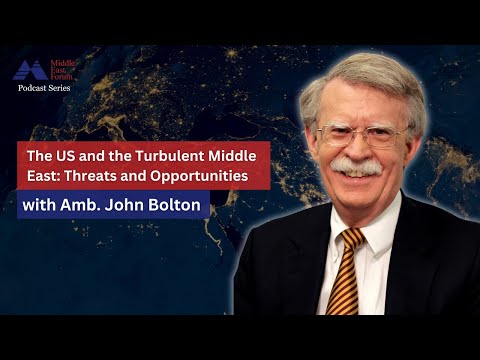 Watch on YouTube
Description
Iranian nuclear ambitions, the Hamas-Israel conflict, Red Sea shipping crisis, a rogue Türkiye, growing Chinese influence: as usual, the United States and its allies face many major problems in the Middle East. How can Americans develop a comprehensive and intelligible policy? How do the U.S. presidential elections impact regional calculations? What can be learned from past, bitter experience?
John Bolton is an attorney, diplomat, author and political commentator. He served as the 25th United States Ambassador to the United Nations from 2005 to 2006, and as the 26th United States National Security Advisor from 2018 to 2019. He is the author of The Room Where It Happened: A White House Memoir (Simon & Schuster, 2020). Mr. Bolton holds a BA and a JD from Yale University.
Transcript Automatic captions
Source: Automatic captions from YouTube, retrieved October 22, 2026. Automatic captions are machine generated and may misspell names and terms; check the video before quoting.
0:08 hello and good afternoon welcome to a very special episode of the Middle East forums weekly podcast series my name is anaf Kalam and I will be moderating today's discussion we are pleased to be joined today by The Honorable John Bolton Mr Bolton has served as the 25th United States ambassador to the United Nations and as the 2 US National Security adviser under President Trump he is also the author of a number of books including the room where it happened a White House Memoir Mr Bolton will speak for 15 minutes followed by 15 minutes of Q&A from the audience if you would like to ask a question you can do so by using the Q&A box located at the bottom of your screen to type your question and with that I will turn the discussion over to Ambassador John Bolton thank you well thanks very much and uh very very glad to be with you today obviously there's a lot going on here in the United States uh uh to preoccupy people but uh it's a very uh dangerous time in
1:12 the Middle East as I think everybody uh here knows and uh I think there are some strategic reasons for that that uh haven't gotten the attention they deserve certainly not since uh the Hamas attack of uh October the 7th and I think the place to start the the most important single strategic uh uh perspective here is that that what has happened since October the 7th uh is not uh an Israeli War with Hamas about the Gaza Strip This is a piece of the unfolding Ring of Fire strategy uh by Iran it's part of an Iranian war against Israel man ested on a variety of different fronts with obviously the opening gun fired by Hamas but with the hoodies in Yemen contributing by closing the Red Sea passage uh with Hezbollah in Lebanon and
2:16 Syria rocketing Northern Israel and and threatening Israel from several different vectors the Shia militia groups that Iran has put together in Syria and Iraq threatening and attacking uh American Military and civilian Personnel in those countries uh and and most importantly perhaps considering the conventional military threat that Iran itself has Unleashed from its territory uh against the territory of Israel uh just a few weeks uh ago now all of this is part of the Ring of Fire strategy developed by the uh former KS Force leader kasum sulamani uh I I can't tell you exactly what the malas and Terran thought they were getting when they started this I think we know what their overall objectives are they want hegemony within the region and they want hegemony within Islam how they thought this was going to
3:19 be accomplished by what they've been doing I can't say but uh I don't think the strategy is going very well fortunately but that doesn't mean that it's not part of an overall uh approach uh it it is important to understand this because if you believe that the only part of the conflict that matters is uh dealing with Hamas and Gaza then obviously uh you're going to have a very distorted picture of what the threat is uh how to protect our allies and in this case not just Israel but the oil producing Gulf monarchies as well as the basic naal interest of the United States and I think that's been manifest in unfortunately in a number of ways since uh October the 7th but the the the main thing to keep in mind is that as as we see the unfolding of the Ring of Fire strategy uh others in the world are watching as
4:21 well Iran is in my view very much an outrider of the new axis being formed between China CH and Russia I think both Russia and China are watching how the United States and its allies behave with respect to this conflict in the Middle East uh and obviously how we're going to uh deal with ramifications elsewhere in the world when Iran sells Russia uh drones and missiles that can be used in Ukraine when China uh increases its oil purchases from Iran in violation of our sanctions uh all of this uh uh fits together not necessarily in ways we fully understand because our intelligence is far from perfect as we all know but it does fit together now let me just take a minute to deal with some of the points that have been raised literally from the day of the Hamas attack uh by those who say oh no th this is not instigated by Iran this is not
5:26 directed and controlled by Iran this is just Hamas waking up one fine morning and deciding to attack Israel you know first what I would say is that I don't think anybody can dispute the facts that the terrorist groups around the region uh for some period of time if they weren't initially created by Iran like Hezbollah they have been armed and equipped trained and financed by Iran and Iran didn't do all that out of the goodness of its heart it did it because it wanted these capabilities uh available to Iran at the time and place of Iran's choosing uh now has this system worked perfectly for Iran uh no it hasn't and uh there there have been disagreements with the terrorist proxies uh there have been times when uh they did things that Iran didn't want there have been times when
6:27 they didn't coordinate effectively does that in any way disprove the notion that this is an Iranian directed Coalition the answer to that's no uh and the uh parallel that I would point to would be the North Atlantic Treaty Organization which just celebrated its 75th Anniversary here in Washington last week anybody who's ever been engaged in NATO diplomacy will tell you that this is not exactly uh a well oiled machine uh the the United States doesn't direct what other allies do it doesn't say to France you do this tomorrow and to Germany you do that the day after NATO consultations are probably the most arduous part uh of Alliance Management U and and as I say the pieces don't necessarily perform like well-armed parts that doesn't mean the NATO alliance isn't uh led by the United States we founded it we are the critical component to it uh and by and large it
7:33 moves in uh directions we want and if it doesn't then we will leave NATO and there won't be an alliance and every piece of the Iranian Ring of Fire uh components uh ha have at least that same picture this is I admit a rough comparison but the idea that somehow the terrorist proxy simply salute when Iran says it wants to do something uh I think just fundamentally at a basic political level doesn't appreciate how coalitions like this are put together now another objection that people have made to say well this Hamas thing is different from what Iran wants is to say basically two pieces uh number one uh we have no intelligence that shows that Iran gave a direct order to Hamas to attack on October the 7th or to prepare for the overall assault and number two uh uh carefully leaked by the administration
8:37 was there is intelligence that says that parts of the Iranian government were surprised at the attack but let me deal with both of those points uh it's true as far as I know at least publicly that there's no written order that we have found that says Dear Mr Hamas uh please attack Israel on October the 7th signed your friend the Ayatollah homine it's true that such a document doesn't exist but that's not how these things are communicated to begin with uh and in fact uh it as we all remember tragically Israeli intelligence and American intelligence missed the attack in its entirety so why should anybody be surprised that we haven't found the operational go order uh for the attack to begin the absence of evidence as Donald ramsfeld used to say is not evidence of absence the pattern of behavior here makes it plain that this
9:42 is part of an Iranian strategy even if that strategy is not fully known to us and even if that strategy is not necessarily working in Iran's favor and the second piece that there were elements of the Iranian government that were surprised by the attack doesn't surprise me at all uh if I were in the Revolutionary guard if I were in the ks Force for example I wouldn't tell the Iranian foreign Ministry anything until the attack began or many others in the government how do you preserve operational security if you tell the diplomats what you're about to do so I think what we've when we've heard these arguments in the American media from from people who uh don't don't take a a position friendly to Israel uh I I think these are just excuses that are being made up and I think it's very important as we look through a long perspective here uh at a conflict that's only I'm afraid in its opening days of actual
10:48 military action that everything else that's occurred since then in the region has been consistent with coordinated action uh did the hoodies uh themselves just wake up one morning and say I think we'll close the bab El mandb straight no they they this is uh uh Iran telling this element of the terrorist proxy Network what to do and the hoodies wouldn't have the wherewithal to threaten anything in the Red Sea were it not being armed uh and equipped by the Iranians likewise Hezbollah we don't know exactly what Iran sees their role as being but uh as even Secretary of State blinkin said said they've made part of Northern Israel uninhabitable uh since October the 7th we've seen the attacks in Syria and Iraq endangering killing and wounding Americans which ought to be enough for us to take action against Iran and then most importantly the attack uh by Iran itself and you know one aspect of that
11:53 attack uh that has not gotten much attention but which was reported at least by The Wall Street Journal and CBS a really chilling uh fact the taking the Israeli estimate that Iran launched 120 ballistic missiles against Iran uh these reports indicate that half of those missiles 60 roughly either blew up on the launch pad uh or crashed before they got close enough for Israel to shoot down that means in addition to dealing with the trone the drones and the cruise missiles the ballistic missile threat that Israel uh essentially eliminated was not 120 ballistic missiles over Israel but 60 so if you consider the risk of another 60 missiles uh confronting Israel's defense systems uh that night could have turned out to be very different this Threat by Iran uh has been building for 45 years now we see it
12:57 Manifest this may not be the ultimate struggle uh but we're very close to uh the kind of uh confrontation that will put not just Israel but the gulf Arabs in potential Jeopardy as well and this requires not a position by the United States of conciliating Iran but a position of saying we simply do not accept this conduct we don't accept the violation of a fundamental American objective since the Revolutionary War of freedom of seas we don't object to our allies being attacked uh and we object to Iran's continuing ballistic missile and nuclear weapons development program that's not the policy we're pursuing now and if we don't start pursuing it it will be at our Peril and Peril for our friends in the region so with that uh uh let me stop there and I'm delighted to answer your questions all right well thank you Ambassador uh so we have a lot of predominantly revolving around uh the
14:02 presidential elections and around Iran now come November in the event of a second Trump presidency what steps might be taken to so to speak undo some of the policies of the Biden Administration and revert back to a world where Iran is once again a bankrupt Pariah State as opposed to the more prominent and Powerful Iran that we see today well it depends on whether Trump returns to some of the policies that he pursued with respect to Iran in the first term uh and it's entirely possible that he will although knowing Donald Trump it's entirely possible that he won't either uh I should say we carried out a campaign called maximum pressure against both Iran and the nuclear proliferation threat from North Korea it's a great title but it's not exactly what the government of the United States was doing the uh pressure against both Iran and North Korea was not adequate uh and the sanctions regimes that were in
15:07 place were filled with loopholes and ways that the targets could mitigate the impact of the sanctions uh you can see a contemporary version of that failure as well looking at the sanctions against Russia in uh its aggression against Ukraine uh this is a broader problem than just a failure of Iranian policy it's a failure of sanctions policy but it could have a dramatic impact and I would just remind everybody that uh uh even though Trump correctly withdrew from the 2015 nuclear deal in May of 2018 uh he also said at the time he wanted to make a much bigger deal with Iran that would cover not just the nuclear program but the ballistic missile program terrorism and other things a position supported by the European three France Germany and Great Britain I don't think there is any deal with Iran that would satisfy our legitimate interest uh covering those activities unless there were regime change in Teran which ought to be our
16:10 real objective but which the first Trump term did not pursue and I would just remind everybody of the uh incident at the G7 meeting in beitz France in August of 2019 I tell the story in my book uh Emanuel macron the president of France had brought into the country Javid zarif then the foreign minister of Iran and had him in a villa somewhere in beitz when President Trump arrived I was already there for Preparatory meetings when President Trump was arrived Emanuel MCR had a one-onone lunch with him to persuade him to meet with zarif and uh after the lunch uh Trump called myself and Jared Kushner and Mick Mulaney the white house chief of staff into his hotel room we talked about what to do I strongly recommended against meeting with zarif malaney strongly recommended against meeting with Shar Jared said he should meet with sarif we talked and we talked and finally the president said
17:13 well all right let me think about it and the three of us left we went out into the hallway and somebody said what do you think he's going to do and all three of us said we didn't know it was that close that close that Trump came to meeting with jav to talk about the big deal or who knows what I'm just saying I I hope that a trump Administration would pursue an even harder line against Iran than it did in the first term and really pursue regime change but there's no guarantee of all right thank you now uh the MEF president Daniel pipes would like to ask well he begins John thank you for the exceptional analysis could you go into greater detail about the implications of us acquiescence to the Red Sea shipping shutdown well this is something I must say I'm amazed at the relatively passive reaction uh not just of the Biden Administration but of much of Europe uh
18:18 to this to this extraordinary development U obviously uh huge amounts of Commodities particularly including oil but but many many other commercial Goods that normally would have gone through the Suez Canal have had to be diverted around Africa uh this this is risks a substantial increase in oil prices at any point certainly it's increasing shipping and other transaction costs insurance and things like that for everything that has to go around Africa and yet the the industrial democracies have accepted this uh I think largely for fear of irritating Iran and for fear in the case of the us of taking actions to reopen this critical seane of communication uh that might increase gasoline prices before the November election it is a terrible signal not just to Iran and the hoodies uh or to Pirate groups around the world uh but to our adversaries that we are
19:20 unwilling to do what's necessary to vindicate the very fundamental principle of Freedom of the Seas that could apply to turkey and the uh connection to Ukraine through the Black Sea it could apply uh all across the South China Sea and a number of difficult sea Lanes of communication there uh the Panama Canal I mean there's a there's a long list of uh of of critical sea passageways uh that following this precedent that could F find themselves uh in in real trouble with enormous economic implications so I'm stunned there hasn't been more outrage about this and and I really wish there were because the signal we should send around the world is we do not accept this period we will not allow this to continue all right thank you now uh Mead Kari would like to ask how do you interpret the fact that the Iranian president elect's first overseas messages have been to hisbah leader and
20:24 to the hooti leaders yeah well you know the The Narrative of uh some people in the west is oh how how wonderful a moderate has been elected president of Iran so a couple of quick Basics the the the uh head of the government in U Iran is the supreme leader I know everybody listening to this broadcast knows that supreme leader has a certain ring to it you know it kind of tells you who the boss is second uh this this moderate this is a this is this election was a choice between Hardline Hardline lers and moderate hardliners and this interim president which is all that he really is because of the Unexpected death of his predecessor Ibraham RI uh is not going to be calling any shots and I think he's following the script now that the mulles have laid out for him look this this is putting a smiley face uh on the regime uh from their point of view it may be a public relations coup uh you wonder why they didn't think of it before I mean
21:27 why have a president colloquially named The Butcher of tan when you can have a moderate president and have the west and the media and the academics pay him a lot of attention I don't I don't see any substantive change in policy here right thank you and uh to follow up uh we have a question from Carrie hillbrand uh who asks can you speculate what the United States and others reactions would be if the houes or for that matter any Iranian proxies succeeded in causing a mass mass casualty event in The Straits or uh against any American targets well look I think we're at risk of that constantly and I I think leaving International Commerce in the Red Sea or Americans in Iraq or Syria is Tethered goats is unacceptable uh this this is uh we're not talking about a Potential Threat here the hoodies have attacked ships including American warships and other Allied warships as well as commercial vessels the threat is there we know it's there we periodically take out a few
22:31 missiles or launch SES uh but we've not done nearly what we could do uh to eliminate the hoodie threat uh and and I think that that uh the unwillingness to do that uh and the the lengthy period of time that went by before we took reprisals even just in uh Iraq against these uh Shia militia left Americans in Jeopardy and I think that's unacceptable too so again this this shows an unwillingness to take on where the real problem is in tan and unwillingness to confront Iran itself and I think that is that was reinforcing the feeling among uh Iranian decision makers that they could get away with this that they could keep their focus on the Gaza Strip uh and and the negative publicity they've generated about Israel about American Aid to Israel that's caused the Biden Administration to be so wobbly I mean we have again followed their script to their benefit not to ours well thank you now Chris Weston
23:36 would like to ask given uh Hezbollah leader say Hassan Nas's threat to attack Cyprus recently do you think that Europe has taken this particular threat seriously to its security well I don't think they've taken it seriously enough it varies from country to Country I think I think there has finally been some progress uh in designating the Revolutionary guards Iran's revolutionary guards as a terrorist organization which we did in 2019 in the Trump Administration uh but but overall I would I would I would describe the information Warfare component of the last uh eight months as being a substantial victory for Iran and its terrorist and I think uh in in the United States we've seen some of the results of that on our University camp campuses uh and and the potential electoral consequences at least that the White House fears and I think it's as bad in some cases worse in Europe I think uh there are many lessons to be
24:40 learned from what we've gone through since the Hamas attack and it may not be the most important in the near term but it could be the most important in the big term our information statecraft collectively needs a massive review and and upgrading because we're not we're not telling the story that really needs to be told we've allowed the Iranians to to to focus on what they describe as the humanitarian crisis in Gaza uh not the one that Hamas itself and Iran have caused thank you uh we have a question here now from Steven orlo who asks it seems obvious that the existential threat to Israel will not Abate until the head of the snake or Iran's current regime is eliminated what are the realistic options to achieve that goal well look I I I think the question is uh is is very well posed I've been saying for quite some time years too many years that the only way you're you're going to have a chance at true
25:42 peace and Security in the Middle East is when there's regime change in Iran uh because so much of the of the dangerous and and troubling activity we see wouldn't exist without Iranian support regime change uh is is a complex subject but I think we can say with a high degree of confidence that the regime is now more unpopular among the people of Iran than at any point in the last 45 years for a variety of reasons for economic reasons for Rel reasons of of conscience for reasons of different religion ethnicity uh the young people I think are widely disaffected from the regime uh I think it's a it it may be an imposing super structure but it's rotten underneath uh the fundamental problem though is that by and large the regime has the Monopoly of force through the Revolutionary guard regular military the bese militia we we saw that in action back in 2009 we've seen it in action repeatedly since then in the economic
26:47 riots in 2019 and and down to the present day I think the most U opportune moment uh for the opposition will come when the Ayatollah hamine uh leaves the scene either through natural causes or he steps aside or whatever uh there have only been two supreme leaders uh since the revolution of 1979 they don't have an orderly transition process what order they had was was really put in disarray when RI died in that helicopter crash um and it's a point when when a new leader has to be selected when personal jealousies ambition uh institutional considerations uh Exist by which the regime could be fragmented at the top uh and that's what we ought to be aiming toward I I don't think we should be unrealistic about this though it could be messy and it will be dangerous but it's at a time of of transition within a regime like this
27:49 that it's most vulnerable and that is the point we should be thinking about unfortunately what's happened for the past 20 years is that oppos I has risen in Iran it's gotten International attention then it's kind of fizzled away then a different kind of opposition comes and then a different kind the West our declared position in the United States should be that we favor regime change not for our benefit but for the benefit of the people of Iran and we should be giving them assistance they they can tell us whether they're willing to accept that we shouldn't force it on them but I think in terms of uh resources Communications resources to help them within the country we're not talking about US military intervention let me be very clear we should follow the lead of the Iranian opposition but that opposition is very widespread and to kind of sit back and act like we're purely observers it doesn't help us it certainly doesn't help the people of Iran there are a lot of suggestions out there we're not
28:52 having a serious debate about how to accomplish it we we have if my analysis is correct we have the benefit of a little bit of time before the Actuarial tables take the Ayatollah hamony away from us we ought to be using that right now to think about what to do all right thank you now unfortunately we have reached the end of our podcast for this week uh Ambassador it has been a great pleasure having you on and we would like to thank you once again for taking the time to join us this week my pleasure glad to be with you thanks for having me of course uh and as always we thank you all again for joining us today and I hope you all have a wonderful day thank you