
Conference or Roundtable
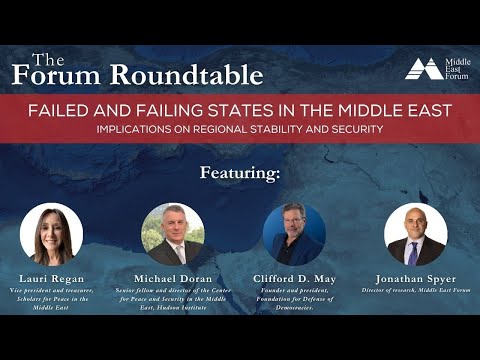
The Forum Roundtable: Failed and Failing States in the Middle East
 Watch on YouTube
Description
In 2010, the Arab Spring, involving anti-government protests and armed uprisings across much of the Arab world, led to civil war, rulers being deposed, and domestic violence. Fast forward to 2025 and the world continues to see instability across the Middle East. The decade-long civil war in Syria suddenly ended with the Assad regime’s toppling; Turkey, facing its own civil unrest as millions take to the streets, has hegemonic aspirations that extend far beyond Syria; Iran’s economy is tumbling in a downward spiral while it faces pressure from both Israel and the United States to relinquish its quest for nuclear weapons lest war become imminent; Lebanon’s new president appears to wish to take advantage of Israel’s successful attacks on Hezbollah and implement true change; and Iraq remains in limbo after the U.S. withdrew forces and Iran became embroiled in post-10/7 regional turmoil. Unpacking this complex and volatile regional reality in this month’s Forum Roundtable are the esteemed Cliff May, Founder and President of the Foundation for Defense of Democracies, Michael Doran, Senior Fellow and Director of the Hudson Institute’s Center for Peace and Security in the Middle East, and the Middle East Forum’s Jonathan Spyer, moderated by Lauri Regan, host of the Forum Roundtable.
Michael Doran is a senior fellow and the director of the Center for Peace and Security in the Middle East at the Hudson Institute.
Clifford May is the founder and president of the Foundation for Defense of Democracies.
Lauri Regan, host of the Forum Roundtable podcast series, serves as the vice president, treasurer, and board member of Scholars for Peace in the Middle East and as a board member of Polaris National Security.
Jonathan Spyer is director of research at the Middle East Forum.
Transcript Automatic captions
Source: Automatic captions from YouTube, retrieved October 19, 2026. Automatic captions are machine generated and may misspell names and terms; check the video before quoting.
0:08 Morning and welcome to the Middle East Forum's new monthly webinar series, the forum roundtable. My name is Lauri Regan and I'll be moderating insightful and informative discussions with leading national security experts on relevant and current events surrounding the Middle East. Today I am truly honored to host three men who I follow closely and highly recommend that you all do as well. They have frequent appearances on various news programs. They publish articles. Um their organizational websites and social media platforms. You can follow them on um X in particular as well. Um I'm going to keep the introductions short for these very esteemed experts uh as we have a lot to cover. Cliff May is the founder and president of the Foundation for Defense of Democracies. He is one of the most important the the FDD is one of the most important and influential foreign policy think tanks in the world. Mike Duran is senior fellow and director of the Hudson Institute Center for Peace and Security in the Middle East and someone who has had a profound impact on the way that we analyze events and players across the Middle East. And of course, followers of MEF know the brilliant work of Jonathan Spire, Middle East Forum's director of
1:11 research. So, we have quite an impressive panel for our conversation on failed and failing states in the Middle East. Uh, lot to discuss. I'll just add that today's program will be recorded and available for viewing. So, I urge you all to share it far and wide. It's going to be a very important discussion. Um, I'm going to start with Iran, which while technically is not a failed or failing state, is certainly an unstable one that could look very different in the coming years, maybe even months, depending upon how things play out. As President Trump attempts to negotiate a new nuclear deal with the Islamic Republic, many of us in the national security space are concerned about what that might look like, despite Trump in his first term pulling out of Obama's horrific JCPOA. And it appears that the Iranian people are also concerned with one man uh who was seen on an ex video writing graffiti on a wall in Iran saying, "President Trump, don't sell us out." So Cliff, I'm going to start with you as FDD has played an integral role in many of the policies that emanate out of Washington on these issues and in particular the maximum pressure campaign that Trump implemented in his first term. In his second term, we had expected more of the same, but
2:14 it's unclear where these current negotiations will lead, if anywhere. FDD's work has also contributed to a new bipartisan legislative initiative intended to codify the maximum pressure campaign gut Iran's ability to fund terrorism and prevent a future administration from easing pressure as Biden had. The Maximum Support Act states, quote, "It is the policy of the United States to provide maximum support to the people of Iran and their desire to bring about a new political system in Iran based upon democracy, human rights, and rule of law for all citizens of Iran. So, couple this with an Iranian economy that is teetering on the brink.
2:50 Um, there are some, including an expert at um, United Against Nuclear Iran that wonder whether the republic's hardliners will continue to defend the regime if unrest starts again um because of the Assad regime and how they saw that collapse. One of your colleagues, Royal Mark Garrett, co-wrote a column earlier this week in which he expressed skepticism about the limits of sanctions to affect Iranian behavior. So, where does all of this go, Cliff? Do you where do you see the negotiations going? And do you agree with Roel that maximum pressure has its limits? And and I can ask you the other magic question, which is if the mullers do fall, what do you see replacing it?
3:29 A lot to unpack there. Um, I'm concerned about the uh direction of the Um, I'm concerned that the uh the the regime in Iran is very very experienced at these kinds of things and how to manipulate Americans and others. They've been doing it for years and years and years and they have two paths to do it. One is they can just drag out the negotiations for a very long time while they continue with their nuclear weapons development work including weaponization which is very hard for even the Israeli intelligence to perceive as going on. Uh the other possibility is a sort of JCPOA, joint comprehensive plan of action. That was the t the title of uh President Obama's deal. It wasn't comprehensive and it wasn't a plan of action. I think President Trump was right to uh call it the war among the worst deals ever made. But I think there is a danger um that the US side, the envoy Steven Whit could be enticed into doing a kind of JCPOA 2.0. Um I was glad
4:34 to see an interim agreement which was proposed by the uh Iranian side was turned down. That would definitely be very bad. We saw that also happen before the JCPOA in 2013, two years before the JCPOA. There was an interimm agreement. That was bad as well. Um there as you know Michael Anton who's director of policy planning at the state department is been m is is made may lead I guess sort of negotiator on the technical issues. I don't want there to be a lot of technical issues. I want what what I want is what President Trump has called for and probably four other presidents have called for but taken few steps to achieve and that's dismantlement of the Islamic Republic of Iran's program to develop nuclear weapons and missiles including ICBM's intercontinental ballistic missiles that can deliver them to targets anywhere in the world. I to be to be very blunt about this, I'm not sure that can be achieved uh through negotiations unless and unless the regime absolutely feels um that the that that President Trump
5:41 will use force to stop uh the the the program if as long as they think n this is a bluff. I know there are B2s stationed now in Diego Garcia in the Indian Ocean. I know there are I but we don't believe they're going to do any of that. So we can string them along and we can fool them. Um so I I'm concerned about these new Michael Antonine's a very smart guy. He'll have he doesn't have the technical expertise here but he can bring along people who do. Uh this is a matter of you know 3.67% is that would that be okay? There is no reason that this regime needs to enrich uranium at all. other uh countries including many American allies that have peaceful nuclear um development or energy use that sort of thing uh they do it with by importing fuel rods from the United States or other places they don't need to have their own and there's no good reason for this regime to be building peaceful nuclear uh development under under mountains and fortified which
6:44 they're doing right now even as the negotiations progress which I think shows bad intent And so I'll stop there and let my colleagues go in, but I'll say, do I think that the regime is in danger of falling down? Look, I think most the vast majority of Iranians hate this regime after almost 50 years living under um a ruling class that is a clergical class, clerical class. They don't want this. But I don't but I think it's very difficult to uh stage a successful revolution against a regime as ruthless as this one is. When the sha was overthrown, you know, I went to I was in Iran as a reporter just after that for the Iranian revolution for a few months in 79. The sha was not going to kill tens of thousands of his people to stay in power. This regime, I think they would.
7:32 Thank you for that. Um Mike, I'm going to turn to you, but first I want to wish you a very happy birthday. Um Oh, thank What is your view of America's role when authoritarian regimes that threaten our national security and that of our allies appear to be teetering on the brink of collapse as one could argue about Iran. Um, and as we saw with Syria, and we're going to get into that a little bit more shortly, but I think there are some of us who expected that a Trump 2.0 would mirror the strong positions that he took in his first term. Uh, and instead, as as Cliff was discussing, we're seeing these new negotiations. Mike, you wrote a column um which was superb, the king's folly uh in which you stated there is quote highly visible version of Trumpism called restraintism that calls not for seeking global advantage by putting America's interests first but for a unitary global policy of withdrawal and restraint to avoid getting sucked into future wars which in its view inevitably damage America to advance the interests of corrupt clicks of globalists. Can you share with our audience how you see a second term uh Trump term impacting the volatility of Iran because it seems to
8:35 me that Trump 45's approach was much more preferable to what we're seeing now. Uh and um I know that you've referred to Trump 47 as a hybrid approach. So if you can elaborate on that please. Sure. Uh thank you. Thanks for having me. Uh I I agree with everything that Cliff said and um for that uh I I agree with everything you said and I'm I'm also a bit concerned about the direction that the nuclear negotiations are taking at the moment. Um but uh in the larger context uh I'm pretty happy with what I'm seeing from the uh the Trump administration. I mean, if I went by uh if I go by what I've seen in Donald Trump's uh truth social postings uh where he said uh that the United States is now going to hold Iran responsible for what the Houthies do or what Iran's proxies in general do. Uh that's a great policy. I'm not sure we're following it yet, but uh at least rhetorically, that's exactly where I would want the um the administration to
9:38 be. Uh he's also said Iran can't have a nuclear weapon. Great. I'm very happy with that as well. Uh what I haven't liked is what uh uh what Cliff alluded to uh or discussed that the that uh Steve Witco is talking about um about uh capping levels of enrichment, capping levels of uh uranium stockpiles and having um uh and having inspections um in order to uh verify that those caps are being maintained. The Iranians have uh in the last decade since the JCPOA was signed, the Iranians have developed um their nuclear program to such an extent that these kind of caps that we're talking about don't really do for us very much at all. Uh because they can just flick a switch as long as they have all of the u all of the more advanced centrifuges installed or easil or ready to be installed easily. Uh then they can
10:40 just flick a switch essentially. um and within within a matter of a week have enough uh material to build a bomb. Uh which means that the breakout time is zero even with those uh even with those caps. Historically we have said we needed we need a breakout time of a year uh in order to prevent in order to in order to be assured that Iran is not going to be able to acquire a nuclear weapon. Uh what's the goal? What's the role of the United States? Well, we're living through this era of restraint in American foreign policy. The American public is skeptical about large-scale military intervention in the Middle East. Um I think that that has been consistent message of uh there has been a consistent message of every president since the second term of George W. Bush that we will not have another large-scale uh intervention in the in the Middle East. that's among Democrats and Republicans. Uh the problem is from my perspective that there is this
11:45 persistent line of reasoning which we find among the Republicans and the Democrats which says that the way to assure that we won't have to have large-scale US um military interventions is by um is by learning how to cooperate with Iran. We should distance ourselves from Israel, distance ourselves from Saudi Arabia, get closer to Thrron because really all of the aggression that we see coming from Thrron toward us and toward our allies is really just a defensive response to our to the threat that we pose to the regime. And so if we convince Tyrron that we really have warm feelings toward it, we can stabilize the whole Middle East uh together with them.
12:29 This theory has been tested time and time again. It has never ever ever succeeded. It was tested in the in the Obama administration and it was tested in the Biden administration. Uh the the neither Obama nor Biden admitted openly that they were doing this. But if you followed what they did, it was really very obvious. So whenever anyone asks Anthony Blinkin Biden's Secretary of State, when are you going to actually hold Iran accountable for any of the uh violations that it uh uh any of its violations of the uh nuclear non-prololiferation treaty or the JCPOA for that matter, he would always answer, we think diplomacy is the best way to do this. Not by any not through economic sanctions, not through uh uh military deterrence or anything else. That means they were trying to find a deal, find an accommodation with the um with the Iranians. They never found it. Um and as a result, what happened is our ally Israel, which was directly exposed to Iran, Iran's attacks
13:32 through its proxies, had to take um matters into its own hands. Um and the United States didn't help it. The proper policy is if the United States is not going to do things itself with its own military on the ground, it has to work through allies. And it has no better ally than Israel. Israel has a four-star military, a four-star intelligence apparatus, um, a high-tech um, uh, defense industrial base which the United States built up over the last 50 years precisely in order so that the United States won't have to do things itself.
14:10 It would be very silly for us to abandon this um uh abandon this ally, to abandon this instrument that we created um in pursuit of some kind of um uh some kind of fantasy of an accommodation with Iran, which has never the Islamic Republic has never ever ever tried to hide its fundamental hostility to the United States. So uh we ought to just face facts and deal with reality the way it is and work together with the Israelis to get rid of this threat that we face of this common threat that we face namely the Iranian nuclear program. Um the I'll just conclude with one last um with one last observation and that's that a year ago or a year and a half ago let's say uh you any let's say prior to October 7th we were very very worried about taking any kind of military action uh against Iran because of the damage that Hezbollah would do to Israel uh because
15:14 of the damage that Iran would do to Israel with its ballistic missiles and so on, but the Israelis have uh have taken the Iranians down a peg or two. Uh we've seen the worst that Iran can do. Uh and it's really not that damaging to Israel, not that damaging to us. So the risk of actually taking some aggressive action to get rid of the Iranian nuclear program is not nearly what we thought it was or uh let's just say thanks to the Israelis, it's now not very risky uh at all. We can all see that very very clearly. So, let's operate with that Thanks, Mike. And that's a good segue into my question for Jonathan. Um, Jonathan, I saw a report that nine US planes loaded with hundreds of bombs, including bunker busters, landed in Israel last week, although I haven't seen anything in the mainstream media on that. Um, could it be that Trump ne uh negotiations are just a a ruse, especially given that if they really wanted to keep the shipment of of bunker busters, etc. under wraps, the shipment could have been done under the radar.
16:15 And as Cliff pointed out, there's also been a record-breaking US deployment, including moving missile defense systems and other material from South Korea to the Middle East along with air defense systems. Um, do you get the sense, Jonathan, that this is all about an imminent strike on Iran or is Trump attempting a larger realignment of the region? And what do you make of the news that Trump prevented Israel from striking Iran as reported initially in the New York Times last week? Yeah, so those are I guess two two separate questions. I mean, first of all, with regard to the movement of bunker busters, yeah, no, I don't I don't think they're indications of an imminent strike, I would be very very surprised if they were. My sense at least is that the administration takes very seriously the uh uh negotiation process it has entered into. And I think that it's uh to some degree goes together with the administration's preference apparently for negotiations. Um, and it's fairly clear that the administration will be disappointed if it thinks it's going to get to something like an agreement that actually properly puts a hold on the Iranian nuclear program. But of course,
17:16 it's not entirely out of the question that the administration could be fooled by the Iranians and we could end up with something similar to JCPOA. I sincerely hope that doesn't happen. If it doesn't happen and if the administration gets wise to who the Iranians actually are and what they actually want in the coming months, then and only then, I think, will the prospect of American strike or indeed an Israeli strike really for reasons I'll go into in a moment uh come onto the agenda. But I don't think we're anywhere there now. My sense at least is that the best possible scenario is we're going to have to get through a period of negotiations at the end of which the administration will realize who it's dealing with and then the possibility of a strike which by the way I very much support would then come onto the agenda. Um and I'm fairly confident, of course we can't know, but I'm fairly confident in that. I would be deeply surprised if it turned out that the Oman uh broker negotiations were just to roost for an imminent American strike. I could be wrong. Of course, it's happened before, but I would be deeply surprised if that turns out to be the case. Not at all. I would even say that the delivery of bunker busters in a
18:18 way, I wouldn't call it a ruse, but it's a way maybe to concentrate with the notion of concentrating the minds of the Iranians in the course of the negotiations. Again, it won't work because it represents, if that is the case, a misunderstanding of the nature of the regime. I hope the administration will soon get to know who they're dealing with. with regard to uh the possibility of an Israeli strike uh and the administration preventing an imminent Israeli strike that would otherwise have taken place. Uh yeah, excuse my skepticism, but I don't buy it for a moment. And I'll tell you why not.
18:50 Uh if somebody has been talking about the possibility of a strike on the Iranian nuclear program for about 20 years, but it hasn't happened, there's a whole long list of people who have supposedly restrained the person from carrying it out. The person in question here is our prime minister Binyamin Netanyahu. The list of people who have supposedly prevented Netanyahu from carrying out a strike on the Iranian nuclear program is quite strong. It's quite long rather. It includes the former Mossad head Mel Dagan who supposedly prevented in his time. It includes the then chief the one-time chief of staff of our army Gapy Ashkanazi. It even includes poor Yuval Steinit in one version professor Yuval Steinit who was energy minister. I forgive me for skepticism. I think that if somebody who's been talking about a strike in Iran for 25 years and hasn't carried it out, that's probably because they don't actually want to carry out a strike on Iran. Binyo, and I'm not bad at BBlogology. I've been studying him for a while and from fairly close up on occasion, uh, is somebody who I think is a deeply cautious leader. He's not cautious always when he's on conference platforms, but when it comes to actually managing policy, he's a deeply cautious
19:52 figure. This is not Ariel Shaon. It's not even Man or Emerald. It's Netanyahu. We need to know what he's about. So the notion of Israel defying American will and uh carrying out a strike is unlikely in this case. If Netanyahu really wanted to carry out a strike, he wouldn't allow the Americans to tell him not to. Managen carried out the strike on Ozak in Iraq against the will and without uh seeking permission from the Reagan administration. Even Elmelt, a less lorded figure and well- reggarded figure than Bacon justifiably I think in our political history carried out the attack on the uh Syrian plutonium plant against the without seeking permission from the then uh George W. Bush administration.
20:35 So no, I don't think that's the case at all. I think if Israel hasn't carried out a strike on the Iranian nuclear program, it's because the prime minister doesn't want to at this stage and that would seem to me to be the background to it. So no, not an imminent American strike. I don't think either an imminent Israeli strike. We're going to have to get through this period of illusion, which I think it is this negotiations before we get to the reality. And at that point, I hope very much we will take the necessary action from America, from Israel, hopefully together. Very interesting, Jonathan. Thank you. Um I I'm going to turn back to Mike. Um Mike, since Obama entered office, we've seen the balance of power in the Middle East change significantly. The Pax Americana that helped to maintain stability and relative peace in the region was dismantled when Obama decided that the realignment in the region and that's the term that you and Tony Bjan coined about Obama Middle East policy uh should involve the empowerment of a new hegeimon in in the form of the Islamic Republic. In your recent essay, you recognized that in the Middle East quote power is gained and kept by those who
21:38 can generate violence directly or by proxy. In an age of restraint, vacuums will be f filled not by the United States but by others and only three states in the region have the military capability to project power beyond their borders. Iran, Turkey, and Syri and excuse me, Israel. Can you discuss the current power vacuums and the way you see the struggle among these three power Thanks. The uh the key arena here if we're talking about among the three of them is of course Syria. Uh this is where the three really uh uh really converge. Uh as I mentioned before, Biden who was following the Obama realignment uh approach was restraining both simultaneously the Turks and the Israelis in uh in Syria while trying to reach an accommodation with Iran about the whole region. We all remember that on October 6th, 2023, uh the uh latest edition of Foreign Affairs magazine was reaching the mailboxes of its
22:40 subscribers with an essay from uh Jake Sullivan, the um Biden National Security Adviser, saying that the Middle East had never been uh uh as quiet as it had been uh you know, over the last 20 years that it hadn't been as quiet as it has been under the Biden administration. Um precisely because they had this uh outreach to uh to to Thran. After October 7th, they continued to try to uh to try to um uh settle the Gaza or reach a ceasefire in Gaza and uh keep the front between Israel and Iran from expanding into Lebanon and Yemen and and elsewhere by maintaining the channel to Thran. They never advertised this, but it was really it was a a fundamental part of their strategy. And it's why even when Americans died in Jordan when they were struck by Iranian uh by an Iranian proxy directed by Thran, the United States didn't uh didn't target
23:43 any Iranians in response, whether in Iran or outside of Iran. Um so uh this uh effort to restrain Israel from uh from attacking Iran, which is another part of the of the policy that we saw really very clearly um at every stage of the uh of the conflict. It didn't work. Uh and in the end the Turks and the Israelis operating separately, not with each other and certainly not um uh uh under the direction uh or of of Washington or even with the agreement of Washington. They ended up toppling Assad in um uh in Syria. So uh uh the uh Israelis benefited greatly from the Turkish Iranian rivalry. Um there is now an Israeli Turkish rivalry. The Israelis and the Turks are bumping up against each other in Syria and President Erdogan has made some very hostile statements about Israel which is uh uh
24:45 which has uh not done anything to endear him to the Israeli leadership. So this is an area where I think we really need uh American leadership. the the job of the United States here is to uh is to separate our allies who don't get along with each other much as the United States separated Israel and Saudi Arabia during the Cold War uh in that kind of way or the way the United States separates Greece and Turkey uh uh now uh we're we we have a long history of doing this of keeping our allies who don't get along with each other apart from each other uh finding accommodations between them. I think that the uh Donald Trump uh can bring out restraint in uh in both parties with respect to each other in a way that neither one of them can do when dealing with each other uh with each other directly. So the the two priorities that by my mind uh flow from this analysis is number one, let's end the Iranian threat once and for all. Uh
25:48 we have something approaching stability in in Syria now. We need to build on that. The Iranians would like to blow that up. This is what they're very good at. Every project that the United States comes at comes uh up with in the region uh to spread prosperity and stability, whether it's the whether it's the Abraham Accords or uh uh or the efforts to uh to settle the conflict in Yemen. um they're ultimately get blown up by the Islamic Republic through its uh proxies because it thrives on chaos and ultimately it wants to drive the United States from the uh the Middle East. So let's recognize that, work with the Israelis especially to uh end the threat, the nuclear threat from Iran, but also the threat of its uh proxies and then separate the Turks uh from the Israelis and Syria and build Syria as a buffer uh like much as Jordan is a buffer now between say Iraq and Israel.
26:48 Um thanks Mike Cliff. I'm going to, you know, on the same on this the same topic, I'd like you to sort of follow up with with Mike's description of the way he sees things playing out. Um, you know, the biggest uh threat, well, according to your your colleague, and I'm going to quote um Ruel once more. He he called um there's far too much quoting of Ruel here. I'm so sorry. He's been very prolific of late, which is very unlike him. Um but but but Ruel said that Turkey poses perhaps the greatest danger to the Jewish state in the Middle East escalating the threat of a conflict he won't be able to avoid. Um so we know that Israel and um Turkey there were these talks in Azarbjan deconliction negotiations. Um Cliff, do you do you what are your views on how um Israel views its national security with the Turks having such a strong presence now in Syria?
27:48 Well, a couple things. I look, I think the Israelis still believe that the the focus needs to be on Iran. Uh I was in Israel not that long ago. The Israelis are fighting on seven fronts. Um they're doing well on all seven fronts, but one general said to me, "Yeah, but if we don't solve the problem of the Islamic Republic of Iran building nuclear weapons, all of this is for nothing. It doesn't it will not matter." Um I I do think there's a if you're you're looking down the road, Turkey looks like a because while it is absolutely beneficial and pro progress that Iran no longer has Syria uh as a colony, um Turkey now has Syria as a colony and we don't know what's what Turkey is going to do with that colony. The other thing the Israelis are doing and I think this is they're correct in doing it. They're saying, "Look, we have to have a somewhat different security posture than we had in the past. We're going to we're going to need a we're not going to let our enemies build up their military resources right close up on our border.
28:52 We going to uh we're going to need buffer zones. Buffer zones in Gaza, buffer zones in Syria and other places. They're not annexing. Um I think over time they can they may be able to move back out of Syria, but I think for a while they're not going to do that. They did a very good job of destroying probably Jonathan can correct me if I'm wrong 80 or 90% of the military resources that Assad had so it wouldn't be inherited uh by the by the new government and that's I think that's very helpful. I think they're trying to protect the Drews in particular in southern Syria not least because there are there's a significant Drews population in Israel very loyal and they have cousins over there and they're worried about it.
29:35 Syria's I look I think Turk I'm more concerned with with Turkey and Erdogan perhaps than than than Mike is. So I I I I take his point that it's useful for the US to try to say okay Turkeykey's a NATO ally. Israel is an important ally, our most important ally in the Middle East. Let's see if we can make sure that they're they're not at loggerheads or at least not at daggers drawn. I think that's absolutely right. But I I think that it's important that the Israelis and I think they realize this understand that you got to prepare long-term but you also have to but not to be distracted from what's immediate and imminent and that's very difficult. I'll just make this other point be while these negotiate. I look I would like to see the US take care of Iran uh the Islamic Republic of Iran's nuclear weapons facilities and destroy them and do it on its own because this is a nation that has for 50 years been chanting death to America. It is in an axis with Moscow, Beijing and North
30:38 Korea. They have military, diplomatic and economic ties. for a fourth member of this axis to have nuclear weapons and the ability to deliver them anywhere in the world. That is not in the American national security interest. This this axis has one thing in common and that is to diminish the United States and have a new world order in which they dominate and America is never great again, never preeminent again, is diminished and in decline. And I I think that's an But if the Americans don't want to if President Trump doesn't want to do what what probably needs to be what I think needs to be done, then work with the Israelis more or less to get it to get that done.
31:18 And if if the Islamic Republic no longer has the ability to produce nuclear weapons and deliver them, then it becomes a seventh rate power. and then you can work on Turkey over a longer period, but you'd have a very changed situation within the Middle East once you don't have uh Iran and its proxies and its threat of nuclear genocide hanging over your head. Well, thanks Cliff. Jonathan, I'm going to have you stay to stay on the same subject because you wrote a column entitled Collision Course. Are Israel and Turkey headed for confrontation? Um, and you recognized Erdogan's desire to to form a new caliphate over a broad swath of territory stretching from the Gulf of Iraq and the Levant across the Mediterranean and to Libya. Um, and we've we've touched on Turkey establishing military bases or taking control of military bases in Syria, but they also have them across the Middle East and in North Africa. Um, they've strongly supported Hamas for years, including through today when Turkish and
32:21 Hamas leaders have been meeting over um it is in effect replacing Iran's regional influence and seemingly did so under the radar I think um post 107 Iranian proxies and Iran itself as as we've been discussing have been uh devastated in in some ways um and that has enabled this Turkishbacked militias to succeed in places like Syria. So my question is, do you does the US have any leverage over Erdogan? And do you believe that Trump will lift sanctions on Turkey, including on purchasing Russian air defenses, bringing Turkey back to the F-35 program, and allowing Erdogan to establish these bases across With regard to the the US position, I mean, it does seem to me that the the position of the administration seems quite friendly and towards President Erdogan at the moment. Um, with regard to Turkeykey's stances, yeah, I mean, Turkey is a strong and vital supporter of Hamas, of course, and a viciferous one, but not only on the rhetorical level. The rhetorical level is interesting. I mean, I followed the president, president Edwin's speech in Adel Fitter of March 30th, where he
33:24 called openly for the destruction of Israel and for Allah to carry Zionist Israel away. Not for the first time. So, you know, this is a deeply anti-Semitic president and an Islamist president obviously committed to Israel's destruction. There is an active Hamas office in Istanul. active by the way not only on political and media level but an active military office from which the late Salaharuri as we know planned the terror attack the murder of three Israeli teenagers that launched the last ram between Israel and Hamas back in 2014. Um I think that Erdogan's stance and this I think is maybe of interest from the US point of view uh derives not only from a desire to destroy Israel that's a detail. I think that he uh is intent absolutely on reshaping the Middle East uh emerge through aggressive policies stretching all the way from Libya across the Mediterranean through Gaza and the West Bank and up to Lebanon and Syria and maybe into Iraq also uh in which his intention is to challenge all those he perceives as his enemies back Islamist and jihadi movements and leverage them into a sort of power play across the region. We know for example
34:26 of the quite astonishing really declaration of an exclusive economic zone basically all the way across the Mediterranean so that Turkey would have some sort goes in and out between Israel and uh and Europe. So this this kind of stuff is obviously entirely unacceptable and if Erdogan is continuing to push in that direction then sure at a certain point he's going to collide with a pretty powerful force which is Israel and certainly Israel has no intention of uh of allowing him to do that. So we're seeing in Syria the way in which the collision course is developing. Uh I think quite interestingly Erdogan has obviously backed the jihadi Sunni jihadi force which took Damascus back in December. That force which by the way just presided over the slaughter of around 3,000 Alawise in the western coast there about a month ago. So it's not nearly as uh pacified as maybe the uh PR coming out in the west suggest that it is. And Israel's in the other direction. Israel doesn't want to and will not accept the buildup of a Sunni, jihadi, Turkish proxy on its border. So what Israel is doing is acting very strongly militarily but also diplomatically to make sure that Syria
35:30 will remain if the only alternative is a Sunni jihadi Syria backed by Hamas supporting Erdogan fragmented and weak. And Cliff mentioned obviously the military push into the demilitarized zone and to take the Kmon. That's one part of it. Relations with the Drews is another. Connections to the Kurds is another. Connections to the Russians and allowing the Russians obviously to maintain their presence in the West is another. So yes, my sense at least is there is a directly contradictory uh strategy being pursued by Israel in its resistance to Erdogan's attempt to build up a kind of Islamist region working for him. And so yeah, I think there's more confrontation down the road. I don't think, by the way, that this will necessarily lead to armed confrontation between the two anytime soon. But I do think that similarly to Israel's relations with Iran, there are two very separate wills here. And I and they they are kind of clashing with one another.
36:22 And I would say similar to Iran, not by chance, because of course, in my view at least, there are two significant Islamist moments in our region. One is the 1979 Islamic revolution in Iran and the other is the election of AK to power in Turkey in 2002. Edoan now appears to be dismantling representative government in Turkey itself. So there's I think possible to call an Islamist regime being born inside Turkey. And yeah, those ideas and the regimes that support them will clash of course with Zionist Israel by their very nature because both regimes are committed to Israel's destruction and Israel certainly intends to resist any attempts to realize that That's a great segue for my next question to Mike. Um because I love talking to Mike about or hearing what Mike has to say about Turkey domestically. Um and we have seen, you know, I'd like your insight, Mike, on to where they're heading domestically in the short term and the and the long term. About a month ago, Erdogan arrested and imprisoned an opposition leader which ultimately led to millions of people protesting in the streets of Ankora. And I've heard some analysts
37:24 talk about this being the beginning of the end of Erdogan's reign. Um, but Turkey isn't Iran and the streets seem a lot less unstable than the Iranian street. So, how stable is the Erdogan government? And before you answer, since we're talking about quotes and these are not from RUEL, this is from FD's Mark Dubit. Um, he posted on X, quote, Erdogan is the Muslim Brotherhood, its military wing in a suit, and entrusting American security to a radical Islamist isn't just a betrayal, it's idiotic. And then he quoted Bernard Lewis who warned Iran will become like Turkey and Turkey will become like Iran. Mark added he was right. Iran's people want freedom.
38:03 Turkeykey's Muslim Brotherhood leader wants the caliphate. What are your thoughts, Mike? Well, I disagree with him on everything, including including Bernard Lewis. I was Bernard Lewis's research assistant. Uh and uh Bernard was a great uh uh he was a great believer in the US Turkish relationship. So um and I inherited that from him. And I I I there are look uh the um the uh views of Reap Erdogan uh about Israel uh and about Islamism are a challenge for the United States.
38:40 Absolutely. There's no doubt about that. They're a challenge for Israel uh as well. But I don't see it um uh in nearly as um um nearly as a zero sum game in the way that I think Jonathan and uh Jonathan Spire and Mark Duboitz's analysis leads us to. Uh Turkey is a lot bigger than Reap Erdogan. Uh Erdogan is in an alliance inside in uh Turkish domestic politics uh with the uh with the nationalist Turkish uh nationalists. Uh it the nationalists are a junior party uh in this alliance, but it's still an alliance of that kind. I don't think anyone in the Turkish national security apparatus has um any intention of having a direct conflict with Israel or is going to bed at night and fantasizing about um liberating Jerusalem or um destroying Israel, anything like that.
39:41 they have um uh even if they do have those thoughts uh they have a whole host of uh very practical issues that are that are much higher up on their uh on their agenda. The number one factor being solidifying the border, stabilizing the border between Turkey and uh and Syria. We're on the possibly on the cusp. I don't want to be too optimistic about this, but it's a realistic possibility now uh that we might be on the cusp of an historic u uh deal between the PKK and Turkey. The PKK being the Kurdish uh separatists who want to divide Turkey into two countries, a Turkish country and a and in the east um a Kurdish country. The PKK is a registered uh terror organization uh in the United States. Uh and the United States is is in an alliance with the PKK in Syria. This has been the biggest impediment to US
40:45 Turkish uh uh to US- Turkish relations. Uh it looks like Donald Trump wants to end that alliance with the PKK in the in the form of the YPG, which is the the um the the Syrian arm of the PKK. uh uh Donald Trump seems to want to end that. That that is the that is far that's a big much bigger issue for the Turks um than anything to do with uh um anything to do with Israel. So uh uh I see all kinds of opportunities for pragmatic accommodation with the Turks which I think we should pursue very uh aggressively. If it doesn't Yeah, I have a great optimism that all of that will work. If it doesn't work, fine. But then I'll be the first to admit it and we can um and we can adopt a different strategy. But I think it's a big mistake to assume hostility and to work on that basis uh without thinking about where that will lead. If uh if the United States becomes aggressive against Turkey uh very aggressive against Turkey, do
41:51 people who are advocating for that think that Turkey is going to become nicer to Israel? Do they think that the um uh that Turkey is going to be nicer to the United States in other arenas where it can uh uh make life very difficult for the Americans? What's the vision? Here's the the bigger question I think we should all be asking ourselves. What's the vision of the new American regional order that we are that we are aiming for? What do we think is realistic? How do we uh how do we get there? And how does turning hard against Turkey get us to that position? I don't see anything if there's a Turkish American clash or a really significant Turkish Israeli clash. I don't see that getting us to a place that's very good at uh at all.
42:42 Thanks, Mike. Um, Cliff, I'm I'm going to before we move on and I want to cover Yemen and and Iraq and Jordan. Um, I I wanted to ask you about your thoughts on whether or not the Trump administration is sufficiently cynical of the new Syrian government. Um, there are serious discussions within the administration about pulling troops. I think they've actually made the decision to pull troops out of Syria, which will likely be destabilizing. Israel's Alma Institute just issued a report indicating that Iran and Hezbollah seek to reestablish a presence on Syrian territory. Um, specifically rebuilding the land corridor from the Iraqi border in eastern Syria to the Lebanese border in the west. And ISIS appears also to be increasing its its figure in Syria, threatening more instability in the country. What are your what are your thoughts on on this?
43:28 Well, a few things. Look, there's a faction certainly within this Trump administration, call them isolationist, neoisolationist restrainers, who either don't understand or why we have troops in Syria or what the purpose is or maybe have some understanding but don't like the idea. Um, I think that the president should be taking credit for the economical use of force we have there. The he's not he's drawing down, but he's not eliminating. And it may be fine with a smaller number as a force. multiplier of American troops there. What those troops are doing is they're working with Kurdish and I'm going to put it differently than Michael that with Kurdish and Arab allies have for some time to suppress the Islamic State. And these allies are also managing to keep Islamic State terrorists who have not been killed but have been incarcerated um essentially in in prisons over there.
44:22 If they don't do it, there'll be maybe thousands, Jonathan probably has a better estimate of the number than I do, who will get out and you'll suddenly see uh Islamic State terrorists going to Europe, probably not going over the border from Mexico quite as easily as they would have a year or so ago. Um that's not not at all on our interest. There's also oil that the US is keeping out of the hands of the Islamic Republic of Iran. That's a good thing. So the use of force by elite troops who act as a force multiplier for troops who are working with us against common enemies that is overall a useful and good thing and that's that's a kind that's a very good way to to use military American military force. Um is that was there another part of your question? I forgot Lori. No, it was it was more about Yeah, you you answered I I'm just concerned about um the Trump administrating administration understanding what's going on in Syria and and you gave a a fine answer, Cliff. Thank you so much.
45:22 And I just should say I mean the you know Michael and I have some disagreement on this too. I I I I am I'm worried for the Kurds of northeast Syria if there's not a US presence. You remember Jim Mattis resigned in the last administration at a time when President Trump almost almost pulled all US troops out of Syria and he said I can't basically he said I cannot be in office and betray people men uh who who who are working handin glove with the with with Americans. Um I can't I just can't be part of that. He was afraid that they'd be killed. But listen, to get back to what Michael's saying to give give the credit there, the US should be talking to Turkey and saying, "We do not want to see Kurds dying in large numbers because you're bombing them or trying to wipe them out, especially if that happens after we have left left some behind at your urging. That would be very damaging for American relations with Turkey."
46:27 Um uh you know that well we won't get unless you want to we won't get into a whole conversation about the Kurds in Turkey, the Kurds in Iraq, the the Kurds and in other lands. This is an ancient na an ancient nation that doesn't have its own state. Nobody's pitching tents on college campuses so that they do have it. And for the most part, most the Kurds that I've been familiar with, they'd love to have their own nation state. There's no question. But if they can just have basic autonomy wherever they are, speak their language, have their culture, not not have a government that wants to wipe them out. I'll just mention one other thing that I think is worth understanding in terms of the Middle East and beyond the Middle East.
47:09 what you have with the Islamic Republic of Iran, I think to an extent with Turkey, these both countries were great empires in the past and their grievances that they're not great empires in in the present and they want to be in the future and I think the same is true of Putin and Russia. He's trying his goal is to restore the Russian Empire. China is an empire. Um Shing Jang, that word that where the weaguers live, that means new frontier. Just look at a map, you'll see it's a bulge out to the west of China. It's not part of China. It's a part of the Chinese Empire. Right south of it is Tibet, another colony of China.
47:46 It's not Chinese. It's Tibetan. It's its own culture. It's its own religion, its own language. And Xi Jinping wants to be the the hegeimon of Asia and well beyond. And Putin wants to restore the Russian Empire. That absolutely means he must swallow Ukraine and destroy it as an independent nation state. and as a culture um the Islam promp of Iran wants to be the hgeimon of the Middle East and doesn't want to subjugate the people of Israel. It wants to exterminate the people of Israel and we need to emphasize what that's about. It's much worse than what anyone else is doing.
48:23 Erdogan sees himself, I think, as a neo sultan, a neotoman. Absolutely. Um, I think to get Syria as a vassal state or a colony or a client, whatever you want to call it, is useful for him. Um, I hope Mike is right, and I kind of think he is, that Erdogan is not going to be too adventuristic and say, "Oh, in order to achieve my ambitions, why don't I just go to war with Israel?" Because Israel is is is a is a major military power. It's shown what it can do. I don't think I think Erdogan is too smart for that. Um, but that doesn't mean they can't there there there isn't real there isn't friction now and won't be friction in in the future because Erdogan is Muslim Brotherhood and because he is a Thanks Bl. I wish we had more time to discuss all of this, but I do want to kind of uh I want to talk I want to turn to Jonathan on Yemen and then we'll do a lightning round towards the end. Um Jonathan on Yemen um and what we might see in that country as the US continues
49:26 to mount strikes against significant targets in order to prevent the Houthi's continued terrorism in the Red Sea threatening western interests. How stable is the current government and whatever that government might be? And do you believe that the Houthis can be decimated in a similar fashion to Hezbollah for instance? Um you wrote in a recent column uh discussing Russia's role in helping the Houthis acquire defensive and other military equipment. um that quote, "Moscow is developing an ever closer strategic relationship with Iran. Seeing itself as at war with the West in Ukraine and engaged in a broad strategic effort to erode and weaken the US and its allies, it evidently identified the successful effort by the Houthis to disrupt shipping on the Red Sea as a node of counter pressure that it was happy to get behind. So, um will Russia continue to help prop up the Houthis now that the US has has become much more aggressive militarily? And what do you see happening within Yemen?
50:18 Well, first of all, I think there's no reason to assume that the Russian relationship with the Houthis will end as a result of of the United States is very welcome commencement of a bombing campaign against the Houthis on Sala since March 15th, if I'm not mistaken. You know, there's been some very very serious action taken by the United States. And and it's really notable actually, you know, that contrary to the kind of characterization of this administration elsewhere in the world that it prefers to avoid confrontation that it's looking first of all to to solve conflicts and all, you know, in Yemen. And I think this is maybe encouraging for elsewhere in the Middle East. After all, the administration is on record, has been very much aware that the Houthis are merely a proxy ultimately of Islamic Republic of Iran.
50:59 The administration has been taking very determined action and it's welcome. Having said that, and I guess this is a bit of a caveat to that, similarly to Hamas in Gaza, and maybe for similar reasons, I don't believe that the Houthis can be induced to reverse or I think it's unlikely that the Houthis will be induced to reverse their ongoing policy of attacks on shipping in the Gulf of Aiden Red Sea route uh through air action alone. And the reason for that is because the Houthis are are not interested remotely in the welfare of their own people, of course, and they're also, I think, not especially concerned about the welfare of their own fighters because they have plenty more impoverished Yemen Shia to call upon, which means that I think that if the United States wants not to get drawn into a kind of long tit fortat set of exchanges between the Houthis, uh they have to up the stakes. And there's been a number of uh reports in recent uh days in both regional media and I think in the Wall Street Journal and other and a couple and Reuters I think also
52:01 regarding the possibility of a uh ground action by the Yemen government or by the Yemeni government and the southern transitional council which is the other anti-h who's the military force on the ground there in Yemen. If that were to take place it would I think need to be with at least some element of western backing from the air. I suspect that if we want to add the Houthies, and I think we do, to the lengthening list of Iranian clients who have chosen to unilaterally exclude themselves from the ongoing regional war currently underway against Israel and its allies, it will need something like that. When I think about when I talk about the lengthening list, the list the list currently includes Lebanese is chose to unilaterally remove itself having received a dubbing from Israel the end of last year. It includes the Iraqi Shia militias who also have chosen to unilaterally exclude themselves. Hamas has not of course chosen to exclude itself yet, but it's certainly taken a beating and has been massively reduced in capacity and can no longer launch missiles, for example, at Israel's urban
53:03 centers as it was doing up until a few months ago. The Houthis are the exception. The Houthis are still very much in the game. We need to take them out of the game. to do that. I suspect that the United States and its allies may may need to escalate from the current uh level of use of force. Welcome, as that has certainly been. Thank you very much, Jonathan. These last couple of minutes, I want to see if we can do a lightning round for all three of you touching on um some a question regarding Jordan and then one regarding Iraq. Um Jordan recently foiled a Muslim Brotherhood plot designed to seow chaos and harm national security there. the individuals were arrested and now we learned uh this a day or two ago that Jordan has officially outlawed the Muslim Brotherhood in the country. Um what what are your thoughts on the stability of the Hashimite regime or reign and can you perhaps touch on any role that Israel might play in preventing Iranian interference in Jordan and maybe around Robin each of you a minute or so? Start with Jonathan.
54:04 Um well with regard to Jordan I mean I think you know it's generally a good rule of thumb not to uh bet against the survival of Hashimite monarchy which has largely buried most of the regional regimes that predicted its uh imminent demise all the way back now nearly uh well all the way back to only 80 years. Um but yeah it's a real challenge. Um by the way I think when it comes to Muslim Brotherhood the ch which of course is the main challenge for the Jordanian monarchy the people standing behind that is not necessarily only the Iranians. It's also good friends Qatar and Turkey who of course are supportive of Muslim Brotherhood efforts throughout the region. So I think we shouldn't always be putting to be sort of pinning the blame on on Iran for absolutely everything. You know Qatar Katar and Turkey I think are probably you know committed to instability in Jordan.
54:48 Yeah, there's much that Israel can do. uh intelligence cooperation between uh the very serious Jordanian intelligence services and those of Israel is is ongoing even when the public rhetoric of King Abdullah and those around him can be quite hostile to Israel regarding Jerusalem and other other areas you know the dayto-day contacts go on there's more that the Jordanians can do certainly with regard to sealing the border into the West Bank and prior to the war that was left dangerously open but that cooperation is there it needs to increase Israeli expertise without any question is already and will continue to be assisting the Jordanians in the ongoing fight against the Islamist challenge there both of the uh Qatar and Turkey supported Muslim Brotherhood variety and indeed of the kind of mischief that the Iranians certainly have got up to in the past on Jordanian soil. Thanks Jonathan clip.
55:38 Well I have make a couple points. One is look I think it's good that the Jordanians have the the Muslim Brotherhood. Um, I think it should be something that's thought about a lot here in the US and in Europe where the Muslim Brotherhood is not outlawed for for being a subversive and proterrorist group. Um, I think the Jordanian regime, the kingdom survives, but it absolutely needs Israeli support to do so. And h and that has always been the case and they don't like to admit that. Couple of just what two historical points. One is remember what Jordan is.
56:13 It's threearters of of the his of Palestine. Its people are mostly Palestinian. There are refugees from Syria and other places. The royal family comes from Arabia, kind of kicked out by the Saudis with the help of of the British. Um but the king is married to a Palestinian woman. Uh his son who is the crown prince will presumably be the next king and that will be this is I find fascinating the first Palestinian king in all of history. Very fascinating. like that, Michael? I did. Yeah. Um, Michael, are you okay if I just switch to Iraq since we're running out of time?
56:51 Um, sure. Sure. So, so let's talk about Iraq really quickly. There's Iranianbacked militias that continue to play an outsized role in the politics in Iraq. Um, and but there have also been reports that these militias are going to are considering disarming. Um, they've seen what's happened to the Houthis with the US attacks there. At the same time, there's reports indicating that Iran is sending long range surfaceto-air missiles to these militias. What's going on in Iraq, Mike? Yeah, they're they're they're running scared right now uh because uh they they've seen what's happened all around the region through Iran's uh proxies and they don't want to be on the target list. Uh and they see the rhetoric coming out of the uh of the Trump administration about Iran. Uh and so they're keeping their heads down. uh for the moment and um um and Sudani, the leader there is um making a lot of the right noises about bringing the uh the Iranianbacked militias up under the Ministry of Defense. U the um Iraqi
57:56 friend of mine uh just came back from Iraq uh last week and he told me that um I'll be very surprised to find out who the most popular man in Iraq is right now. And do you have any guess who that I leave it to the experts and it's Benjamin Netanyahu. They're all of the all of the opponents of the all of the opponents of the uh uh of the Iranianbacked militias are uh are speaking very favorably about uh Israel hoping that the Israelis will come and save them from these these militias. Uh uh you know it's a serious thing actually. I I don't expect that the Israelis are going to save them from those militias, but it's interesting to see how people read the uh uh how people uh on the ground are reading the the the chessboard. You remember uh when the Israelis uh took out Nasalla and activated the pager uh operation against Hezbollah, the the the people of Idlib
59:00 um in um uh in northwest Syria were these are the the Sunnis who are opposed to the Assad regime. and see Iran as an enemy were also chanting uh in favor of uh in favor of Netanyahu. So, it's a kind of a theme around the region. There's a real opportunity here uh to uh to to if not drive Iran completely from Iraq to uh to weaken its um the state within a state that it has created there. Uh if not to destroy the state within a state. I'm not sure if we can go that far, but we can certainly weaken it significantly. Uh, but this all goes back to what we started talking about, the Iran nuclear uh the Iran nuclear uh talks. The way those are proceeding is giving the friends of Iran around the region a little bit of reason for optimism when they see the Iranians say we will not sit down for direct negotiations with the Americans. It's beneath our dignity to sit with those uh um uh with those uh with those people.
1:00:04 Uh and we go along, we Americans go along with it and uh and allow them in their weakened state to dictate the terms of the negotiation. We don't do ourselves any favors in places like Iraq. Exactly right. Yeah. So, I can't thank you all enough. I wish we had another hour. We could get into much more detail on on these topics as well as so many others. But I had the two of them. They they were just about to give in to me on Turkey. They were just about Well, I knew we could spend a lot of hope. Hope Mike is proof on Turkey that hope springs eternal with him. He'll never ever hope springs. Always always.
1:00:43 That that's great. Um I I thank you all. I thank everybody in the audience. Please follow these the important work of all three of these brilliant uh experts on the M East and beyond. And uh I wish everybody a good afternoon. Again, I can't thank you all enough for joining us and look forward to following all of your work on X and elsewhere. Thanks, Ameilia. Have a good afternoon.