
Webinar or Talk
Jason Greenblatt Explains Trump's Middle East Venture with Jason Greenblatt
 Watch on YouTube
Description
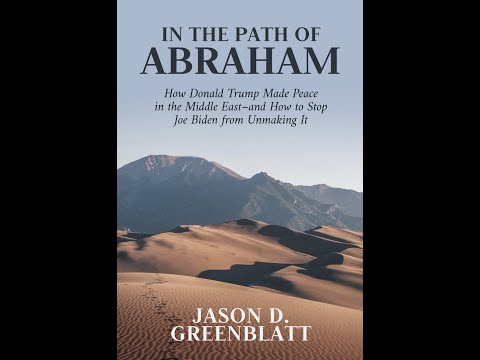
In his new book, In The Path of Abraham: How Donald Trump Made Peace in the Middle East – and How to Stop Joe Biden from Unmaking It (Wicked Son), Jason Greenblatt argues that President Trump brought a new and successful policy to the Middle East that enabled it to achieve multiple historic peace agreements between Israel and some Arab states. What was the key difference from prior U.S. policies? What long-term implications do the Trump years have for the Middle East?
Transcript Automatic captions
Source: Automatic captions from YouTube, retrieved November 2, 2026. Automatic captions are machine generated and may misspell names and terms; check the video before quoting.
0:00 All right. Hello and welcome to the Middle East Forum speaker webinar series and podcast. I'm Stacy Roman and I will be moderating this discussion today. We're pleased to have Jason Greenblat who served as special envoy to the Middle East under the Trump administration where he was a chief architect of both the priest peace to prosperity plan and the Abraham Accords. Join us to discuss Trump's Middle East venture. Mr. Greenblat will speak for 15 minutes and open it up for questions. should you wish to ask a question, please use the Q&A box located at the bottom of your screen to type your question. And with that, I will turn the discussion over to Mr. Jason Greenblat.
0:36 Good afternoon. Thank you everybody for joining. Thank you for the introduction. I think it's uh an important day that we're having this discussion because I think it allows me to use by real example what our approach was that differed from other administrations perhaps. So we see what's happening. Israel, the IDF has launched an offensive against Palestinian Islamic Jihad. Some call it Islamic Jihad. And uh they're doing that to protect their citizens, to protect their country. Our first and foremost rule was to stand by Israel with unequivocal support. Unless Israel did something wrong, and but I mean wrong, actually knowingly do something, which for the most part from everything I had ever seen, Israel might make mistakes, but it doesn't go out and target or start offenses like this without any kind of provocation or without a legitimate reason. Um, but prior administrations gave unequiv gave equivocal support.
1:35 They would say things like, "We support Israel. Oh, but Israel has to uh tamp down, you know, its attacks. They have to do it with equal measure. They have to do it proportionally. We didn't buy into any of that kind of talk. We took at at face value Israel's ability, its skill, its knowledge, its intelligence gathering to do what it needs to do to protect itself. And I'm sure what's going on today um by Israel is happening for the same reason. The second thing that we did was take a close look at Iran. From the day we came into office and certainly from our very first trips to the region, it wasn't just Israel, but it was the entire Arab world who we met, not the entire Arab world, but those who we met who felt abandoned by the Obama administration because of the Uh the exclusion to that were the Palestinians, not because they uh didn't agree. We don't know where they agreed.
2:27 They just were silent on the issue, but everyone else felt that the Obama administration put the region in significant danger. So the Iran issue was very much tied to our work. It was tied to the Abraham Accords and uh I think the region is again nervous because the Biden administration does not seem to be willing to give up on the notion that this Iranian regime is a regime that uh can be trusted. They think that this regime can be trusted to get back into the JCPOA and we'll be compliant. They won't be compliant. And more than that, even if we give them the benefit of the doubt and they're compliant, all we're doing is kicking the can down the road and in several years, Iran will have the ability to build nuclearial weapons. The JCPOA did not end their ability to build nuclear weapons, but rather it simply delayed their ability to develop nuclear weapons. And part two of that equation, which often does not get a public airing, has to do with the fortunes of money that Iran spends to filament terrorism around the world, in
3:29 particular against Israel, which we're seeing again today through the Islamic Jihad efforts where Hamas of course and Houthi terrorists who fire against the UA and Saudi Arabia and Hezbollah and other proxies throughout the region and We took the approach of telling the truth instead of diplomacy. Some people like the way President Trump speaks or tweets, others don't. But one thing he can never be accused of is not speaking clearly. We did not go into meetings with nice words and diplomatic words. We spoke to everybody, of course, politely, but with very clear language. One example of that would be we refrained from using this concept that everybody seems to love, this phrase two two-state solution. Why did we refrain from using that? Because it means nothing really.
4:18 It's a concept, but without drilling down into the details, nobody really knows what you're talking about. Among the things that's the biggest problem of this so-called two-state solution has to do with Israel's security. By its very definition and the complaints that people lodged against the peace plan that President Trump unveiled, a two-state solution would mean that the Palestinian a Palestinian state would have full sovereignty, completely control whatever it needs to control within its own borders. And even if it's Israel would have to worry that what's happening in Gaza, what's happened in Gaza since Israel departed from Gaza many years ago would continue to happen.
4:58 So rather than rely on uh you know good faith, best wishes and crossing our fingers to say that a Palestinian state, if one were to ever come into existence, would be able to keep law and order and stop anyone from attacking Israel, we gave Israel the ability to control the security. If the Palestinians were able to keep security, then Israel would never have to go in or do anything to jeopardize uh Palestinian sovereignty. But if the Palestinians were unable to do that and and likely as certainly at the beginning because they have so little experience with this, they would not be able to do this. So it was very important for us to not only allow Israel to do what it needed to do to protect itself, but also to prevent others, in particular the UN, from criticizing Israel for doing what it needed to do to protect its country.
5:47 We gained uh trust from all sides. We were very careful in an otherwise leaky White House as all white houses seem to be. Nothing just about nothing leaked from our plans. So the leadership in the countries that were involved trusted us to speak openly and honestly and uh ultimately that yielded many benefits. And um we also ultimately were able to take away the Palestinian veto card. For years, the traditional thinking was that un unless the Israeli Palestinian conflict is resolved, there would be no more peace between Israel and its Arab neighbors other than Egypt and Jordan.
6:25 In the end, we were able to prove that wrong. The region had changed. I'm not saying that that philosophy wasn't true years ago, but the region had changed tremendously. Everyone not only was worried about Iran, as I mentioned earlier, but everyone also was completely revamping their societies. They were trying to wean themselves off of oil. They were trying to come up with all sorts of exciting new ways to have people work in different industries, including technology. They were all worried about their security generally. And they all more or less recognized that Israel could be a partner in so many of the things that they were working on rather than a negative force or even an enemy. So we seized upon that and it was clear that mo many of these countries those that signed obviously the Abraham Accords but even those I'd like to call the countries who have not yet signed the Abraham Accords recognize that they have their own national interest to protect both their security as well as their economic opportunity and their citizens and the right to have a relationship with Israel whether
7:27 formally as those who signed the Abraham Accords under the table as they all did before we even stepped onto the stage uh continuing through today. However, they wanted that relationship with Israel and Israel wanted one with them. It shouldn't be up to the Palestinians how they can handle it. So, we spent several years developing the trust, making sure to stand by Israel, trying desperately to improve Palestinian lives, but to no avail every economic opportunity we presented to them. Uh, which by the way, one of the biggest um misconceptions in this whole conflict is that the Palestinian leadership wants to improve Palestinian lives. It's not true.
8:09 They're purely focused on their political gains, their political wins. And anytime we try to improve lives on a temporary basis, not to say give up all of your political aspirations while we give you economic aid, uh, they just were not interested. They blocked us every step of the way. Another very important misconception is people talk about the Palestinian leadership as if it's only President Abbas. Let's remember that in Gaza, where there are roughly 2 million Palestinians, they're ruled by the iron fist of Hamas, a terrorist proxy funded and controlled by Iran. And it was uh really interesting to me that at the beginning, every time people from the US government and others would approach me and say, "We have to deal with the two-state solution. We need a two-state solution. President Abbas could bring us to a two-state solution. And I would ask them, you know, a rhetorical question sort of, but an important one. What if we managed to get President Abbas and then Prime Minister Netanyahu in the room and we managed to put down a peace plan that everybody could embrace? How do we sign
9:13 that peace plan? How would Israel ever sign that peace plan without the Gaza situation being remedied? How do we deal with Israel making concessions when in the end they're only clapping with one hand on the Palestinian side? And nobody ever has an answer for that. Their answer simply was, "Well, let's not focus on that. Let's just keep talking about the two-state solution. Let's give the Palestinians everything they want other than certain things that we can negotiate and everything will be fine." There's very much, and this is true of the Iran deal too, there's very much in the history of this conflict a sort of let's hide our head in the sand. Let's pretend everything will be okay as long as we just inch this thing forward here and there. Keep things calm and uh let's blame Israel for a lot of what's going on. Let's refrain from blaming President Abbas. Let's give blame on Hamas when we need to. Let's not ask for the Arab neighbors to do anything. That was the philosophy from everything that I heard from people who helped uh give me the background of the deals that had been floated before. So, it's true we broke
10:17 some China. It's true we made many people uncomfortable. It's true we spoke hard truths whether it was Nikki Haley at the UN, Jared Kushner and I out of the White House, David Freriedman in Israel and others, Mike Pompeo, so many others. But I think the result of all that breaking of China and educating people and being honest and forceful and truthful and bucking the traditional thinking, which again might have been true before we stepped onto the stage, but was not true when we were in the White House, ended up resulting in two things. one of course the Abraham Accords which are historic and amazing and continue to bear fruits. We're up to the second anniversary pretty soon and it's really remarkable how the region has changed because of them and I keep seeing more and more growth and opportunity and friendship between the countries that are involved and even those that are not yet involved. But we also laid out a very detailed plan for the Palestinians for a future. And instead of the Palestinians engaging on that plan and complaining rightly so that they can't agree to pages and pages of the plan, which is fine, nobody ever
11:21 prevented them from negotiating the plan. Instead, what they did is they disengaged from the US. They refused to look at the plan. They condemned the plan before it even came out with statements coming out of their leadership such as, "We hope this peace plan is born dead." And once again, they prove themselves unwilling to negotiate in good faith. So, I think my 15 minutes are up in about 30 seconds and what I'd like to do is give you an extra 30 seconds to ask questions because I'm sure you have many of them. So, I'll end here and again, thank you everybody for Absolutely. Thank you so much. Uh, so the first question is from Daniel Pipes.
11:59 Jason, on behalf of the Middle East forum, thank you for this important statement. Turning to specifics, Jared Kushner states in his memoir that David Freriedman misled the Israeli leadership into thinking that Donald Trump would exceed an immediate annexation of about 30% of the West Bank. Well, in fact, the president would only support annexation where the Palestinian Authority were the Palestinian Authority to reject the very carefully worked out peace to prosperity plan. Could you please comment? Well, why don't we start with an easy question, Daniel?
12:33 So, the answer is this. Uh, as some of you may or may not know, I left the White House at the end of October of 2019, several months before the peace plan was revealed. I don't know the answer as to what was going on between my departure and the few months before uh the press conference. Obviously, I was at the press conference and it was an amazing press conference, but there's clearly a difference in recollection between David and Jared. Both of whom are friends, both of whom I trust and respect. Um, David has said multiple times in the press that he stands by his recollection of the events. Uh, obviously Jared must stand by his recollection given the book. So, it would be really hard for me to answer the question when I wasn't in the room, so to speak.
13:19 Absolutely. Thank you. Uh, Andrew Rosem Marine asks, uh, who should get most of the credit for the Abraham Records? Jared Kushner and the UAE ambassador Otiba rather than President Trump. Um I I rarely focus about credit because my in my view the Abraham Accords has many parents many many parents including by the way parents who came before let's call them grandparents parents who came and grandparents who came before we stepped onto the stage. There were many Israeli diplomats, for example, that visited the Arab countries and started to lay the groundwork. BB Netanyahu laid the groundwork before we even stepped onto the stage. But if you're asking me directly, you know, where credit goes in terms of the final result, I mean, there's no question President Trump without him, none of this could have happened. There's certainly no question that Jared Kushner led the team and a lot of this was as a result of his vision. You know, we're all awaiting more excerpts to be coming out of his book. Some of which will be interesting
14:23 like the one Daniel Pipes asked about, others will be a little bit more revealing as well. Um, but Jared was a key and influential figure and very much trusted by the Arab countries. Ysef Alatea for sure a key player and I write about him in my book. Ron Durmer a key player, BB Netanyahu. But I would also say that each of the Arab leaders, those who signed, who were extraordinarily courageous to do this, uh, who signed the Abraham Accords, and even some of those who didn't sign, but were willing to support it. Uh, one of the really interesting things that people forget about is the day that the peace to prosperity plan was revealed six or so maybe eight months before the Abraham Accords, you had the Bahrain ambassador, the Alman ambassador and the UAE ambassador in the White House, you know, listening and clapping along with everybody else about the peace to prosperity plan. So, I think people should focus on the very very large team of people. For those of you that are familiar with the word minion, which is a quorum of 10 men when Jews gathered together to say their prayers, my view
15:27 is we had a very large minion of men and women and so many other people throughout the world helping us on this under some really courageous leadership. Fantastic answer. Uh JL asks, "How much confidence do you have in Biden's promise that the US will not let Iran develop a nuclear weapon, especially since that would most probably involve military action?" It's an excellent question that it's hard to answer and and I I'll answer it in two ways. I want to talk about Ukraine for a moment and Taiwan. Let's start with Taiwan. So, you know, we have this strategic ambiguity policy. I actually did a podcast on this. I host a podcast on Newsweek called the diplomat and I said after watching all these news programs and all the strong sounding statements coming out of the US government, the truth is we really don't know what this strategic ambiguity statement says. We says we say we're going to give weaponry to Taiwan to defend itself. But how much weaponry?
16:26 What are we going to do? How much money are we going to commit troops? Nobody knows. Take Ukraine. Um, most people feel President Biden is at this point maybe he could have done things differently before the crisis, but at this point he's probably doing the best that he can do under difficult circumstances. A lot of people feel that it's the Europeans's problem. I agree with that. I mean, I I'm glad we're supporting Ukraine, but I think the Europeans need to step up more and more, but in the end, nobody's putting American boots on the ground, and I don't think the American public has the desire to put boots on the ground there. So, that brings us to the question of Iran. Um, sometimes diplomats and politicians say nice sounding words that sound smart. They sound right. And I'm not criticizing what President Biden saying. It probably came out of President Trump's mouths and BB Netanyahu and Yer Leid and Afali Bennett and so many others. But what does it really mean? And the answer is we don't really know. Um, what I do know is entering into the JCPOA would be very bad for us. I don't know if there's a plan B, but I also don't know whether we could really keep that promise. And it's
17:30 a a fair important question you're asking. I'm not sure anybody, including President Biden, can really answer that question at this point. Absolutely. And to follow up on that, Steven Orllo asks, "To what extent, if any, is the current administration undermining the many achievements of the prior administration? And what achievements do you believe are Um, interesting question because the title of my book is In the Path of Abraham: How President Trump Brought Peace to the Middle East and how to stop Joe Biden from unmaking it. Uh, until President Biden's visit, I was certainly very worried. I remain worried about Iran. Obviously, we just discussed that and that is a key factor in terms of, you know, forget all the important wins that President Trump got, whether it was Jerusalem, Golan, moving the embassy and ultimately the Abraham Accords. the biggest way to unwind the Abraham Accords and turn the region into a disaster if he enters into some semblance of a new Iran deal. That doesn't make sense. But um it seems that he has no intention to change most of
18:36 the things that President Trump did. Uh I think if he tries to open a consulate in Jerusalem, that would be a big mistake. I think on his visit when he went to the East Jerusalem hospital without an Israeli presence, that was a mistake. It gives the Palestinians this political win that not only means nothing, doesn't improve lives, won't bring peace, but it undermines, you know, perhaps in certainly in spirit, if not in law, I think it undermines his compliance with the Jerusalem Embassy Act and the fact that Jerusalem is Israel's capital. I don't know of any other country that President Biden or anyone for that matter would visit unaccompanied by the country's host. In fact, told telling the country's host, "You can't be here." It reminds me when President Trump was going to visit Israel and did, but when they were the advance team was planning President Trump's trip in May of 2017, the US government um embassy andor consulate, it might have been the consulate team were planning it. They were somewhere near the Western Wall, somewhere in the old city, and the
19:38 Israelis were expressing their concerns. And one of the staff from the US government said to the Israelis, "Get out of here. this isn't even Israel. That's not an exact quote, but that shows you the mindset of some. So, I think that's very dangerous. And the more President Biden does things like that, that's a problem. Uh giving money to the Palestinians, for example, uh let's take UNRA, where he committed additional funds. UNRA is a broken, corrupt organization. It leads to nothing to help Palestinian lives. Um it's a waste of US taxpayer money. We need that money here at home these days.
20:12 So, I am worried. I think on an overall basis he's keeping some of the policies. He's standing by Israel, although it'll be interesting to see how the US government responds to today's um defensive maneuvers by Israel. Uh I remain worried, but at least we're now you know what, a year and a half or so into his term. I haven't seen anything dramatically problematic other than the Iran deal. Thank you so much. Nissan Bore asks uh to what extent the PLO's repeated rejections of generous Israeli US offers from 2000 to 2009 have played a role in convincing certain Arab countries that there is no point of waiting for the PLO's approval.
20:56 I think a lot I and I write about this in the book as well. I think the Arab countries largely understand first of all they understand the difference between Ramla and Gaza and they understand that Gaza is a big problem. But in terms of Ramala, not just the PLO, the Palestinian Authority, for which President Abbas wears two hats, um they they recognize it. It's one of the reasons the Abraham Accords came about. They're frustrated. They spend a lot of their own money to help the Palestinians. Um they they understand it and they're not afraid to say it at this point. They say it delicately. They don't say it all the time. Not all of them say it, but they understand the Thank you so much. Uh from JLK.
21:42 So we have at least three books on the Abraham Accords. Freriedman, Kushner, and yours. What are the differences? As we may not have time to read them all. Sorry. Um you said my book was the best. I I didn't hear the question. Yes, absolutely. That's why we have you Well, luckily for the moment we have two before Jared's comes comes out. So um I think they're very different. I could speak to David's and mine. I, you know, I can't yet speak to Jared's because although I've seen excerpts, I haven't seen the whole thing. Uh, I think David's is very much a memoir. Um, it's a it's a good book. I liked reading it. Uh, mine is much more a policyoriented book. Uh, definitely has personal anecdotes, but it's mine is very much a story of who we were, you know, how did we get to where we were, what did we learn? If you want to really learn about the Israeli Arab conflict and the Israeli Palestinian conflict, I delve into that in a in a really strong way.
22:34 and why did we make the policy decisions that we did? So without um you know saying mine is better, it is no without saying mine is better and David's is not they they are actually very different and you know depending on what you like. If you want to learn more about what we did, I think mine is a great source. If you want to have great personal stories and interesting facts and some maybe more background about things like Jerusalem, David's is a great read as Perfect. Thank you. Uh, Sandre Bilistano asks, "Why why doesn't Jordan figure into the so-called two-state solution with it being a deacto Palestinian Uh, the short answer is they don't want to. You know, it's uh it's a lot of people come up with that idea. People have suggested along the way some sort of confederation either between the Palestinian entity and Jordan, even incorporating Israel into that. Um there are some movements that say, you know, Jordan is Palestine. In the end, unless Jordan is willing to be involved in that matter, which they're not. Um they're all just interesting ideas, the
23:37 theories, not necessarily wrong ideas. Everybody should think creatively, but I don't think at the moment those are going to go anywhere. Thank you. Eric asks, "Do you think that Saudi Arabia would sign a peace agreement with Israel without a Palestinian Israeli settlement agreement? And to go a little further than that, do you foresee any Arab countries joining the Abraham Accords in the near future?" I think until the Iran issue is settled and until the world calms down a little bit, it's going to be difficult for Saudi and probably most other countries to jump into the Abraham Accords. We could be surprised. Many were surprised by the Abraham Accords themselves. But the world has become so tense even before um Taiwan, right? We had Ukraine and before Ukraine it was still tense. I'm not sure people are ready to jump into the Abraham Accords at this very moment. Hopefully things will calm down, but we just don't know.
24:33 It just seems to be getting more and more tense around the world uh month by month. Uh as to your question, part one of your question in terms of Saudi, it's difficult to tell. Saudi is a much bigger country. The keeper of the two holy mosques has this very very far-reaching vision where they're changing their country and their society so quickly and so dramatically. While relationship with Israel is on that list of things, um I don't think they're prepared to do it at the moment in a formal way, in a sort of peace agreement or Abraham Accords way. Uh my hope is it happens. I do think it's inevitably inevitable. My hope is it happens in the not too distant future. But I look at it a little bit differently. I say let's applaud them every time there's a positive move. So for example, several weeks ago they opened the airspace to Israeli flights. They had opened airspace under the Abraham Accords for flights to and from the UAE and to and from Bahrain. Now it's fully open. Uh that's a big deal. It's a big deal for Saudi Arabia to have done it. Very courageous. It's a big deal for Israeli
25:35 tourists. It saves time. It saves money, fuel, and all that. Um, I believe they're going to start letting in Israelis at some point for their international sports competitions. Whether they have to do that by the rules of the sports competitions or not, I think it's a big deal and we should say thank you. So, I focus more on how do we get them continuously moving in the proper direction? uh the fact that they're willing to move in the proper direction and then eventually maybe we get to that peace agreement that everybody is so excited to uh to finally Absolutely. Uh Jack Kushner states, "Some Arab countries, nations say that they that unless Israel takes military action against Iran, very soon they will leave." Uh could you comment on that?
26:22 Uh I'm not sure. Unless Israel takes military action against Iran, they will leave. They who the Arab nations probably the Abraham Accords. He's a scream. Oh, meaning they'll they'll depart from the Abraham Accords. I think that's uh I I'm not sure I agree with that. I think the UAE and Bahrain and Morocco signed the Abraham Accords for a multitude of reasons, including being partners uh equal partners with Israel on security. Uh, I don't think and and of course I think they recognize Israel's military and intelligence prowess and hope that Israel could be at the forefront of defending not only Israel but the region, but I'm not sure that they would issue this sort of uh ultimatum. You know, you fix this for us otherwise we're going to take the accords down. I I haven't heard that. I want to think about that a little bit, but my gut reaction is I don't think so.
27:16 Thank you. And Robert Laric asks, "Does Israel really have or the region really have peace? And could you comment on how this is different from the the peace agreements with Egypt?" So the region itself does not have peace. You know, there's always this uh Middle East peace process phrase that, you know, everybody used for years. I never used that because solving the Israeli Palestinian conflict or even the Abraham Accords does not create Middle East peace. You still have Syria, you have Yemen, you have Lebanon. There are so many issues, but what President Trump and the other leaders did is create peace in the Middle East, parts of the Middle East. I think it's dramatically different than Egypt and Jordan. Uh first of all, you have significant business ties. Even more than that, you have Israelis going there and even American Jews like myself going to these countries and feeling at home, feeling welcome, feeling comfortable. I feel comfortable in Jordan. I feel comfortable in Egypt because I've gotten to know those countries. And I had a unique job in the White House. But I think many don't understand those countries and may not feel as
28:18 comfortable as they could or should. But in the that's Egypt and Jordan. And they're great places to visit. But I think because the peace between them and Israel was a little bit on the colder side, perhaps a cold peace as people say, people don't believe that much has changed with respect to those two countries. And it's more of a military peace situation. Whereas with the UAE and Bahrain and Morocco, it's really it's a warm piece and it's just going to get warmer. The trade is happening. The UA UAE minister mentioned in uh in the World Economic Forum in Davos not too long ago, several months ago, he anticipates that uh trade between the UAE and Israel will grow to five billion dollars in the next several years.
29:01 Remember that's up from zero or roughly zero because they had some under the table deals prior to 2017. you have kosher food in the hotels, kosher restaurants, you know, synagogues opening. It's it's really quite a big change and uh I encourage everyone to go there and see it for yourself. Wonderful. Thank you. And our in our last minute here, could you give us like one or two key takeaways from your book and where we can find it? Thank you. Uh the book is available on Amazon or wherever you get your books.
29:33 Um, I think the the message I want to leave you with the book is it's not this has nothing to do with David's book. There are other books coming out of the White House that are sort of salacious, gossipy, backstabbing. Um, I have just about none of that. I'm clear about my views on Secretary Kerry and President Obama. Uh, but I try to treat everybody with respect. I try to treat everybody with um a realistic view of where they stood, what their positions were, even recognizing, for example, Saudi Arabat or President Abbas who I can't you know stress how much differently I think than them but at the same time you know I recognize the positions that they have the predicaments that they have the um you know I may disagree with their approach I certainly disagree with many of what they call facts and history but at the same time they are the people or Saab has now since passed on that these are the people that we have to deal with to see if we could ever bring about peace. So, it's a realistic book, but it's also a hopeful, optimistic book.
30:32 Um, not stareyed, but at the same time, not giving up. Wonderful. Thank you so much. I'm sure we all look forward to reading that if we have not yet. Um, we've come to the close of our webinar. Thank you, Mr. Greenblat, so much for joining us. We really appreciate you taking the time. My pleasure. Thank you all for listening. Of course, for our viewers, please be on the lookout for our weekly webinar offerings email coming out over the weekend. Thank you all for joining us and I hope you have a wonderful day.