
Conference or Roundtable
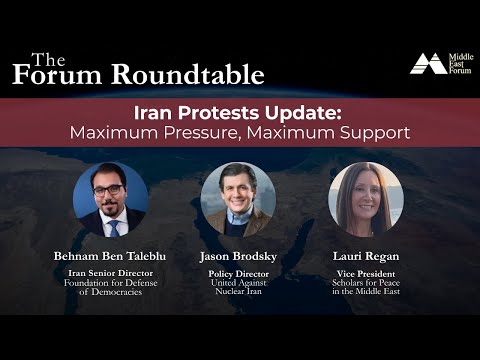
The Forum Roundtable: Iran Protests with Behnam Ben Taleblu and Jason Brodsky
 Watch on YouTube
Description
Iran’s nationwide protests have entered a new phase, and the stakes are rising by the hour. In this Forum Roundtable, host Lauri Regan is joined by Behnam Ben Taleblu (FDD) and Jason Brodsky (UANI) for a hard-nosed discussion of what’s driving the unrest, why this cycle looks different from past waves, and what “maximum support” could actually mean in practice.
The panel breaks down the economic trigger and political “hook” behind the uprising, the regime’s response (including internet shutdowns), and the debate over what U.S. pressure should look like beyond statements: sanctions, cyber operations, communications access, and targeting the repression apparatus. They also examine Israel’s posture after the “12-Day War,” the risks of regional escalation, and how Tehran’s weakened proxy network could reshape the battlefield from Hezbollah to the Houthis. Finally, they explore “the day after” questions: defections, fractures within the security services, and what a post–Islamic Republic transition could plausibly look like.
Share this episode, and subscribe for more MEF Roundtable discussions on the foreign policy and national security issues shaping the moment.
0:00 – Welcome & Overview
1:12 – Why This Protest Cycle Is Different
12:28 – “Maximum Support” Options For Washington
19:05 – Israel’s Role: Now And The Day After
27:35 – The “Day After”: Defections, Transition, Pahlavi Debate
39:47 – Russia & China: Support With Limits
42:15 – Turkey, Ethnic Mobilization, And Regional Power Shifts
48:52 – Proxies Under Stress: Hezbollah, Houthis, Hamas
53:10 – Gulf Overflight/Basing Rumors & Deterrence
57:02 – International Response, Media, And Legitimacy
Transcript Automatic captions
Source: Automatic captions from YouTube, retrieved October 15, 2026. Automatic captions are machine generated and may misspell names and terms; check the video before quoting.
0:09 Good morning and welcome to the Middle East Forum's monthly special podcast series, the forum round table. My name is Lori Regan and I'm privileged to host these important panel discussions with the world's leading experts on critical foreign policy and national security issues of the day. This afternoon, we'll be discussing the Iran protests, including issues pertaining to their success, regime change, US and Israeli involvement, and the impact on the region more broadly. And I couldn't imagine two more brilliant guests to discuss these important issues than Benam Benaloo, Iran program senior director and senior fellow at the Foundation for Defense of Democracies and Jason Brodsky, policy director at the at United Against Nuclear Iran. I do want to thank everybody in the audience for joining today and for your continued support of the work that the Middle East forum is doing. It's your support that allows everyone affiliated with MEF to be so impactful in the development of policy that keeps America and our allies strong and secure. Just a reminder that today's podcast is being recorded and will be available for viewing. So, please do share the recording far and wide as I know this is going to be an insightful and informative discussion.
1:09 Welcome Ben and Jason and thank you so much for joining us today. Thanks for having us. Thank you, Ben. I'm going to start with you and ask you to share with our audience a basic overview of how the current protests are different from prior protests that we've seen over the past two decades. Putting this in historical context as well as what led to the situation and what the goals of the protesters are in the context of reform versus regime change. I I kind of see like a perfect storm here where there's a need for social reform, human rights issues and abuses, um economic collapse and environmental problems like lack of water and electricity that have come together and a conflration that's led to Iranian citizens finally having enough. Can you touch on your perception of what's actually triggered this and what maybe also touch on the demographics of the of the protesters and how that may be significant as well as the um impact of Iranian nationalism on all of this?
2:06 Absolutely. Well, I think you you tied together all the loose ends there perfectly, Lori. First and foremost, thanks for having me. Great question. Always good to be with friends on Middle East forum. Greetings, Jason. Good to see you all. Uh belated happy new year. A lot has happened in 2026. We are now, you know, late into We [clears throat] are now late into week three and past week one, week three of a nationwide anti-regime uprising. And this is again the latest installation of Iran's nationwide anti-regime uprising that we've been seeing fits and starts of booms and busts of since December 2017.
2:41 This latest iteration, this three plus week iteration being brought to you by uh you know an economic crisis particularly the devaluation of the real relative to the US dollar hyperinflation in the Iranian economy that triggered a small protest and a strike uh in parts of Tehran's bazaar among merchants on December 28th, 2025. the contagion effect, the fast ripple that was felt that was felt across various different geographies and demographies in Iran's body politic, university students, Hebrew Unionists, you name it, uh fast amplified this and the hook in despite everybody suffering from hyperinflation in Iran was not a political hook in to uh was not was not an economic hook in to that economic trigger, but it was a political hook because there has been a shared baseline thesis uh among um you know large swats of the Iranian population which I think by no surprise now we can believe to say is strongly anti-regime that the threat to their daily life is not foreign bombs the
3:44 threat to their daily life the impediment uh to their daily success is not western sanctions the impediment uh to living a normal life it's not the Israeli Palestinian issue it is all the Islamic Republic of Iran it is the values views and interests of the hard men the clerical elite the religious elite, the military elite, political elite, the the corrupt kleptocratic business elites of the Islamic Republic. And that's why we've seen boom and bust cycle of protests from December 2017 to present. Each one triggered by different non-political phenomenon because they're done with reform altogether. This has been a story of the Iranian people trying to push past the state, trying to develop a critical mass to push push past the state and unfortunately each time being met with brutal force including harsh military repression as well as a shutdown in cyerspace which we can get into. This time quote unquote it's different because those trend lines that we saw in the past rounds of protests have really been turned up to 11. You saw a widening geographic scope of protest before. You've seen it catch
4:47 on like wildfire. Now all of Iran's 31 provinces have experienced some level of unrest. Different demographies. Yes, you still have the youth and Gen Z, but you also have significant ethnic minority participation particularly with the Kurds and the Beluch in this uh protest as well as of course very different socioeconomic strata. The fact that you could go from truck drivers to trade unionists to university students within 48 hours tells you a lot about the shared nature of this grievance um which actually is a sustained shared grievance and the more the regime used violence the more everyone felt the same baseline hatred and disgust for the regime and that kind of got them to get out.
5:25 Quickly now, drawing a contrast, many believe that 2022 2023, the woman life freedom movement, which you all know was triggered by the killing of a young running Kurdish girl for allegedly improperly wearing her hijab wrong. That uh touched off a 9 10-month nationwide protest that was so violently repressed and was also met with a series of chemical attacks on Iranian school girls that many analytically in the West thought there's no way in hell the Iranian people are going to be brave enough to get out and protest anytime soon. And yet, less than 2, three years later, they did. as a correlary in the west in the diaspora in particular there were attempts to unify and organize at that same time and given the shortcomings and the political drama and the failures to do so people thought well this would have a chilling effect or a deterrent effect on Iranian protesters that clearly is not the case in fact Iranian protesters more than ever before are chanting a name of a particular person the crown prince who was part of that attempt to unify the diaspora back in 2023 fast forward to the 12-day war those same experts who said all of this would have a chilling effect uh on uh Iranian protesters and said that uh Israel and America's
6:28 military strikes would set back Iran's democracy project and set back Iranian protesters failed to see how the grievances of Iranian protesters and the grievances of Iran's democracy movement was targeted towards the regime. And less than 6 months after these same experts told you there would be a rally around the flag. You had Iranians taking out into the streets to burn the regime flag and erect the pre-1979 flag. And the most proximate cause, and I'll stop here, as to why it is different, is because Donald Trump in particular has chosen to make it different. He earned really a pretty fantastical reputation among the Iranian dissident community uh both inside and outside the country. and he is the owner at the end of term one of the uh you could say epithet of the most liked tweet in Persian Twitter history from January 2020 when he wrote a tweet supporting Iranian protest bars and Farsy and given in term one that he torpedoed the conventional wisdom that you can have pressure and sanctions on a regime and actually still covet and build a support base among the population and then at the same time that you can provide political support
7:31 for protesters and that not be a kiss of death. He really rode that well into term two. He talked about being locked and voted. He talked about help being on the way for protesters. So, he significantly raised the expectations of Iranian protesters. Significantly heightened the fears of the Iranian national security elite. And with a regime this bankrupt and with such a track record of failure economically to environmentally around 2025, all eyes really are on the president to see will he put his money where his mouth is, will he really help make it that much more different uh as we get really horrific reports of the violence and the bloodshed because uh unfortunately the numbers are staggering. There is nothing like this in modern Iranian history.
8:10 Anywhere from 12 to 20,000 killed. Thank you, Benam. We're going to get into um some of the the things that the Trump administration can and and will hopefully do uh shortly. But Jason, I want to turn to you. Um given the internet blackout, [clears throat] excuse me, it's impossible to know as as Benam pointed out, we have statistics anywhere from 1,200 to 20,000 citizens being murdered. Um you know, the the streets the numbers are probably much more. There's I'm sure tens of thousands who have been arrested, tortured, um threats of hanging uh after the torturing. Can you spend some time talking about the will of the people to continue the battle given the massive mobilization against the protesters and whether you believe they have the fortitude to keep fighting? I've heard, you know, the little reports we're getting that the numbers on the streets are dwindling. At the same time, we did get very um encouraging reports early on that the protesters were tearing down the Islamic Republic flags and were taking over towns and provinces. Um, so if you could talk about that and also address a post on X from last weekend
9:13 that indicated that the IRGC issued a statement that they'll penalize a mission of action, seemingly indicating that many members aren't necessarily showing up or executing their orders. How how much veracity do you believe uh can be applied to that statement? Well, it's great to be with you, Lori, and thank you for the Middle East Forum for the kind invitation. I agree with Benam's comments. I think that this round of protests is about regime change and not reform and that's really key for people to understand here. Uh I would say that the 1999 and 2009 cycles of protest in Iran were spoken the language of reform uh really but since 2017 onward there have been regime change calls at these protests and I think that's what we're seeing now as they reach a critical uh mass. Uh I I I would say that um the Iranians that I've seen have exhibited great bravery and courage under literal fire. Uh and I don't I think the regime is trying to portray that it has the situation under control, but it really doesn't. And I
10:16 don't think that just because people are not in the streets and the volume maybe that they were um a week ago doesn't necessarily mean that the regime has it under control. uh the drivers and the motivations uh for the protests have not gone away. In fact, they've only worsened. And so uh the regime has no answers for the Iranian people other than bullets. And that the Iranian people understand that. And so we're going to continue to see in my view uh these uh bouts of the demonstrations and protests uh carry on uh because uh the the underlying drivers of uh the current dissatisfaction in Iran are only getting worse by the day and the regime has no answers other than repression. Now your an your question about uh you know the whether the IRGC is going to penalize omission of action. Yeah, I thought that that was very interesting. I think that there have been some signals that the uh US intelligence and our allies and partners have picked up of some uh fissures in the security services
11:19 potentially but not it's unclear about how widespread they are. I also thought it was very interesting that Iran's army Iran has two militaries. One is the Islamic Revolutionary Guard Corps which is gu charged with protecting the revolution and then is Iran Iran is a regular army. Iran's regular army which is not um usually uh uh automatically deployed uh when there is uh occurren demonstrations happening in Iran uh threatened to get involved as well. So I thought that that was interesting and that might feed into the sense that there may be some um uh nerves uh within the ranks of uh some of the guards uh as to uh shooting on their own people. So uh that was very interesting. But make no mistake, the even the conventional army in Iran has um in the past had to suppress protests and there are uh commanders in Iran's conventional army who have been sanctioned for human rights abuses. So uh that that does add to the sense that there may be some uh dissatisfaction within the ranks, but the regime is trying to paper over it and cover it up to as much as they can
12:22 to make it seem like they have the situation under control when they don't. Thank you so much for that, Jason. Um then, um let's go back to the Trump administration. And as is so often the case with the president, one minute it looks like maybe a military attack is imminent and the next minute people are worrying that Trump is ignoring his own red line and he is pulling an Obama. Um I'm personally in the camp that has faith in the president to do the right thing. Although his Wednesday announcement that the killing has stopped was a bit worrisome. what options are available and what would you like to see which I know has been called maximum support but what does that look like and what are the various approaches the administration could take from diplomatic which is more advanced wing of the administration um to kinetic and in the kinetic context what would the target of military attacks look like and what are your thoughts on the Pentagon moving the USS Abraham Lincoln from the South China Sea to the region well let me just begin where I think it is the toughest which is not you know getting into hypotheticals about potential military campaigns, but trying
13:24 to get into the president's head because I think the president has everyone right where he wants them, which is allies and adversaries having to guess as to what is going to be his next move. Uh if past this prologue here, when you do see a slowdown or a downturn in the rhetoric, that's actually potentially when the chances of things going kinetic uh go quite high. I mean, that was the 2025 lesson we should all take away. There was about 4 months of leaks and strategic reports of the administration quarreling or having a tiff with the Israelis all to find out that there was a there was a plan uh from the get-go. Uh one does indeed hope again that there was a plan from the get-go. I would just simply say the stakes of even such a political strategy like to fake someone out or uh to do an about face in the media. The stakes however I would say are much much higher. And the reason is because of that death count. I I I can't tell you how many Iranians felt the wind beneath their wings, felt the injection of optimism that the most powerful person of the most powerful country in the world heard what they were saying
14:28 and was going to stand with them and was going to actually hold the people who were cracking down on them accountable. You know, it is not a, you know, just for the supreme leader and the IRGC to connect the dots between, oh my goodness, Trump is the guy who six years ago, this month, pulled the trigger against Kasamsmani and who 6 months ago took out the crown jewel of the nuclear program. That is an observation for the people as well. They saw that the Ayatollah 6 months ago had no clothes. They saw how the Ayatollah came up short in max pressure 1.0. And so that gave them significant optimism. And I would say here, step number one in terms of policy, do no harm. You know, I think as helpful as the president's statements were, the inability early on to talk about the killings and calling it a stampede, that was a that was a moral and political setback for the United States. You know, when you're invi inviting and injecting such optimism to at the same time have to hedge, I think with respect is is unfortunate. The same of course goes to the tools that should have been in place. An internet shutdown unfortunately and with immense respect is not new. This line that I know Lori,
15:31 you're a friend. Jason, you're a friend. Ladies and gentlemen, friends of MEF, you're friends. You're probably sick and tired of hearing me say this, but this line that I've been saying for the past 3 weeks that the Washington Post says Iran that democracy dies in the darkness. It's not just democracy, it's Iranians dying in the darkness. I have been saying that since November 2019 when the regime first experimented with a multi-day nationwide internet blackout. the fact that we're caught with our pants down again and our option is to surge Starlinks and have to rely on smuggling to get that in there and then also have to work on fortunately now it's free but work on stuff on the back end to make sure it works and still have no credible response ready to go for when the regime does GPS spoofing or jamming basically electronic warfare against the limited Starlink terminals that exist in the country that is I'm sorry that is unacceptable so I absolutely am enthralled with the statements of support from members of Congress I'm enthralled by the NOS's and the nonprofit community and the human rights community talking about, you know, sending Starlink, but that is stuff you do. That is max support stuff
16:33 you do when there aren't thousands dying on the streets. And you all, again, speaking from the heart, you all know me. I'm relatively milded individual. When Iranians are dying in the thousands like this, that is actually when you you intervene in a way that is seen that levels the playing field between the state and the street. And if it is the regime that chooses to escalate, you make sure that they know that they are leading with their chin. So far from me to have to talk about targets, but I'll talk about some things anyway. If the US is going covert and not kinetic, it should have two weeks ago perhaps in conjunction NSA and unit 8200 run the same kind of counter cyber campaign to dismantle the spinal cord of command and control between the regime's repression apparatus from IRGC which includes in the basie the ground forces then of course the the the police vij the special units all the way down to the vigilante groups that command and control needed to he severed two weeks ago. Then once there was talk of the internet blackout, there had to be an
17:37 information operations campaign to make sure that our government messaging and I don't just mean voice of America and and all the things that have been lagging again when there was no conflict. I mean how to get the president's message and perhaps even the opposition's message directly blared into the country. How to target and dismantle IIB be it kinetically or on again on the cyber side. So again, to have the imagery of state media simply no longer being able to spew state propaganda and then perhaps again third going against kinetically or covertly the apparatus of repression and here everyone is talking about oh B2s are not in the air, OB2s are in the air. Oh the carriers are coming. They're not coming. Do we have the standoff weaponry? The US has a robust base infrastructure in the Middle East with many drones that do unmanned com that function as unmanned combat aerial vehicles. The Americans just created a better version of the Shahed or the Israeli Haro. Uh that stuff low inensity. I think we're talking about this stuff the wrong way. It's not a satisfy and stupify like Maveli says like operation with mass violence.
18:38 Imagine a low inensity campaign that could have started earlier that the president doesn't even have to address that is just designed to crash into the apparatus of oppression and tactically help pave the pathway for protester success. And if it escalates, that's the regime opting in to escalate. They have to know they lead with their chin. That is something I think that the president should be seriously considering rather than have to see this as an all or nothing approach. Thank you, Benam. Um very informative. Uh Jason, let's talk about Israel's role um to date in all of this. What Israel's role um can is in real time and also what Israel's role would be possibly in the day after and going forward. So, in the context of what Israel has has done to date, can you share your thoughts on Operation Rising Lion, also known as the 12-day war, and the impact that that may have had on the perception of the Iranian citizenry um in the context of what role Israel is having currently?
19:35 Please provide insights into your thoughts on perhaps is is Mossad um active in in Iran. There was an assassination that took place with the commander of an Iranian missile unit that was killed by a suicide drone that originated from within Iran. So I'm wondering about the MSAD also cyber activities whether Israel could be participating in military interventions. I do know that there was rumors that Netanyahu called Trump on Wednesday and asked him to please hold off on any military intervention at the moment so that Israelis can better prepare. And then finally in terms of the future Israeli role, I saw that you reposted a report on ex citing a senior Israeli security sources saying that quote if Iran attacks there won't be another round. We will act to topple the regime.
20:17 So Jason, there's a lot there, but what are your thoughts on all of this? It's great. Uh, thanks Lori. I'd just like to continue on with some of the points that then um raised. I think that people are concentrating on the military side, and that's absolutely critical. Um the US in my view has to uh follow through on President Trump's red line in order to really show that help is actually on the way to level the playing field and targeting the uh police and the IRGC suppressive apparatus because uh that can level the playing field between the Iranian regime and the Iranian people. But military is only one part of what the US is undertaking at the moment. There is also economic sanctions. We saw a sanctions package that was rolled out yesterday uh that sanctioned the secretary of the Supreme National Security Council Ali Larani who by the way whose daughter resides in the United States. You just can't make it up. Um so uh and then the Treasury Department also mentioned that they are tracking the uh flight of capital outside of Iran. Uh and uh I hope they free try they freeze those funds and
21:20 hold them for in reserve for the Iranian people. So there there are a lot of economic um uh measures that we can take to isolate the regime even further. I think it's long overdue to implement the MASA uh act uh which uh is law now and now Secretary Rubio was the original sponsor for when he was in the Senate and from Florida. So uh that is long overdue to be implemented and that would really impose sanctions on Iran's Supreme Leader and some other top regime officials for human rights abuses and terrorism. that should be implemented. Uh I also think the United States should lead a diplomatic campaign with its U E European allies and partners to isolate the Iranian regime diplomatically. And this is where we have to really work with our European friends because they have a lot of diplomatic exposure to the Islamic Republic that we don't in the United States because we don't have diplomatic relations with Tehran. But Europe can downgrade diplomatic relations across uh the EU block uh as well as the UK. Uh can um uh kick out
22:23 the Iranian ambassador and other Iranian diplomats. Uh they can shutter uh the um centers uh that the regime uses to uh propagandize and radicalize on European soil. Um and our European allies also, I'm sorry to say, they have to get with the program and blacklist the IRGC as a terrorist organization. Canada and Australia have already done so. There is no reason why the EU and the UK um still are unwilling to do so. Now, the UK has historically had this issue between the home of us home office and the foreign office. uh and there's been this this this dispute for years over whether to to blacklist the IRGC despite uh the IRGC plotting terror uh on Europe on UK streets and the EU needs consensus from across the block and there are some countries like Spain which are very problematic and a roadblock uh to uh sanctioning the IRGC as a terrorist organization. So there's that that in terms of diplomatic and economic measures. We also as Penum mentioned cyber operations uh jamming the ability of the Iranian regime to turn off the
23:27 internet targeting their command and control apparatus. Uh so that's in the cyber realm and we also are do we also what we are seeing with the conflicting reports and the volume of reporting from um the US government. I think we are seeing um an information and psychological operation from the US government happening in real time targeting the Iranian regime to um aimed at misdirection lulling them into a false sense of complacency trying to confuse their decision-m as to what President Trump is going to do. And one of the hallmarks of President Trump's approach is unpredictability and we saw that during the 12-day war and I think we may be seeing it now. So that's why you're seeing all these conflicting reports. one day uh we're talking about military action, the next day we're talking about diplomacy and Iran holding uh holding off on executions. So I think that that's what we are seeing here and it is a form of a psychological operation against the Iranian regime.
24:22 Now to your question on Israel u oh and by the way I wanted to mention one more thing that um we didn't discuss. I do believe the justice department should file a federal criminal indictment against Ali Kam as supreme leader and senior Iranian regime officials. Uh, I'm not saying the US is going to capture Kam like they did with Maduro and Venezuela, but I think it would be a symbol and a signal to the Iranian people that we recognize their calls, that he is an illegitimate leader and that would be a very important signal that we make. So, that would be the last um US response that I would counsel.
24:54 Now, on Israel's role, I think Israel is uh taking a back seat here. The US is in the driver's seat uh on the response to the Iranian regime, and that's the way it should be right now, quite frankly. I do not think it is smart for unnamed officials or uh reporting in Israeli media to talk about Mossad presence in Iran at the moment. This is not about Mossad. This is about the Iranian people. And this is the real dissatisfaction on the streets that they have towards this regime. And the spotlight needs to be on them, not on Israel and its capabilities, which are absolutely uh unbelievable. But that is not where our focus should be. Our focus should be on the Iranian people. So I think uh our friends in Israel uh and I have enormous respect for them need to keep it a little more uh down low if you will as to um what or what not or or what or what not uh Assad and Israel's intelligence community may be doing on the ground. Now I think that we are seeing um uh Di Bara who's the head of
25:58 the Mossad uh have a meeting uh I think uh in the United States. He's visiting now uh to speak with US special envoy Steve Whit and potentially other Trump administration officials. So I I have no doubt that Israel is there's a robust intelligence exchange happening daily between the United States and Israel and Israel does have a play a role a role to play here. But uh I think that Israel is playing a supporting role where the United States is really uh uh running uh point on uh this entire uh issue. Israel does have equities here. Uh I think there is a real risk that Iran does lash out at Israel. Let's not forget that during the Masamini protest in 2022, Saudi intelligence and the US detected uh a plot by Iran to uh bomb uh and terror uh plot terror attacks against Saudi Arabia uh and attack them during the Masamini protest because they held Saudi Arabia responsible for those. Now, I think that this is a real risk now as well for Iran to try to deflect what's
27:01 happening on the ground and to try to lash out at Israel. So there is a precedent for this. Uh the US was able to deter that attack on Saudi Arabia. Uh but uh that Israel absolutely needs time to prepare and make sure it is uh all the contingencies and all of their defense arrays are uh ready and ready to go should uh the United States attack and Iran lash out at Israel specifically. Uh so that is a very real risk and I'm sure that that's always part of the conversation right now. Thank you Jason for you covered a lot there. Um [clears throat] Ben, um let's turn to the day after and I I mean by that let's hope that the Islamist clerical regime falls. Um do you have an opinion on just how inevitable that might be? There were rumors about a week ago that uh Kame was planning his exit to Moscow if he didn't feel confident that the regime could survive. I know you have a different view on that. Um, also similarly as as Jason brought up, um, Secretary Bessant uh shared that Iranian senior officials are shipping money out of the country presumably in preparation to flee. If we start with
28:03 the assumption that the regime's collapse is at some point imminent, what are your thoughts on the inevitability of the crown prince resuming the monarchy of his father versus let's say a military dictatorship instituted by the IRGC? And if Palavi returns home, do you see him as a temporary transitional figure or a permanent head of government? Um, you know, what are your thoughts on democracy versus something which you know is an American concept versus what what existed prior to the Islamic Revolution, which was, you know, a pro-western monarchy. Um, and maybe perhaps also if you have time then on touch on the IRGC's control of the basic and important economic and business um and and and why I asked about per perhaps the IRSC uh having a military dictatorship instead of a democracy.
28:54 So there's a lot there. Let me do my best to tie tie the strings together because there's a lot that you know we all as like analysts and Iran watchers are learning about and refining both our analyses and our assumptions about how Iran works and how Iranian politics works in very real time. So, for example, one debate that is constantly being fleshed out right now, given the fact that, okay, there's a national security strait cracking down on unarmed protesters. One question is how far up does that chain of command go? And what kind of regime type is Iran today? Many months after the 12-day war, there's an 86-year-old supreme leader, a title meant to be taken rather literally, but we've only seen him above ground maybe a dozen or so times since the end of the 12-day war. And it's assumed that there is no electronic communication with him and senior staff. So if he is really calling the shots, how plugged in can an 86-year-old on his best day be who's been in a bunker since quite a while?
29:54 And how loyal would those lieutenants be? And if it's not a sultanistic kind of regime, uh then we're having another academic kind of debate about can a group be a leader. We we're assuming right now that the revolutionary guard corps has no factions, has no shades, and is a monolith. Whereas what we've seen is there's a kleptocratic generation that are veterans of the Iran Iraq war that went into the business world. You know, I'm thinking the likes of the Mosen Rafi of the world. There's the part that went into politics and remain in politics like the polybuffs of the world. uh who kind of you know there was a line that he said about two decades ago now he said consider me a Hezbollah type reszosa like when he was mayor of he said this consider me a builder but of the Islamist orientation consider me a capable strongman but of a Islamist orientation then there is the youth where much of the youth who have been involved in the proxy wars and the post 911 you know uh grayzone conflicts of the Middle East uh actually don't have the best impression despite obviously the 12-day war and despite the
30:55 return of President President Trump uh they don't necessarily have the best impression of American resolve and they only have begin to face setbacks in the region um post October 7. So they really have about two decades of experience of actually saying oh we should be pushing the envelope. They have two decades of success up until last minute failure uh in a place like Syria. They believe that America left Iraq and Afghanistan because the Iranians helped push them out. And they believe that they still have options in places like Yemen. So what faction of the guard corps comes to power to do what you said matters just as much as if they can even unite and coordinate to do that at all. One of the most interesting things I have heard and we, you know, I always tell friends at FD this as well. As much as we focus on ideology, you talk to anybody who's come out at any level. I'm talking university students. I'm talking engineers. I'm talking protesters and dissident. I'm talking we know dissenters who worked in the in the government at a in a low-level bureaucratic level in the '9s and 2000s who are now in America. And
31:57 again, that was their image of Iran. And the first thing they tell us is you have no idea how much this is not about ideology and this is about corruption and kleptocratic interest and you guys are missing the boat here when when when you're not focusing on how these guys when they're at the helm they're utility maximizers. It is not uh unaciomatic exactly as Jason was saying that you can have an ideologue like Larijani with a with a daughter in a country that he's calling the great Satan. These are these actually these things go together. Those are the blurry red lights. So in that kind of world that raises options for if you have sustained pressure from above and sustained pressure from below that yes you might in the short to medium-term force cohesion amongst a very diverse factional kind of group.
32:45 But the goal is if you keep going that's how you get the cracks to emerge and that's when that individual selfishness level can permeate to the group level to get them to defect. And that really is the key word here if we're looking to have real power for the street. Real power for the street. One is volume and consistency in terms of numbers and protesters. Two, it is obviously if you're getting a strike or you have, you know, strikes in major revenue generating sectors for the regime that puts an economic component. And the third and the real X factor is the guys with the guns. Islamic Revolution Victory Day in February 11, 1979 was declared victorious on the day that the Artesh, the national military declared neutrality. So it is all about how can you get the guys with the guns on your side, offside, or to be shooting at the other side. And the ability to coordinate will deter will be determined in no small part by how much pressure they face versus how much of an offramp you offer. And this is the stuff that has to be coordinated. And this is
33:47 actually where the crown prince gets very interesting because we'll get to you know monarchy and stuff in a second but this is where actually he gets interesting because he had taken some heat many many years ago for talking about trying to pave a pathway for defections for the security forces. And this is the kind of stuff that can, if you do successfully, can make Iran not look like Iraq and can take real experiences from Argentina, Brazil, uh, South Africa for how do you get the regime and the security forces at the mid level to be reintegrated, rehabilitated and basically turn a chapter rather than open a new chapter on blood lust. So this is this is an interesting thing in both in terms of authoritarian transition academically that we're looking at and in real time to see how can these different groups coordinate. What is the organizational capacity and do they even have the competency to act on behalf of their own interests? Let's say that the IRDC was a monolith in its entirety and they had a keen interest in pushing aside uh the supreme leader and going in the Egypt plus Pakistan model of a military dictatorship with some kind of a
34:49 potential political figurehead could be religious, could be pseudo nationalist, but you basically remain enshrined at the top of the security state generating the revenue from all the corruption and the kleptocracy just like both of those militaries do. This is a real test to see can they even organize to do this? Do they even have the same assessment of the shared interest and is there a competency to do this? Yes, we've seen the IRGC maybe a decade decade and a half ago thwart uh you know uh foreign contracts for an Iranian airport. I think it was with Turkey and they wanted to have their construction workers do it. We've seen in the in the late 90s in response to the reformist protest after the closure of reformist newspaper and at Tehran University uh IRGC officers write letters to the Iranian political league talking about how they would intervene if the political establishment doesn't get a hand on the protest. But the question today is as much as Kam has played musical chairs, as much as some of those folks have died, as much as some of those folks have moved into the background, do the IRGC political elite today who really haven't been briefing
35:52 Kame in person because again those who did aren't really there anymore post 12-day war, can they really organize to do this? And that's why those who talk about military dictatorship, one of the assumptions is that they can be competent, they can organize, that a group can be, these are a heck of a lot of academic assumptions, by the way, that they can organize, that they are more monolithic than factional, and that ultimately ultimately it is going to be unclear if there would be any real substantive change because one of the stories of Iran post Iran Iraq war is that it is the fusion of the clergy and the IRGC. If you're talking about the military entering politics, it's already been there. If you believe the military hasn't been, I got a bridge to sell you with your name on it. So, all of these are amazing assumptions. Now, we finally get to the crown prince's role. One of the most interesting questions people have been asking me since the since these grossing protests started is it going to be democracy versus monarchy? I said to which I've consented consistently before I even entered my view or talk about what the Iranian people want. Do you know that monarchies
36:55 can be democratic? Some of America's best allies are democratic monarchies. Uh I don't mean where it's like an elected succession, but I mean in terms of the political structure is democratic and representative. I'm thinking about the UK, a major five eyes country, NATO country. I'm thinking about Japan. You know, you can have a democ democratic system within a larger monarchic system. And so it's about a constitutional monarchy because the priority is not republic or monarchy. The priority is rule of law. And Iranians have been protesting for over 120 years in Iran for rule of law and popular representation. And that's the real goal. And this is actually why I think Pavli is more impressive and successful than ever before because he's got a track record against a backdrop of 46 47 years of regime failure in Iran. He has a credible brand. It's not just some royalist nostalgia of old people. It is actually a brand that says here's what yesterday looked like. Here's what tomorrow could look like. And it contrasts very sharply with your present peril and your present nightmare. And that's why he's only been increasing in
37:57 terms of popularity. And I think if you ask him, I think he just had a press conference earlier this morning. His pitch is to be a bridge to the other side. How quickly, safely, effectively, and efficiently in an otherwise turbulent process. And we have to be honest, this is the Middle East. It can always get bad. It can always go from bad to worse. But otherwise, how can you quickly, efficiently, and safely get to a post-Islamic Republic future so people can vote for monarchy or republic? But the point is to give people the vote because up until you get to a post-Islamic Republic, you can't have a political leader come from within Iran because they'd be repressed. What you have on the streets, what you have in the jails, what you have in home and house exile, what what you have are revolutionaries. What you have abroad, for better or worse, is political opposition. You have to be able to marry the two, get to a post-Islamic Republic future, have him midwife that, and then have the Iranian people decide. That's when it becomes truly an internal matter, and that's where Uncle Sam can really play a role.
38:54 So Jason, let's turn to Iran's anti-western partners. Where are China and Russia in all of this? Um, we know that Iran is dependent on China with Iranian sanctioned oil being purchased unimpeded by China. So, can you discuss China's role in helping Iran survive? Um, including by providing jamming equipment and surveillance systems, which I understand they're doing. And at what point does China decide to cut its losses versus continuing to help the Mullers survive? And as well, Iran is supplies Russia with with drones and and other military equipment for its war with Ukraine. So, what are your thoughts on that?
39:27 Well, I think that China uh and Russia are definitely partners of Iran. Uh, but their partnerships are limited. Okay. Uh Russia and China are providing political support for Iran. Um they're providing economic support for Iran. They may be selling weapons and other arms or parts uh for um you know Iran's missile program. U but they are not going to go allin to save the Islamic Republic. I think we saw this during the 12-day war and how isolated the Islamic Republic was. Russia didn't come to really the assistance of Iran in a big way. China didn't either. And I think that the you know the no limits partnership uh for uh you know some of these access of autocracies has limits if you will. And uh I think that uh you know Russia and Iran have a strategic partnership agreement but there's no mutual defense clause in that agreement. Uh and so I think that people, this is why when I hear uh hysterical warnings of uh you
40:31 know the if the US undertakes military action against Iran, it's going to result in a world war. No, it won't. Uh and it's a misunderstanding of the limits uh and the interests of Russia and China as it relates to Iran. Russia and China have other interests uh including their relations with Saudi Arabia and the UAE and other Gulf Arab states. So that is going to be balanced as it has traditionally been with its relations with Iran. It uses Iran as an anti-American uh kudel uh in the region to uh counter the Americanled security order. And so uh Russia and China uh are uh definitely helping Iran but the assistance that they have been providing uh has limits. Now I would be very skeptical of Russian offers to mediate between Iran and the United States.
41:20 highly skeptical. How skeptical is Russia wants to save the Iranian regime at at little as little cost as possible. Uh the same goes with Qatar. Uh the same goes with Oman. They want to save the Iranian regime. So if I were a US policy maker, I would be very skeptical of these overtures that are branded as mediation but are really exercises in trying to save the Islamic Republic. And uh that is in direct contravention to the very clear desires of the Iranian people who have been protesting who want the regime gone.
41:55 I'm glad you brought the the uh negotiations up and their attempts to mediate. I that's an important point, Jason. Thank you. Um [clears throat] then um are you concerned about Turkeykey's role in a Middle East no longer intimidated and arguably dominated by Iran and its ring of fire um in the form of its terrorist proxies? We know that when there's a void, it doesn't remain empty for very long. And Erdogan has been working to rebuild the Ottoman Empire in a 21st century Islamic caliphate. So, you know, I I'm I'm worried about Turkey. Also, I saw a rumor on X earlier this week that Iranian um Azarbjani Turkish political groups have issued a joint statement calling on Iran's Turk population to join the protests. Um, and I understand that this is one of Iran's largest ethnic communities, perhaps suggesting that potential ethnic and regional mobilization is occurring. Is this Turkeykey's way of helping to bring down the regime? And as a member of NATO, but not necessarily a friend of Israel, what are the possible scenarios that you see playing out? And does the role have a
42:57 does the US have a role in in preventing, let's say, the replacement of a Shia uh terror supporter with a Sunni terror? Well, certainly I think there's three big constituencies that have a role and have an interest and I'm not going to do it from the perspective of Turkey because obviously they have a role and interest as well, but it's in response to a rising more Islamist, more aggressive Turkey. I would say that's America, Israel, and Iran. So, first with America, America certainly has a desire to achieve the goals put out in the NSS by Trump this year, peace, prosperity, and stability. We have to see who and what forces and who backs those forces are the impediments to peace, prosperity and stability. Where could Turkey play a more constructive role? Where is it already playing a highly destructive role? And one of the challenges with Turkey and one of the challenges with our paradigm and even with my language you saw constructive versus destructive is that it is absolutely possible for them to do something both at the same time. They can walk and chew gum in reverse. They can uh be a country that turns over Iranian agents to the Mossad as has
43:59 happened in the past and thwart an Iranian intelligence plot and they can be the same exact country that is home to the biggest sanctions busting scheme uh in US Iran sanctions history. They can be the same country that hosts so many Iranian refugees, but they can also be the same country that allows the Ministry of Intelligence and the IRGC a free hand to prey upon, pick and kill those refugees. So make no mistake, this is the mosaic of Erdogan's Turkey. And that's why, you know, many years ago, uh, the phrase came up that, you know, Erdogan is master of the U-turn and it's all about for US policy forcing Erdogan into having the lesser hand, forcing him to recognize that he cannot win the contest and that it's in his best interest to do the U-turn. Now, obviously that U-turn gets more complex with Turkeykey's very complex electoral politics, where the MHP is, where the Kurdish issue is, but let that be Erdogan's problem. We don't have to make that our problem. One big goal for Uncle Sam needs to be deconliction and mediation between Turkey and Israel over Syria, particularly visav the Shara government and particularly visav Turkey being a passive or active supporter in
45:04 the regime's ability and intent, Tehran's ability and intent to rehab the axes of resistance. You know, for example, if Tehran used to use the land bridge to get men, money, and munitions across the northern tier of the Middle East to Lebanese Hezbollah, well, then it shouldn't be about getting bags of cash from Iran to Turkey uh into Lebanon either. So, there's a lot that is on the table. I think this is not going to be an issue where you win Turkey over, but it's going to be an issue where America has to very with Israel, knowing full well the role Israel can play here to be able to get Turkey to horse trade, say, "This is your priority. It's going to cost you this. If this is your prior, it's going to cost you this. Meanwhile, this is what we want. And if we don't get that, by the way, more and more and more potential for friction visav the Israelis. Now, to bring in that final third element, which is Iran, if you ever do get a free and democratic Iran, uh, one of the things that we're going to be seeing is that shift that you mentioned, you know, the full not not just the waning of the Shi terrorism, but the full retreat of the Shia terrorism. And that is precisely where a
46:06 different kind of Islamist order could be asserted by Turkey potentially backed stopped by Qatar or some other countries as well. But in this world, what would that different Iran look like? If you have a nationalist Iran first foreign policy, which is precisely what a Turkey would be afraid of, then one of the defining elements would be a Turko Persian competition versus cooperation. And one of the shivs that the Turks are afraid of is actually the Kurdish issue because the Iranians in the past have been able to use that well despite having a Kurdish population of their own. Conversely, Turkey plus Aarabaijan has been increasingly more intent on trying to play a destructive role when it comes to Iran's ethnic composition, national integrity, and territorial unity. I think this kind of stuff as a first generation Iranian-American is actually pretty dangerous, right? You're tearing apart the social fabric of that country. but also worse misreads the situation on the ground because um it's not that this is how Turkey is going to be trying to break apart the regime.
47:06 It's actually that if Turkey knows it has more competition than cooperation in a post-Islamic Republic Iran, the challenge is how is it that Turkeykey's going to be keeping a weakened Islamic Republic of Iran afloat and by potentially doing some nationalist messaging to uh Azeri Iranians. That is one reason why for the first few days uh you know Azeri Iranians were not at the forefront of the protests. Uh now all of that s changed majorly when there was major strikes in the tab bazar and then also in the city of Tabris Iran's most important Azarian majority city ended up going protest as well. So that kind of pushed back on the kind of panturic uh shiv here. But make no mistake if there is a democratic Iran there will be more state competition with Turkey. That's actually why you would need Osiris Accords more than ever before to rebalance it. So yes, we are seeing the waxing and waning of different forms of Islamism. This is something that Uncle Sam cannot be indifferent to. And this is actually where there is a significant Israeli element that can help be a buffer driver or dampener as well. Lots of options, lots of room for
48:08 miscalculation here, but keep your eyes on the Middle East because the politics of the Middle East, as much as there is ideology, is also very medieval European balancing and bandwagon. balancing the bandwagoning. Just look at Saudi Arabia over the past 5 years and this will tell you how volatile uh this region is in terms of its political orientation, who you can and can't make a deal with. So interesting. Thank you, Ben. Uh Jason, I I wanted to also discuss the impact of current events on the Islamic Republic's regional terror networks. Um there are reports that Iraqi and Lebanese militias trained in terror operations have been brought in to help quell the protests. And if accurate, what are those implications on? in particular Hezbollah and Lebanon. I did see a report at the end of last year that stated that sources close to Hezbollah said that a gradual but significant change is taking place in its relationship with Iran and that thrron is in crisis mode pri prioritizing its flow of funds with unconditional support of Hezbollah no longer the case. So, you know, what are the what what are your thoughts on how this is all going to impact the
49:10 everybody from the Houthies and Hamas to Well, I think that what differentiates this round of protests from previous protest cycles is that Iran has been fundamentally weakened in its uh regional power. We have uh Iran's proxy network which is a shell of its former self. uh currently compared to 2022 that proxy network was pretty ascended uh then uh and even after council Solommani uh was uh taken off the field by President Trump in 2020. Iran still had that proxy network intact. Now it does not. Uh the Hamas has been badly badly badly degraded. Hezbollah has been gravely weakened. It's another shell of its former self. The Houthis have been um really punching above their weight and trying to replace in many respects Hezbollah's role within the broader axis of resistance. The Iraqi Shia militias have been quieter uh if you will um you know especially in the context of post
50:13 October 7th massacre in Israel but I think Iran wants to hold those in reserve and to preserve uh that uh network itself. Uh but we have seen reports as you mentioned uh and I think today there was just a report that European intelligence is picking up on Iraqi Shia militias heading to Iran to assist the regime in suppressing protests which is rather uh surprising to me in a way because the Iranian regime has according to some estimates and IRGC forces including besiege members uh to uh you know work and choose from to suppress some of these So, um, that should raise some questions for us. What does this say about dissension in the ranks? I don't have the answer to that, that they have to rely on non-Iranians to contain domestic political uh unrest in Iran. Are they trying to save those forces or are those forces or some some elements expressing uh qualms about shooting at their uh fellow Iranians uh where they have to
51:16 rely instead on Iraqis? So, uh this raises all sorts of questions. There are some analysts who are skeptical of some of this reporting of Iraqi Shia militias heading to Iran and Iran having to rely on Hezbollah to suppress protests. Uh but there have in every um round of protests since two dating back to 2009 really there have been these reports of Iran relying on non-Iranian forces as from its broader proxy network to uh contain uh the uh unrest in the streets. And so, uh, I think that raises just all sorts of questions.
51:52 Thanks, Jason. Small footnote, Lori, something that just came to mind. If we're thinking about Uncle Sam watching and waiting, I mean, this is the stuff that ISR picks up and then you know, undeclared kinetic activity could easily stop. Meaning if you are really doing the Trumpian version of R2P responsibility to protect, this is how you can stop the situation going from bad. I mean it is already worse but stop going from bad to worse which is to not allow the Islamic Republic to import these things. We are sitting watching waiting from the KOAK from multiple bases in the Middle East. This is something that is eminently stoppable.
52:28 If you're seeing Toyota trucks, no offense to Toyota, coming across uh the border uh in mosque, this is something that is eminently stoppable. And it's easier, I would add, it's easier a lift for the US to strike before they get to Iranian soil than So, in these last couple of minutes, I like this conversation. So, let's keep a conversation going in in a in a lightning round uh type of uh discussion. Um what do you both make and anybody please feel free to to chime in um of the reports that the Saudis allegedly refused to allow the US military aircraft to overfly the country um on the way to Iran. Is this accurate?
53:10 And if so, does this go to the Saudis protecting their market position in oil or is there something else a little a little bit different that that is motivated? I wasn't surprised by that report. I saw the same report before the 12-day war. uh and Saudi Arabia is doing this to protect themselves because they feel exposed by Iran and they're concentrating on economic growth and they want to have stability and they don't want to be the recipients of Iranian missiles and drones uh it would after uh if US were to attack and strike Iran over its human rights abuses. So we Saudi Arabia is doing this as an effort to put to protect itself essentially. So I'm not surprised by that uh in any respect. Uh but I think we've seen President Trump act irrespective of these warnings uh from uh our Gulf Arab partners in the past. So I would kind of put that in that context.
54:00 When you speak about warnings from our Gulf Arab partners, what about the um rumors that that uh Qatar has said that we couldn't use their base? Um and and there I mean while the yes and the UK are withdrawing soldiers apparently from the base cutters also said and other nations have said you're not you're not going to launch any attacks on Iran. Is is that accurate? I mean I'm not sure. The the Qataris have said this stuff in the past and quite publicly by the way. This is part of their public diplomacy. This is how they avoid exactly what Jason said which is to avoid any kind of kinetic blowback. And who knows, the Qataris may be even offering up the Allodate base as a place for symbolic retaliation and deescalation on the back end of the potential, you know, live round between uh the Americans and the Iranians or the Israelis and the Iranians. Uh who knows?
54:51 But I mean, ultimately, we've seen these threats from many of the GCC countries before. Some much more public facing, have a much more public diplomacy component, others potentially more serious when it comes to logistics and basing and overflight. Um, but I think in general Iran has unfortunately been able to for the past two decades in the region wield both a knife and a handshake. A knife in the back, a handshake in the front, get many of our traditional GCC partners to hedge closer towards them because the track record of Republicans and Democrats coming to the age of the GCC or seeing things as the GCC see it when it comes to sectarianism, a rising Iran, a very different kind of Syria have not been that great. And so I'm not surprised that out of sheer self-interest, let alone out of ideology that these folks are doing this. But just to go back to Saudi Arabia one second, it's very interesting quote I saw earlier today by uh Congressman Joe Wilson where he said, you know, I'm surprised that Saudi Arabia wouldn't want this kind of thing because ultimately if it leads to a cycle where there's a better Iran, uh that would actually be a net positive.
55:51 And I think this is a message that we need uh to foot stomp. there is positive political change in Iran. Perhaps one day we can get to a region where the two giants, the Sunni side, the Shia side, the Arab side, the Persian side uh can actually race each other not to export extremism but to do more for their citizens. Uh can race each other to be a better partner for Israel, race each other to be a better partner for America. I certainly think that you know there is room for good competition uh between these two sides of the Persian Gulf than bad competition. So I think diplomatically it's imperative for Americans who want to see that change to help our partners see that change and not just take these talking points from any GCC country locked, stocked and loaded, but to push back on it.
56:32 So where do you see the international community in this? Um you know when Israel uh defends itself in a in a war with Hamas after 1,200 Israelis are killed, you know, the streets are on fire with leftists and Islamists protesting and screaming and the UN is issuing anti-Israel resolutions. Um, I know there were hearings that there Masinabad was at the UN yesterday and um, our streets in in the US tend to be pretty quiet. No one is protesting the mass murder of Iranian citizens. What are your thoughts on that? Well, I think uh, there's a tendency of no Jews, no news. Uh, and there's a element of anti-semitism that is very prevalent uh, in the West and I think we have to all acknowledge that. Uh, first of all, that that's first. Secondly, uh I I think that the US has been trying um through the meeting that you cited yesterday at the UN Security Council uh to shine a spotlight on Iran's abuses. I thought that that format with Masinad and Ahmed Bati uh briefing the council and confronting the Iranian delegation to the uh United Nations was quite
57:35 powerful and effective and I think the US should do similar things uh in the future. It's the diplomatic isolation component of the toolkit that the US uh has. Uh but I and I think that the Munich Security Conference made a very good decision that I just heard about today of disinviting the Iranian regime foreign minister from its conference. This is these are very important steps. I don't think that people may say that sounds uh you know uh very uh petty. It's not petty. It's actually important because the Iranian regime likes to um the international legitimacy is very important to the Iranian regime as crazy as that may sound to someone and they're very sensitive about this. So the Munich Security Conference did the right thing and I applaud them for that. Uh but I think there are other steps we could be doing. We should be trying to get Iran out of the human rights council. It plays a leadership role there. That's crazy. Uh there should also be steps, as I said earlier, to downgrade diplomatic ties. Um, also no, if there's no internet connectivity for Iranians,
58:39 there should be no visas. There should also be no interviews for Iranian officials because you have uh the press, Fox News, and others interviewing Iranian regime elites who have internet access while the rest of the country is blacked out. And I think that's an outrage. Why? They needed they have internet access so they could sit there propagandizing and spinning and promoting disinformation to inject into the US domestic policy debate. But Iranians on the streets, ordinary Iranians can't can't speak. So how is that uh some way to support the Iranian people? It's not. It's prioritizing the regime over its people. And so I think our media has a very important role here to play. I can't tell you how annoyed I get when I see um every few months Javad Zarif Basaraki who was another Iranian official uh having a piece in very prestigious western publications say it's a variation of the same piece over and over again recycled ideas that never work and always fail and we just give a
59:43 platform to this regime when it's people are saying they're illegitimate. So, I think we really need to take a concerted effort to uh real close off a lot of these uh pathways that the regime has uh for breathing room. Yeah, Lori, I I think Jason and I need to write an essay in the journal for Imam Hussein University. Now, let's see if the shoe fits neatly on the other foot. [laughter] That's great. That's a great way to end. Just a footnote to to Jason's amazing list. Get the Supreme Leader off of Twitter. Get the Supreme Leader off of any kind of Ryan social media. I mean, at at this point now, we're beyond the point of diminishing returns. If you want to know what this guy is saying, there's a million websites to find it.
1:00:21 Uh we're beyond the point of diminishing returns. No more own goals from the West. Everyone can play their part. I mean, and I want to give a special shout out to the Foreign Ministry of the Netherlands. My god, they've been they've been leading uh the EU uh you know, in terms of the fiery speeches and getting the European Parliament and the presidency to do a lot. Um you know, everybody can play their part. You can't expect a country without a certain core competency or capability to punch above that weight, but you do what you can with what you have. And that's really, I think, what all the international community and the Iranian diaspora and Iranians inside the country uh are asking for.
1:00:55 Thank you both so much for we could continue talking for another hour on the topic. Um, but I I really appreciate you both taking the time. I know how busy you are and uh with media hits and and whatnot and appearances. So again, MEF from everybody at the Middle East forum, I thank you both for joining. I thank everybody in the audience for for joining and listening and please do share this recording forum. Why? Because I think this was a very important and informative discussion. So I wish everybody a wonderful afternoon and thank you both. Thank you. Great to be with you. Thank you.