
Webinar or Talk
"Iran: Diplomacy or War?" with Beni Sabti
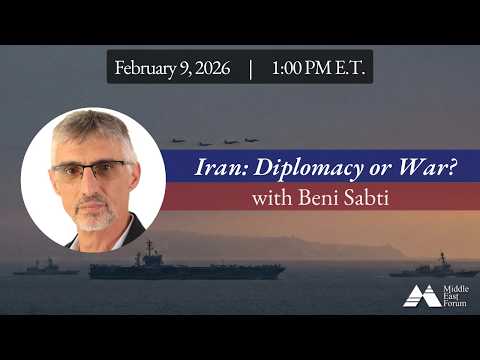 Watch on YouTube
Description
As U.S.–Iran talks resume in Oman, Washington faces a familiar but sharpened dilemma: diplomacy, deterrence, or confrontation.
In this episode of the Middle East Forum Podcast, Lauri Regan speaks with Beni Sabti, an Iran expert at Israel’s Institute for National Security Studies, about the strategic moment confronting the Islamic Republic and the United States. Sabti examines why negotiations narrowly focused on Iran’s nuclear program fail to address the regime’s broader missile development, regional proxy warfare, and internal repression.
He explains how Tehran has misread recent military signals, continuing its destabilizing behavior even after direct confrontation with Israel and the United States. The discussion also explores Iran’s internal unrest, the regime’s violent response to popular protests, and the limits of Western support for the Iranian opposition.
Sabti assesses the prospects for regime change, the risks and constraints facing Israel and the United States, and whether sustained pressure could alter Iran’s trajectory. The episode concludes with an examination of U.S.–Israeli coordination and the strategic uncertainty shaping Washington’s current approach.
Speaker:
Beni Sabti, Iran Expert, Institute for National Security Studies (INSS)
Host:
Lauri Regan, Middle East Forum
🔔 Subscribe for weekly analysis on Middle East security, geopolitics, and U.S. foreign policy.
Transcript Automatic captions
Source: Automatic captions from YouTube, retrieved October 15, 2026. Automatic captions are machine generated and may misspell names and terms; check the video before quoting.
0:09 Good afternoon and welcome to the Middle East Forums weekly podcast. My name is Lauri Rean and on behalf of MEF, I once again thank you all for joining today and your for your continued support of the critically important work that we do. Just want to remind everyone that in addition to today's podcast, please join us on Wednesday at 3 PM for Israel Insider with Alex Suski, as well as on Friday morning at 11:30 a.m. for this month's forum roundt on the Saudi pivot away from the United States and Israel. I'm very happy to be joined this afternoon by the insightful Benny Sati, an Iran expert at the Institute for National Security Studies in Tel Aviv.
0:43 Benny will be discussing Iran diplomacy or war and provide us with an update and his insights on the latest round of negotiations in Oman between the US and Iran and where he sees things headed with the US's armada of military assets in the Middle East in response to Iran's crackdown on its citizens and intrigence on development of nuclear weapons and ballistic missiles. Benny will speak for about 15 minutes followed by 15 minutes of audience questions. Today's podcast is being recorded and will be available for future viewing. So, please do share the link with those in your networks who would be interested in learning more on this important and timely topic.
1:16 Welcome, Benny and thanks so much for joining us this afternoon. I hand the floor over to you. Hi, thank you all and thank you for having me here. I'm very glad and I hope it will be useful and fruitful for you. Yes, we we come to these uh amazing days that we are in very uncertain place and time and and the big question is is US and President Trump going to to attack Iran regime and not Iran the country or the people because they massacred their people and also they bring instability and terror and the missile program and other negative things to all over the world and even to us. So this is the main question that is on the table but it doesn't begin only today or in these last days. The issue with Iran is going on for 47 years exactly right after the victory of of the revolution back in February 79. Actually, we are in the
2:20 middle of the days of the revolution when when it came came through and the regime was was there for a new uh to to take over Iran as a country. The shah the king ran away a few weeks before that of course and since then we have this Islamic regime that the most important thing that it wants is to expand the revolution and it's a very important thing not only for middle east but but it it's for you to understand because they don't want to take only Middle East and its countries they don't in the borders of Syria, of Iraq, of Lebanon, of Israel, of course, of Jordan because once all of these countries was were part of Iranian Empire, they want to bring back the empire. And not only that, they resist other ideologies, especially the ones who believe in rebelism, in democracy, in respecting
3:25 others. And others are first of all the women, the Jews, the minorities, any kind of minorities they resist that. So actually they are in a war with us since 47 years ago. And the first sign was taking US embassy in November 79, a few months after the revolution. Maybe we forgot about them after that because they had their Iran Iraq war and many other challenges. But Iran is back in the in the beginning of 2000s and with much more self-confidence and they resist again the the liberalism the democracy all of the American values or the western values and we come to this place because of that resistance the terror actions of hisbala which is the right hand of Iran outside of Iran. This is an Iranian army. Iran regime army of course outside of Iran against the US troops or US civilians are much worse
4:30 until the ISIS came. They were the first group to to hurt Americans much before ISIS or or Taliban or or 911 or other things. So we have to know that it's it's a common problem and we come to these days when we understand act after October 7th that violence is their way to promote their goals and to bring all their ideology to everywhere. So, Israel stood for itself since October 7 against Hamas that is of course another kind of terror organization that was supported by by Iran and others. They are Sunnis.
5:13 So, it's it's a little bit complicated but also against other groups. So, Israel managed this war for these two years very successfully. But but now Iran comes and threatens the whole world with the missile program and with the nuclear program. And we saw that we Israel and US and also with support of the Middle Eastern countries and European countries. We went to a war in June against Iranian regime. We had a lot of successful steps and we almost even maybe destroyed some of some of them and some of us think that it was going to that place to destroy the whole regime. But it didn't happen for some reasons. There was a ceasefire by President Trump and and other reasons.
6:05 But the problem is that they didn't understand the message of the war and they brought back their missile program and they have almost that original number of the missiles like they they had before the war and of course other issues. They still help and kamas and and bring them money and and other terror organization. They don't stop with the propaganda. This is also another very important issue all over the world. All the demonstrations that you see in the western countries in Paris, in London, in New York, all the issues that happen in your places, it's also because of Iran regime, not only kata. So this is what I mean when I say they didn't understand the message of the war. And because of the war the another thing, another amazing thing happened inside Iran. The Iranian people who suffered this regime for 47 years and especially this in these last years
7:09 with the inflation with the lack of water and electricity and everything that they have the right to have that suddenly they came out. It's it's actually a direct result of Israel, Iran and America war in June. But it took a little bit time, a few months. And you know, in a in the Iranian eye, a few months is nothing. It's like one minute. So it's a direct result of of the war because they saw that their regime is like a a paper tiger. So they had the courage to came to come out, but they are the easier enemy for Iran regime.
7:47 They massacred them. They killed about 30,000 40,000 60,000. Nobody knows the right answer, the right number for for that. And suddenly, President Trump for the first time since the revolution supported the the people. This is a huge thing for the Iranian people. He was the reason that they came out more and more. He promised to come and help them. The help didn't come immediately in the days of the protest and the the people are tired and beaten and killed and they went home. But the energy is still there. If we go to that war and we see all the ships and and all the planes and all the steps to be ready to attack Iran that that are happening that comes through, it's a huge energy for Iranian people. The problem is that American administration suddenly chose the other solution to go again for the negotiations. We are very confused about that. We don't know how that happened.
8:51 Israel is very worried. Actually, prime minister of Israel is coming to to us tomorrow or maybe the day after to ask what happened here because we are very confused about that. But maybe there are things that we don't understand. I don't think that President Trump promises something and doesn't do something about that. I know that he's honest. He's a businessman. He's other things that they say, but I know that he's honest. he keeps his war. So we have to see and wait what can happen between us and Israel, US and Iranian people, US and Iranian regime. We are in a very complicated place but it cannot take much more time. We are really in that boiling point of all these points, all these triangle. So we have to wait and see what can happen. One interesting that I have to say and and the thing that this thing that is happening in the negotiations and you have to really pay
9:54 attention to that Iran says that they are coming to talk only about the nuclear issues and nuclear program but there is no nuclear program today. We bombed it. There is nothing from the Iranian side to bring to the table. So this is one thing that I as an Iranian don't understand it. It's like someone who goes to a store with no money, with no credit card and takes things and goes home and nobody chases him. I don't know. This is the strangest thing that happened today. And I I don't think that US administration and vit of course President Trump and others they are not naive. They are not stupid. I actually had three four minutes of talk with Witkov in a summit a few weeks ago. A long story. He was in Iranian hands for for a few seconds. I think he was afraid a little bit even. But I I let him I let him go after that. I saw that he was
10:57 very afraid. Uh so I asked him and I and I begged him not to give Iran regime more time to be very correct with them and not giving them more time than more than that. And he said yes we know that they they want to bring other tricks and then deceive us and we won't let them. So in this point I don't see how Witkov knows the Iranian regime nature but maybe we can be wiser after a few days or there is something of a surprise or something but today it it looks like very very complicated. Um so this is my words for now and now we can go for questions or any other notes.
11:46 Thank you Benny that was a great overview. appreciate it. And there are a lot of actually really good questions, so I'm going to just dive right into them. Somebody asked, "What effect has and will the funneling of resources and intelligence from the West to the resistance in Iran have on regime change I don't think so. I don't think so because if if we see the results and I can see it only from the results. I don't have any pre-information or something secret. I just see the news just like you. I'm Iranian. I'm Israeli and I combined my values and and Israeli values and this is what I see from the result. We can see that there was this this massacre and if they they had guns and if they had they had information things could be different but I think west is not helping them with with physical things or with information. actually the ones who bring us information about the logistic issues of IRGC where they keep their trucks like ISIS trucks they have
12:50 the same methods you know it's a very strange thing that they are called different groups different terror groups but they have the same method they have the same terror they have the same trucks the same motorcycles every one of them it's it's the same thing and everything began with the Iranian Till 79 we didn't have all of these things and suddenly this Islamic movements came out they are the same but we don't we sometimes hear the Iranians please go bomb this place of trucks of motorcycles the storage of guns or bombs or anything of Iran regime they guide us to the place they have the information and they have they help us I don't think that we help them in in these issues Yeah, interesting. Thank you, Benny. Um, someone else asked, "In the event of a fundamental change in Iran's political system, whether through a managed transition or collapse of the regime, how do you assess the implications for
13:52 the country's territorial integrity? Um, do you see foresee the emergence of um sessionist tendencies among certain ethnic or regional groups? uh is there a shift toward a federal decentralized governance model? What what do you see First of all, and it's also related to the other question, the chances to bring down the regime are very high today. The the people had that they don't want this regime. The regime made a secret poll about four months ago, five months ago after the war, but before the protests.
14:31 It was supposed to be secret, but it was revealed accidentally to the Iranian media and it was out and we saw that 92% of the Iranians hate the regime. Not resist, not unsatisfied, not want to change this issue or that issue to fix the water issue. No, they hate the regime, their values, IRGC, everything that they do. They shouted in the protests, "No to Gaza, no to Lebanon. I live only for Iran." It means that your goals are not my goals. They hate them.
15:06 So they want to bring down the regime and and this is the best time to do that. And what can happen after I know that you hear very much about the minorities in Iran, but they don't want to tear Iran apart. They are more Iranians more than they are Kurdish or Baluchi or Azeris or Arab or other things. They love Iran. They they are actually in the center part of that ancient Iranian empire. They lost a lot of territories. Yes, Iraq was once Iran.
15:39 Syria was once Iran. Usbakistan, Kazakhstan, all these territories of northern part of Iran. Afghanistan was part of Iran. But after a few centuries they they were another nation. They went for to be another countries. But Iran as it as it is today they want to stay together. And they shouted also the their option in this protest. They want to bring the monarchy back. I'm not naive. Okay. Not all of the Iranians are monarchies. Not all of them loved the king or the kingdom and what was there until 79. The king also did very bad things. The father, the son is a much more liberal, more much more than his father was 79. He respects others, the minorities, women, Israel, the Jews, liberal values. So he looks good and kind of the best option for Iran to be
16:42 united around him. Maybe some kind of monarchy in Britain in Britain. This is the thing that they have in mind. He doesn't have to be the head of the country. H and he wants to really bring the democracy back. So uh this is what they know from their past. Nobody taught them real democracy, real freedom. So they want to go back but with more liberal values. The problem with this guy is that he doesn't have any kind of soldiers, any kind of organization inside Iran and it comes from a romantic and nostalgic place. The support for him is not a a real thing, a boots on the ground. It's not like that. So if west could help him with that maybe it was better not bringing guns and information to to to resist but guide them to be more democrats and bringing democracy to Iran. Maybe it was better than guns.
17:43 Thank you for that. Someone asked um whether there is substantial Iranian support for an Israeli attack if there's sanctions and relief and a nuclear agreement with the US. And I'm just going to throw in my opinion there that I don't see the Trump administration that actually withdrew from the JCPOA entering into a new version of that with sanctions relief. But let's assume that some kind of agreement is is met. This person is asking if you see Iranian support for an Israeli attack. First of all, as we say in Israel, the minimum of the demands of President Trump doesn't meet the maximum that the Iran regime wants to give. If they want to give anything, as I said, there is no nuclear program. So, what are what we are talking about? If we are not going to the second step or third step, the terror program and missile program and of course freedom for Iranian people and and human rights. So what we are talking about this is not logic at all. So for what to make an agreement and President
18:51 Trump knows that we assess some of us assess that he wants the legitimacy to attack Iran to be in a maximum place of legitimacy to to attack Iran again. And it's a very amazing thing after 47 years in 6 months attacking Iran to twice almost 6 months. It's a very amazing thing. We didn't imagine it that can happen but even leader of Iran said that I I won't bring war to to your homes and he brought it almost twice. So there is nothing to make an agreement about. I think President Trump is going to to show that to the world, to the Iranian regime, to the Iranian people. H Israel is very very connected to to US administration in that place and and very synchronized and as I said, prime minister is going to to US to talk about that. What are you going to do with the Iranian regime
19:53 and the talks and and to be updated? So, Israel is not going to do something by itself without we cannot we cannot call it in permission. It's not kind of a permission because we are still an independent country. Uh but but being in kind of a in a synchronized place is very important for Israel because we are kind of very close and and like brothers. Israel and and US are really like a twin for each other. one is very big and one is very small. Okay. But but still so we don't assess that Israel can attack Iran or wants to attack Iran if there is no kind of synchronization about that with with us. But we have to wait and see a few days to see what can happen between Trump and BB. Um Benny I'm just going to give the flip side of that. Is there support in Israel for an Israeli military attack on Iran?
20:51 Yes, sure. From the public, you mean? Yeah. Yes. Yes. But but the people very sorry to say that. Okay. People don't understand in these issues in that depth and in the details. So we can make a poll about we have to attack Iran or we have or we cannot attack Iran. Okay. Yes. No. 60% year. It's not it's a kind of a professional thing. It's not a political thing. you know, in in in Israel, maybe the one thing that everyone is agreed about is the Iranian regime issue that it has to be brought down and it's a evil regime and everything. So, it's kind of 100% agree agreement about that, but it's not a public issue at all. It's a professional issue. Where is the nuclear program? All with all that I said. Okay.
21:46 But where it is exactly? Where is the missile program? Where is the terror program, the propaganda program? These are things that people are not involved and it's not about the mood or political Thank you, Benny. If Israel or the US attacks Iran, what would be their target? Um, and is an attack enough to bring down the regime? Well, in these last years, Iran regime became like Hamas. Actually they taught Hamas to be in that way of resistance and surviving and killing their people and and stealing and kidnapping everything came from Iran regime and now they are doing it inside Iraq and they became more and more fanatic about that.
22:31 Now they are in that place. So what one bombing or three bombing it doesn't help to bring down the regime. It should be a kind of war or or I don't know ve a very much bigger than 12 day war. First of all to bring down the regime we have to take out the the leader. He is the glue of the Iranian regime because if we bring him down there is no successor for him. His son is the only one that potentially can be his successor. But all the people and the other clerics and also some of IRGC hate him. So he is not a good option for themselves. And the moment he's gone, there can be a rebellion inside IRGC, inside the army, inside other establishments.
23:24 So if US succeeds to take him out of this equation, there can be a huge change. But what can it go to? We cannot know that from now. But we know for sure that the leader is the is that thing that has to be away to bring him down and to disappear and the day after maybe we can help help that crown prince. Maybe we can help that parts of army that can rebel against the whole regime or or you know what make some agreement with the moderates the more moderate parts of IRGC that want even to rest rescue themselves. They want to save themselves but they they are ready not to hate Israel or or US or it's together actually. So this can be enough for us and for the Iranian people actually the terror program in that moment is gone.
24:21 The missile program is gone. Nuclear program doesn't exist of course. So the leader is the main problem. If US succeeds to do something with him, it's not the same day. So, thank you, Benny. Someone's points out that um you know, Israel, there was a point in time that BB actually asked Trump to not attack because Israel would be on the receiving end of any response by Iran or would very likely be on the receiving end. And now it appears that Israel is militarily and defensively ready for anything that is thrown at it and is switching course. What then? And a lot of people want you to get inside Trump's head. A ton of questions are related to that, but you what do you think is holding the US back at at this point? I mean, Trump doesn't seriously believe that, you know, he's going to come up with it a deal with them. So, what do you think is holding the military back? I'm very sorry. very sorry to say as a part of media don't believe everything that is said to you by the media especially
25:27 when it comes to what Israeli prime minister taught or said to us president there are so many spins so many psychological war in this in these days everywhere and I'm very sorry to say that but this is the way that we made the 12 days war so successful. In that half an hour of the beginning of the war, that night that we eliminated 44 IRGC generals or highranked officers and 18 nuclear scientists which two of them were the responsible and the scientists of how [snorts] to make the nuclear bomb and when they are not here the world is safer. This is the reason actually that there is no nuclear program because the people are also not here. They had the knowledge with them and they are not here. This is maybe the thing that they want. BB says yes we are
26:30 defenseless. Let's wait. Let's this let's that. We didn't buy it inside Israel. Every five minutes we have another news about what BB said, what BB thought. Iran is a very good issue to make spins. It's kind of a very exciting thing. It's like a very nice movie of Arnold Schwarzenegger and Rambo and and all those things that maybe you saw. I'm in that old. So these are my heroes. Okay, don't judge me please. So maybe there are new ones. I don't know. So they are making that thing that scenes because they want to h catch Iran regime again not prepared. So take it with a grain of salt. Everything that comes out, especially from Israel, take it a little bit more with cautious.
27:24 Very good advice, Benny. And on that note, unfortunately, we have run out of time and there's still some questions that we didn't get to, but uh you covered a lot of ground and really appreciate you taking the time to to join us this afternoon. Thank you to everybody in the audience. And again a reminder to join us on Wednesday for in Israel Insider with Alex Selski and on Friday at 11:30 a.m. for our round table discussion on Saudi Arabia. Again, thank you all. Thank you, Benny. Much Thank you very much.