
Webinar or Talk
“October 7: The Wars Over Words and Deeds” with Asaf Romirowsky
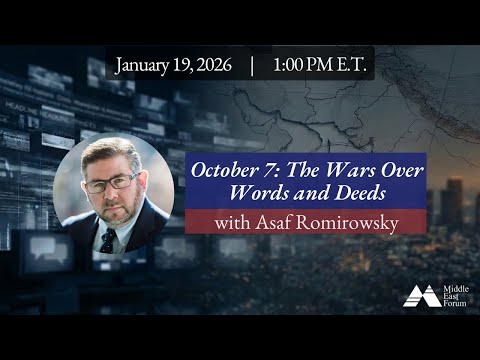 Watch on YouTube
Description
In this episode of the Middle East Forum’s weekly podcast series, host Lauri Regan is joined by Asaf Romirowsky, executive director of Scholars for Peace in the Middle East and the Association for the Study of the Middle East and Africa.
Romirowsky discusses October 7: The Wars Over Words and Deeds, a new edited volume examining the geopolitical, cultural, and academic consequences of Hamas’s October 7 atrocities. Drawing on contributions from leading scholars, the book explores how Islamist narratives, disinformation, and ideological activism have reshaped discourse in Western institutions — particularly on American college campuses.
The conversation focuses on the failure of academic rigor in Middle East studies, the role of foreign funding and activist networks in higher education, and what Romirowsky describes as the “political economy of antisemitism.” He also addresses the post-October 7 surge in campus radicalization, the convergence of extremist ideologies, and the broader implications for American democratic institutions.
Subscribe to the Middle East Forum for more expert discussions and analysis.
Transcript Automatic captions
Source: Automatic captions from YouTube, retrieved October 15, 2026. Automatic captions are machine generated and may misspell names and terms; check the video before quoting.
0:09 Good afternoon and welcome to the Middle East Forums weekly podcast series. My name is Lori Regan and on behalf of MEF, I want to thank you all for joining today and for your continued support of the critically important work that we do. We are joined this afternoon by my friend and colleague Assaf Roarowski, executive director of scholars for peace in the Middle East and of the Association for the Study of the Middle East and Africa. This afternoon, Assaf will be discussing his new book that he co-edited with SPMA board member Donna Divine entitled October 7th, the wars over words and deeds, examining the impact of Kamas's October 7th atrocities on geopolitics, media, and the landscape of higher education. Assaf will speak for about 15 minutes followed by a 15-minute Q&A session. So, if you'd like to ask a question, please feel free to use the Q&A or chat function at the bottom of your screens to enter your submission and we'll do our best to get to as many of your questions as possible. Please do limit your submissions to questions only. Today's podcast is being recorded and will be available for future viewing. So, please do share the link with those in your networks who would be interested in learning more on this timely topic.
1:11 Welcome, Assaf, and thanks so much for joining us this afternoon. I hand the floor the floor over to you. Thank you. Pleasure to be here and appreciate the hospitality. So, as Lori said, this is uh I'll be discussing my latest book that came out October 7th. And this is a project that we took on literally uh a few months after October 7th to try to dissect the reality and how really how everything the the reality on the ground reverberated uh not only inside higher education and culturally but also looking at the understanding of Israeli society but in particular a lot of the institutions and how all of this was basically came to um I would say highlighting the failures that we saw on 107 and the reactions to them at large. In particular, I would say my my focus in this book was really to kind of understand how in particular institutions like higher education, which I I deal I live and breathe in with with both of the groups that I had as Mia and as PME really there was a
2:15 they they esphyxiated the entire use of knowledge in general and understanding of the reality on the ground really highlighting the gap between the perceived reality on American college campuses and the reality in the Middle East at large. uh and what we did and when you look at you know many of the scholars that we gathered here together part of this was an attempt to I would say reclaim the language of the Arab-Israeli conflict try to understand exactly the essence of the Islamist narrative that Hamas and Iranian proxies have been using to arandise their agenda and how they use it within within the foundation building to lead leading up to 107 and really more important importantly which I think is a critical aspect where I did a much deeper dive in the book itself into what I call the political economics of anti-semitism and that is to say really who has allowed and who has funded this entire architecture that has thrived on
3:18 American college campuses when you look historically uh and really at how 107 came about you're looking at several battlefronts one of course is the war on the ground in Gaza which of course we're still dealing with today. Uh notwithstanding where things are moving politically going, there is still uh there's still there's still Gaza to deal with and it's still unclear what Gaza is going to look like. Hamas is still there. There is the multiffront war with Iran related to of course all the proxies in the region that played out. But a front that was lost to my mind on Israel was really the front uh in the United States and in Europe. But in particular when you come to the United States, I would argue how the Islamist narrative was able to layer itself and to basically hijack American democratic institutions that turn to nar the narrative on its head. And for that I know I have focused a great deal on higher education. None of this none of 107 came about in a vacuum. And what was needed to allow this to happen and this
4:21 was really part of a clear agenda was how do you win the hearts and minds of the west and how do you win the hearts and minds of Americans to sanitize Islamism on within their institutions. It's not a secret. The PLO already back in the 1960s came to the conclusion maybe they won't be able to defeat Israel militarily, but they can win the hearts and minds through agents of soft power and that has been through academia. It's also no surprise that when you look at the the history of all of this that um one of the first meetings uh that we know about regarding Hamas happened here in Philadelphia back in 1993. It's historically not as you know if you connect the dots uh it's important to note that of course 1993 the meeting took place in Philadelphia because as a counter to the Oslo peace accords so if you connect the dots even further Hamas sets up shop in Gaza in ' 87 by 1993 they're already in Philadelphia raising money and so part of that understanding was and what was
5:25 ignored uh unfortunately was the use of charities And really and the use of monies that were used to launder money and how those charities were connected to higher education that basically lent itself to the laundering of these monies that allowed them to continuously buy and establish chairs and departments especially in Middle East studies in these very institutions. That is not a new thing. We started to see already the hijacking of the academy and the purchasing of chairs and departments with the clear agenda that if one buys a chair or department, one buys the politics in which these topics are being taught. That has already been taking place uh already since the 1960s. But there saw there was an acceleration of the movement where you start in the 60s you started to see Saudi money coming in but later on obviously we saw other stakeholders who are buying all the way to the billions and billions of dollars that the Qataris have now invested today
6:27 in higher education including not only higher education but also K through 12 and with the idea of layering and sanitizing the Islamist agenda on American society. There was also a convergence ideologically speaking when you talk what I talk about the red green and brown alliance. So you have basically the greens Hamas, you have the socialists as far as the red and you have the Nazis all coming together on the greater hatred towards Jews and Israelis and and Zionism at large. No matter what if even if they have their own supposed differences ideologically, what binds them together is the greater hatred to come together and work together. So if you look as a case study, which is what we did within the political economics of this anti-semitism, for example, who funded a lot of the encampments on American college campuses, you saw the left and the right all coming together to fund a lot of this activity. Money's coming in from groups like Soros, money is coming in from groups like CARE, money's coming
7:30 in from other, you know, PE, for example, groups that uh were involved in Occupy Wall Street, the Women's March. there was a plethora of groups that all came together in order to project this higher uh hatred um towards the state of Israel. What was different I mean and I think this is also part of the the enormity of the problem itself is the fact that even if you compare the reality of post 107 to what happened after 9/11 was the pride and zeal that we saw within the ranks of professors in higher education who were parading around how proud and accelerated how awesome uh how wonderful the actions of 107 was and how they for walking around with pride and zeal supporting Hamas and ISIS and others with the idea of basically sanitizing and normalizing terrorism within the academic ranks as a way to say that this is okay.
8:30 Furthermore, the most I would say common place, the paradigm that is used to describe the Arab-Israeli conflict and in particular the Israeli Palestinian dynamic is within this understanding of a white settler colonial movement. And if indeed Israel, which it's not, a white settler colonial movement at large, this action i.e. 107 is thereby it is justified. So as a result of all of that and and as and know adding to the layer of the binary element of how Jews and Zionists are seen as the victim victimizer mentality as a fact the colonial colonializer mentality when this binary perspective that allowed the students on campus and the faculty for that matter to make it more digestible to make it more explainable and to understand the fact that this evil hate and you know the fact that Jews are, you know, are easy enough to hate because of, you know, what they are defined to be in a very
9:32 binary way makes gave no room for any kind of explanation about this reality. So when you when you when you go back to what we did with the book itself, we collected scholars who actually looked at these different aspects. Hamas. I looked at the reality of of Gaza when it cames to the lying, their grandizing, as far as numbers, as far as the accusations of genocide and apartheid. I mean, we looked at a large swatch of all the elements that allowed the foundation that basically were the building blocks for selling 107 as a binary understanding. Which means, and I know to my mind is that higher education basically decided to forgo any kind of inquisitive research into the reality underground, understanding scholarship, learning the languages, learning the ideologies, learning the people, learning exactly what led to all this to happen, and immediately bought into a propagandish narrative that had a
10:37 predetermined understanding. It was very binary. Nobody discussed any of this stuff. Everybody bought into the narrative hook, line and sinker without looking into the larger map that took place here. And it is critical to understand which I think is also part of the blinders that existed on the state of Israel is that there was a hypers sensitive focus on the threats on the ground which again very real and and and indeed uh are major threats but ignored the threats that happened on American college campuses that allowed Hamas to thrive. The fact that groups like SJP, Student for Justice in Palestine, which are a sponsor group of the American Muslims for Palestine, had toolkits already on October and October 10th, how to activate, how to mobilize the fact that we know today factually speaking that you had connections between those hostage in between the host between the hostage takers and the students on the
11:41 ground at Columbia University. The fact that you had leaders of Hamas and themselves who went on Al Jazzer and other Hamas outlets thanking their brethren and colleagues on American college campuses that for some reason was lost on the state of Israel in the way they were trying to dissect the intelligence as far as what was happening, how they allowed Hamas to basically thrive on an American college campus and to basically hijack all of this entire architecture and turn the reality on its head, positioning the fact that everything that happens in Israel is somehow every and every American Jew is basically a microcosm of that and again all tying into the victimology uh you know and you know and trying and showing the aggression that played out here is the fact that this is all justified thereby they too like the victims of 107 are indeed legitimate victims and a legit legitimate target sorry and are allowed to be targeted on
12:43 every American college campus. And so the flip side of this narrative is that again that no matter what happened on 107, the Palestinians are and Hamas for that matter are indeed um they are the eternal victims of this reality and the the you know and and the real aggressors of this this challenge was of course the state of Israel. What you see today, interestingly enough, the book uh our book came out uh now in in November is that you know now that we're almost you know you know even even though we are you know a significant amount of time almost you know as far as the war itself that's been going on for almost two and a half years now is what you still you know what you're seeing today is you're seeing a growth of denialism of the reality of 107 and that deniialism has been codified by our very institutions and continues to to to manifest through every aspect in local in local politics as well as as also as far as international politics. But still
13:47 academia is still ground zero for a lot of this and allows us to grow and metastasize. And what we're trying to do here is really, I think, hold these very institutions accountable to what they're supposed to be doing and to actually bring back, reclaim the language, uh, and to actually deal with facts on the ground and with scholarship, but to actually understand where the ideologies are coming from and not allow this to thrive and metastasize in a way where we have no control over the product that we are producing. And I think that that's really a concern for all of us to be carefully looking at as far as trying to understand what reform in higher education looks like. How do we fix these elements, but to also understand the nature and the origins of where all this is coming from? Um, threw out a lot out there, Lori, but let me, you know, and and I'm happy to dissect as much as you want. Uh, but I think that that's a pretty kind of solid overview of of what the project was about and how we got No, that was that was terrific, Assaf.
14:47 Thank you for that. Um I I'm going to take the liberty of asking the the first question and I want to quote you from an article in the algam miner that that discussed the book and you said we saw constantly a der of information and the promotion of fallacies on campus a kind of rapid fire of lies and disinformation. We felt that we needed to actually look at the question of Israel and the Middle East from a rigorous academic standpoint. So Assaf to me the obvious question here is and you touched on this is you know shouldn't all studies in the academy whether K through 12 or the university level shouldn't they all be rigorous and you know I want to ask how we got here but to me the more and and you again you touched on that also to me the more important question and the goal of this book was what can we do about it now that we are here um what are your thoughts on people like Bill Aman you know I would say in October 8th Jew who has um his his philanthropy on university campuses has been greatly impacted by the behavior of students, faculty, and administrators on campuses that he supported. We've got Trump
15:50 pulling federal funds and trying to negotiate with campuses to bring a rigorous academic curricula back. What are your thoughts on on these steps and the impact that they could have? So again, tackling both of your questions, I mean 100%. First of all, all disciplines should have rigor to them. I mean, the fact of the matter is I would argue that we've lost that. I focused on Middle East studies. I come out of Middle East studies, they've been kind of the lowest hanging fruit, but I would say that Middle East studies in general is a microcosm for the academy at large. We've lost rigor. We have allowed scholar activists to take over the campuses basically that the metrics of their so-called scholarship is based on their activism rather than producing scholarship. I mean case in point all you have to do is look at the case study of Claudine Gay uh now the disgraced you know former president of Harvard uh talking about plagiarism. There were professors who came out right after they discovered what took place there is the fact that an average Harvard professor
16:52 used to produce more a year than what she produced her entire career. I mean, so the question of the rigor and scholarship and again this is an interesting point that you raised here and this is something that we also brought up when uh if you look at what happened the reactions to 107 on the campuses and all the encampments that were happening when all of this was happening you saw all the presidents speak out and trying to like deal with the situation on their campuses. Interestingly enough not one single president said go back and learn. I mean, you know, it was shocking. The fact of the matter is that the entire we we use higher education is still a meritocracy of American society and we we we we know if you know the problem that I'm seeing today and we've observed Donna and I and many of the other contributors of the book is that there's been a great focus on feeling. You know, how we feel and you know we're trying to make people feel comfortable in the classroom and whatnot. It's not about feeling. And the fact of the matter is if I as a a lecture, as a professor, make you feel uncomfortable. Good. Maybe
17:56 you'll learn something. The idea is not to cajul one's thought. It's to make you learn how to think, how to have, you know, going back to inquisitive thinking, inquisitive research, but try to do the work. And if it makes you feel uncomfortable, you don't like it, that's okay. But go do work and learn. I mean, we are in an environment of infotainment where we're feeding kids. you know we have now to deal with the elements of AI we have to deal with you know everything is spoonfed I mean so libraries are a dying business nobody's reading anything we actually have to go and go back to basics which on a positive side you are seeing a beginning now as far as kind of like where there's a little positivity of a change of trying to go back to common core to go back to civics there's a there's a there's a growth now of civic centers happening on American college campuses you know you people used to go and study when you and I were on campus, Lori. You know, there was discussions about western civilization talking about these elements of how you talk about there is that that is no
18:58 longer part of the curriculum and many of these campuses. So I think that you know we talk about rigor we also talk about what is the product that universities are actually producing and I think that that is clearly something we need to talk about. Remind me your next question your your your second part of your question. Uh so I don't you know Well, it was more about what the Trump the the Trump policies and right right the policies right the policies and really the wake up of the donors so positively yes I mean and Bill Aman is not the only one there was finally of a waking up of what exactly the academy is producing and you know I say this tongue and cheek and I've said this for years that we may have bought the buildings the opposition has bought the education from a costbenefit analysis they've done a clearly a much better job and the fact of the matter is that and none of these topics are debated. They are seen as gospel. They are seen as binary. As I said, they've they they've narrowed them down to a very black and white narrative and they're not being discussed in in the
20:00 larger community. We pride ourselves Jewish community for sure about diversity of opinions and trying to talk about X Y and Z opinions. But the fact of the matter is that our diversity in that regard when it comes to Israel and the Middle East has come back to bite us because you know there there are 15 million opinions on these issues and of course we've also raised not to mention a very healthy fifth column within the Jewish community that is also has bought into the Palestinian narrative. So, for some reason, you know, one's uh one's Jewish belief is based on one's pro Palestinian activism in some twisted way, which by the way, we've devoted an entire chapter to that topic as well, where we h we dissected an environment where you had Jews who came to Jewish high holidays and instead of coming wearing a Jewish prayer shaw, came with kafas, the synagogue on Yom Kipur, again talking about JVP and and one of the far progressive left organization. So again, we've spoken about many of these phenomenas in the book itself. So it is
21:04 good that there is a spotlight. I mean the the hearings on Capitol Hill and what and and what and what Trump is currently doing is positive. That being said, um there's going I mean there's a lot of push and pull. Uh what you are seeing now is that you know case in point a place like Colombia so there's an attempt to try to uh figure out a way to work with the federal government. And so for example, Colombia paid I think between 220 $250 million as kind of a a small fine, but that was petty money because let's put it into context. They get close to 1.3 1.4 billion in federal grants. And so again, as far as the uh the ratio between the amount of money you're going to pay to work with the federal government, there has to be some kind of working together if these institutions are going to succeed. Um you know, Harvard is still playing the game. Harvard has an endowment of a small European country and they think that they're going to be able to ride the wave though of late I think you know too little too late Alan Garber the current president is now coming out
22:07 saying that there has been anti-semitism history but again they are not openly saying they're willing to work with Trump uh and and the Trump government and they're trying to see can they ride the wave until the next elections but it's not a sustainable environment and I think that people are waking up that parents and grandparents are paying paying 90 70 to $90,000 a year and the question is is a what are they buying for that? And more importantly, is my kids safe on campus? And I would argue it's not only kids, it's faculty, you know, faculty who have sympathetic views to Israel and the Middle East are targets. They have created a toxic, hostile environment for individuals. I mean in both of the groups as Mia and SPME that I head you know and you Lori that you're involved in we hear stories daily of professors who are being targeted by their peers not invited to faculty parties there have been violence there have been you know physical attacks on them there has been verbal attacks on them you know there is a is a legitimate threat to actually talking
23:10 about these issues and actually openly you know with with you know and if you do you take a significant risk of being targeted not only by your peers but also by the students who you teach and so you know so I think it's good that you know donors are taking away money or trying to figure out what exactly is happening uh but we also have to look at the long-term reform in higher education and what that looks like and that's that's a bigger question that needs to be put out there to kind of clean uh the institutions so they can do what they're supposed to be do what they were intended to do for that matter uh thanks someone asked um brings up a great point and they and they asked is it not fair to say that the craziness on US college campuses is more a problem for the US than it is for Israel and I think that's a really important point because what's also being taught um is not just you know anti-Israel animist but it's anti-western um these kids hate America so what are your thoughts on Assaf 100% I mean so first of all you know it's it's a good it's a very good
24:12 point the ideology is 100% correlated it's anti-American it's anti-western it's anti-semitic uh it's all together. Uh I mean again similar to how Iran describes you know the relationship between the US and Israel or Islamist narratives that America is the large say and Israel is a small say in that satanic connection that is a greater hatred. That's exactly what I was referring to as far as the convergence of the uh red green and brown alliance. All these ideologies are coming together because they themselves are anti-American. And so it's interesting, you know, the people's forum and what's happening currently now in New York, uh, they're all funded, you know, there is CCP money, there's Russian money, none of these are beacons of American western society who care about that. The opposite is true. What they're trying to do is use American institutions, go basically turn American democracy on its head. And but what I think is critical to understand as far as and this may not be part of the question but is worthy of note why it's also a battlefront for the Israelis I mean you know many of our own
25:16 members as Mia members and SP members and our Israeli members they come to the US they've come to the US to for research projects to exchange uh to do work with their peers and things like that there is been a shutdown of those kind of relationships they're being boycotted it's it's becoming more and more problematic to publish in American publishing houses, academic publishing houses because of the bias. It's becoming harder and harder to get positions in some of these places. And so there is on the one hand a growth of trying to make sure that the rigor continues and that we see more um more exchange of ideas. That's a lot of the work that we're trying to do is create more of those relationship peer-to-peer uh and to maintain those relationship.
25:59 But there are challenges the places you know where there are hostile places that Israelis are not welcome because of the environment. And I think that that's uh again that is counter and anathema really to what the goal of academia has been an exchange of ideas research work together. Uh that's one of the basic tenets of the academy. Uh and if you don't have that and you're basically prejudge based on facious information what does that mean to you? I mean the fact and American academics who support boycott and anti-semitism who are refusing to go look at facts on the ground refusing to go look at archives inside of Israel because they want to boycott Israel. So it cuts both ways but they are they come in with with with blinders and a predetermined reality without looking looking at facts and we need to change that.
26:51 Thanks Assaf. Somebody asked um is Pam Bondi investigating the ties between Hamas on US colleges and Hamas in Gaza? And I think in this context maybe you want to touch on um the boy case and the impact that that might have on disclosing some um Hamas connections. So there there is active investigation going on uh you know uh you know about ties to Hamas uh within within many of these uh student groups namely SJP and AM the American Muslims for Palestine which is a sponsor of the SJP. Um there is uh currently a a litigation going on that has now been going on literally uh David Boy uh was killed back in 1996. is actually the 30th anniversary of his death uh this year. Uh and the same perpetrators that were involved in that lawsuit uh that go back to the Hyland Foundation case. Um what happened after 9/11 is the kind of you know synopsis of
27:54 what happened up until 911. Uh American foreign policy went over went went after uh state sponsored terrorism. Uh after 9/11 Bush changed the legislation. you could start going after the charities. And what we discovered within a lot of the litig litigation that's going out there is that some of these groups were literally funneling money towards Hamas uh and um and and and use these groups on college campuses at large uh to sell their agenda. Uh and uh AM which is an outgrowth of a group that was called IAP that no longer exists. uh you know they basically um changed their name and started working and doing the same thing and there's currently a unpaid uh judgment that is now being worked on trying to re you know to go after those same groups and try to tackle these elements as they play out in their new formulation under these new groups on on American college campuses. It's also important to you know as a anecdotal point I would ar it's also worthy of
28:56 note that the person uh the individual who called the kill on David Bo was no other than Salah Haruri. Salah Haruri was one of the number one three leaders of Hamas and was the individual that uh was meeting with Hassan Nrella uh you know pictures you know at the beginning you know right after 107 and leading up to all of this later on was taken out by the Israelis. That's how high up it went as far as the connection of individuals and and as you and I know Lori I mean pay to slay and the use use of terrorism has been uh a tool of Hamas of the Palestinian Authority uh and they use it as a very as very critical tool. what has been what what is you know what has been allowed to happen here is that victims of terror uh and this is really this the case you're referring to is really about the enforcement of the anti-terrorism act the ATA is the fact that now you know there's been an opening to actually go after uh these groups legally wise and I think those are those are critical precedents that can take place here and can have a
29:58 reverberating effect on the funding so to your earlier question you know to my mind reform in higher education as it relates to all this is also doing background checks on who's coming to campus and affiliations. So if Muslim Brotherhood groups which are now being discussed whether or not they're going to be designated now that to uh to date only the in only they've been designated only in their local countries I would like to see designation here in the United States. So if groups like care, SJP, AM are designated as FTO's then you could also have clear red lines when it comes to faculty and to students about you know applying for campuses. Do you have you ever had affiliation with these groups and that would be a very clear line that is being crossed and that's also part of the larger goal of some of these lawsuits that are currently happening. So um unfortunately we have run out of time. Assaf we could continue talking about this for another hour or so but um we unfortunately have to end.
30:58 I thank you so much for joining us. I thank everybody in the audience for joining us. Again this is recorded so please do share far and wide and Assaf thanks million. I too have booked it. Have a good