
Webinar or Talk
"The Druze and their Prospects in Syria" with Ahmad Sharawi
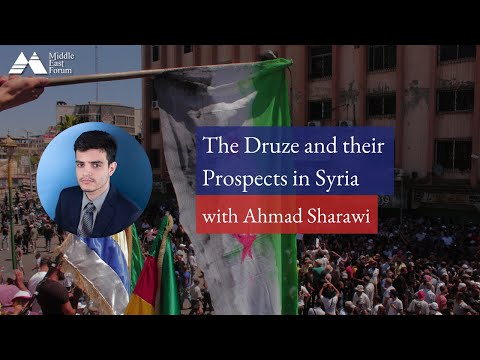 Watch on YouTube
Description
The Druze of southern Syria, long known for their pragmatism, now face an uncertain future as the country’s landscape fractures. Caught between Islamist factions, Iranian-backed militias, and shifting Western interests, they are increasingly vulnerable to sectarian violence. On two occasions since the fall of the Assad regime, the community has faced attacks from forces associated with the new authorities in Damascus. Many lives have been lost. What path forward remains for this small but resilient community, and what do their choices mean for the balance of power in the Levant?
Ahmad Sharawi is a research analyst at the Foundation for Defense of Democracies, focusing on Middle East affairs, specifically the Levant, Iraq, and Iranian intervention in Arab affairs, as well as U.S. foreign policy toward the region. Previously, Sharawi worked at the Washington Institute for Near East Policy, where he focused mainly on Hezbollah. He holds a B.A. in international relations from King’s College London and an M.A. from Georgetown University’s School of Foreign Service.
Transcript Automatic captions
Source: Automatic captions from YouTube, retrieved October 16, 2026. Automatic captions are machine generated and may misspell names and terms; check the video before quoting.
0:10 All right. Hello, good afternoon and welcome to the Middle East Forums weekly podcast series. My name is Anav Kalam and I will be moderating today's discussion. We are pleased to be joined today by Ahmad Sharawi who is a research analyst at the foundation for defense of democracies who joins us today to discuss the topic of the Drews and their prospects in Syria. Mr. Sharawi will speak for about 15 minutes followed by a 15-minute Q&A session from the audience. And if you'd like to ask a question, please feel free to use the Q&A box or use the chat window. And with that, I will turn the discussion over to Mr.
0:49 Ahmed Sharawi. Uh, first of all, thank you for hosting me. Thank you for the Thank you to the Middle East forum for hosting me on this very timely topic. Um, I'm very excited to share my thoughts on the Syrian Drews community, their future, and uh, what's been going on for the past 10 months. Uh, first of all, let me get started and define who the Drews are. Um, so the Drews is a is an is an ethnoreigious minority um that is primarily concentrated in the Levant region. Uh that's Lebanon, Jordan, uh Israel and Syria. Um where they where they originated from um they're an offshoot of Shia Islam uh at around uh the year um they closed the door for conversion um and they moved to the Levant right after that. Um they're a distinct minority. Um some of them claim uh to be adherent of Islam, some of them don't.
1:48 Um that's another topic that we will discuss that I will discuss f uh further in the during the conversation. Um but they've they've they've played an essential role in the nation building in uh in all all especially uh in Israel, Lebanon, and Syria. Um there's a very small community that is in Jordan. It's around 32,000 concentrated in northeast Jordan, but the majority are in uh are in Syria. There's around 700,000 um concentrated in three or four different uh a small a small group that is concentrated in the Idlib region that is the area that was controlled by Hayatam the former jihadist coalition um that is that was run by Syria's current interim president Ahmed uh there's a community in the reef demos region that's south of Damascus uh on the outskirts of Damascus um there's a minority or a community in uh the Konra province uh which borders the Golden
2:51 Heights and the majority of the Drew population inhabits the southern province of Sueda and it is the only province in Syria that has a Drew majority uh which of course is in southern Syria borders the Dah province as well as uh Jordan. Uh in Lebanon, of course, there's also a community there that is mainly concentrated in central Lebanon in the Mount Lebanon region or the Allesu mountains. Um also played an important role in Lebanon's history, whether it's during the civil war or uh combating in 2008.
3:28 And of course in Israel, uh the Jewish community has played an essential role in the in the state building project. um they serve in the IDF unlike any other uh minority within Israel. Um it's they're it's compulsory service. So unlike for example the Israeli Arabs uh who are of Muslim or Christian uh faith are not obliged to serve in the IDF but the Drews do serve in the IDF. Um so how is this how is this all connected? Um so throughout history um as I stated the Drews played an essential role in in the creation of the new Syrian state. Um it was back uh during the French mandate period uh where Drew's leader named Sultan Bashar uh launched the revolt against the French. Um and uh following that uh Drews members of the Drew community served in the government as prime ministers as ministers of defense and army chief commanders uh mainly
4:30 primarily in the period between the 50s and the 60s. Um but that doesn't mean it wasn't turbulent for the Drews. For example, uh Syrian president in the 50s, Adibash Shisheki, uh actually waged a war against the Drews um in southern Syria and he was eventually killed by Drews in Brazil. Um so the the relationship between the state and the Drews has not always been positive. Uh again, there was uh multiple violent episodes throughout the years uh against this community. Um um following the ba takeover and that's the Assad regime's takeover primarily in 1970. So the bath regime took over power in Syria in 1963. But it was until 1970 where Hafaz Assad, the Syrian president, the father of the former Syrian president Bashar Assad took over power and uh created this uh or mandated this corrective movement which uh put him at the helm of power in Syria is where we we started to see uh the forming of a
5:34 relationship between the Assad regime and the Dus community. Um, let me point out that the Sueda region uh is one of the most impoverished regions in in Syria and that's because there's a lack of natural resources in the area and uh this area has been severely neglected by the Assad regime uh throughout the years. Um, and so throughout throughout from from 1970 until until 2011, uh, the Drews still uh joined the army, the Syrian army, and were part of the security security apparatus of the regime. Um, but they did not reap the benefits of this relationship unlike other communities in Syria. Um and so now we've reached the point of the Syrian civil war 2011 uh which of course started against the Bashar Assad regime following the wave of Arab uprisings uh in the region whether it's Egypt, Tunisia, Libya, Yemen. Um and so uh the protests which started in the DA province which boarded the Seda province uh they never gained
6:36 traction uh within the Dus community and that goes back to to a belief within the Drews um that they must uh be in in line with the with the current government or with the current leadership and that's of course in fear because because they fear persecution and they fear that their community will be targeted if they do join any sort of uprising. And so that the Drews took a neutral stance initially uh while while while the Assad regime resisted any any sort of uprisings and and and uh protests within Syria. And so uh when when the Syrian civil war became became sectarian and there became a sectarian nature to it um the Drews were uh forced in or to create their own militias in order to defend themselves and that's when we started seeing uh militias from Iraq coming in uh Islamist militias emerging mainly the Islamic State but not but also not forgetting Jabat Nusra which was al-Qaeda's affiliate in Syria and of course uh uh the group where Ahmed
7:40 Shara, the current president, emerged from. And so the Jews were forced to create their own militias, not to fight against the Assad regime, but but um to uh defend their communities from any any u because of their ethnic uh because of their ethnic makeup. Um and so uh throughout throughout that period, we saw multiple attacks against the Jewish community. Uh back in 2018 there was an offensive led by the Islamic State against Sueda where more than 200 uh uh members of the Jewish community were killed. Um in 2015 we saw a massacre of of the Drews in Idlib province in in the Kalblo province or Kalblo village uh from Jabbatan Muslim militants and that's also essentially in order to understand the current dynamic between between the Jews and the current leadership but I'll get to that later.
8:35 Um, of course, as I stated, Sue was one of the most impoverished uh regions in in in in Syria. And so throughout the civil war, they started seeing less investments and less infrastructure and more uh alienation from the from the central government in Damascus. And thus uh they started protesting against uh the Assad regime in in in what is called uh the what was called the SUAK uh or the SUA movement against the Assad regime. And so we started seeing these daily protests demanding freedom uh demanding the downfall of the Assad regime. And uh we started seeing more of an autonomous uh nature in Sue, one where the central government does not have a strict hold over the territory in in that area. And of course that uh that situation finally finished when with the fall of the Assad regime back in December 2024. Uh and of course we saw Drew's militias take part in the liberation of Damascus along alongside
9:37 other militias uh in southern Syria. Um but that was also the start of a very uh tense relationship with the new government in Damascus. And let me just talk about the communal relationship within within Sweden and within the Drew community. Um so unlike other minorities in Syria, the Drews lacked a political uh leadership as in they had they did not have any any official political parties um where that repres that represented them and and thus their political voice was represented by the religious leaders and in Suea or in in the D community there were three spiritual leaders um at the at the time of the fall of the Assad regime. uh one of them is Hikhmat Hijri, the second is Hammud Hanawi and the third is uh Ysef Jarb. And uh of course these all three figures play an important role in dictating uh the future of the of the community uh how the community should respond to the recent developments and uh they basically uh are in charge of of
10:42 the community's future. Um and so with the fall of the Assad regime, we saw a divergence within within the uh spiritual leadership. Of course, Suea initially resisted integration and on December 29th, so 4 weeks after or 3 weeks after the fall of the Assad regime, we saw Syrian uh forces affiliated with the Ahmed Shara regime tried to enter Sueda and they were essentially kicked out from the province uh because they did not coordinate with the Drew's leadership and that's what where we saw the first tense uh example between between the two uh between the two parties um within sued at that time.
11:22 Uh there was there were elements who were open to integration with the state but calling for concessions. Uh and we had other groups who were calling for um a decentralized system. And so throughout the throughout the months that followed the fall of the Assad regime and with with clear signs that the new Syrian president Ahmed Shar was trying to consolidate more power uh and centralized power under his own hands. uh we started seeing these diverg divergences grow between between the Drews and the central government in Damascus. Uh essentially one of the biggest issues was uh the new constitutional declaration which is the interim uh constitution that currently governs Syria in the drafting process and so uh we started seeing calls for a decentralized system where each uh community essentially uh governs its own affairs.
12:14 Um and so uh that created a major gap between Damascus and and the Drews. Uh we saw a violent episode in March in in the sub the Damascus suburb of Jaramana uh home to a Drew community, a Christian community as well as uh uh Sunni comm Sunni Arab community. Uh we started seeing clashes between Drews militants and government forces. uh the death of Drew civilians and with that we started seeing an erosion of trust between between the Drews and the government which finally uh reached its its final point in July uh when tensions between Bedwins Sunni Arab Bedwins in Sueda uh as well as Drews militants escalated into an intervention by the Syrian army uh against these Drews militias. Of course, we saw images and videos of of extra extra jjudicial killings, uh, human rights abuses and atrocities against civilians, and that essentially eroded any form of trust between between the Drews and and the government in
13:17 Damascus. And now we're seeing calls for for complete independence, autonomy, and not and the Drews asking not to be part of the Syrian state. Of course, I wouldn't say that the Drews are unified in that stance. Um, of course, as I stated before, um, there's been divergences within the community itself in terms of how they see their relationship with Damascus, with with groups open to integration and others that are not. But, but again, as I stated, this final violent episode back in July really eroded the trust and uh, led many people to change their opinions on how they view the new government in Damascus uh, and the new Ahmed Shara government. Um just back to my point on the three spiritual leaders. Uh Hemmed Hijri who was one of the most vocal opponents of the new government has managed to consolidate control over the Drew's uh leadership in Sueda. Uh now we're seeing him take a bigger role uh within dictating the matters or the affairs of the of the community. Um and we're seeing that the two other leaders
14:19 have been sidelined. Um so there's there's one clear narrative that exists in Suea is that they need a clear mechanism for accountability for the crimes that were committed. Uh they want a mechanism to preserve uh their local characteristics and religious as well as uh complete independence and uh the access or increase increasing access or expansion of humanitarian aid uh after 2 months of of uh of of of the violent episode. Um until recently or until last week uh there has been a fragile ceasefire in in effect. Uh last week the United States special envoy to Syria uh Mr. Thomas Barack uh met with the Jordanian foreign minister Aman Safodi as well as the Syrian foreign minister Assad Shibani to agree on a road map for stability in Sueda. Uh one of the major components was that the local armed for or the local security forces will be composed of residents of Sueda uh which has been a demand uh prior to to the July attacks. Um the
15:24 Syrian government also opened uh or said that it was open to an international investigation to see uh what happened in Sueda and to hold these people accountable. Uh however, the Drew's leadership rejected this plan and called for full autonomy. All right. Well, uh many thanks for your presentation. Uh we have a few questions coming in from the audience here. Uh I will start with one from uh Devi Eden who asks, "I understand that the Drews usually do not seek an independent state, but I thought I heard the Syrian Drews are now seeking independence from Syria as a separate autonomous state. Is this true? And why the change?" Um yes, I mean this is unprecedented. As I stated in my in my presentation, the Drews usually uh seek to uh uh I guess remain in line with who is currently in government and and and seek to be part
16:25 of the national fabric in fear of persecution and and they they recognize that if they form their own state that they will be uh persecuted or attacked by by the more stronger and the stronger uh neighboring states. Um, in the case of Syria, as I stated, I think that that trust that existed between between Sueda and Damascus, between the Syrian Jews and and the Syrian government in Damascus has been fully eroded and that they saw death with their with their own eyes. Uh, they saw many of their brethren massacred and thus they they now they're seeking independence because they they think that u this is the only way they can preserve it themselves. And of course uh let's not forget that the Israeli support of the Drews which has been very significant since the fall of the Assad regime has only has also empowered the Dus community in Syria to seek independence uh because they understand that there is a there is another force that is willing to back Right. Thank you. Now uh David Lavine asks uh why did Wii Jumblat ally with the leftists?
17:29 Um, I mean, I'm I'm I'm assuming uh he's asking about the ci the Lebanese civil war. Uh, well, Wlot was always uh a big fan of the PLO, the Palestinian Liberation Organization during the uh days of the civil war. And uh uh actually it was his father who aligned himself with the PLO under the leftist nationalistic movement during the during the Lebanese civil war against the Christian philangist forces uh as well as Israel and and and other factions. Um so it was a ma it was a marriage of convenience uh for power and in order to solidify his uh his role in Lebanon. And so W Jlot given that his father Kamal Jlot was assassinated in 1977 by the Syrians uh took over that role and expanded on it.
18:20 All right, many thanks. Um I uh we'll go now to a question from uh Andrew Rosemarine. He is a international lawyer based in the UK who actually represents Drews clients in the UK and he would like to ask given the dangers to them from various mass murdering militia should Syria's Drews seek sanctuary outside of Syria. Um just first of all the Syrian Drews are very well I mean they're very connected to their land. I don't think the issue of territory is or territorial relocation is is a is a is a card that they're willing to pay. Um, I think the the the territory they've inhabited in southern Syria uh is very is very important for them and that's how we and that's why we saw that reaction uh back in July when when the Syrian government entered. Uh we saw a fierce force that is willing to defend it its forces uh it its territory uh from from from from the from the Syrian armed forces. And that's the case in almost any any any Jewish
19:23 community all over um the region. Same thing in Lebanon. uh they see their territory as as a as a as a represent as a representation as a representation of their identity and thus uh I mean this this exists in most in most Arab cultures. Uh seeding territory is seen as a sign of weakness and uh I guess a very an important loss that is that might resemble even the loss of honor. Um so I don't think again I don't think that's realistic. I think what they're seeking right now is more protection and trying to solidify their own territory from any outside force.
20:02 Okay, thank you. Um, uh, Adam Turner asks, "Have the tiny number of Drews in Idlib and Damascus fled to Sua?" Um, actually the the community in Idlib has maintained the presence. uh we're seeing more people leaving Su and going to the smaller communities in in Ree Ram and Jamana uh just to avoid uh I guess similar fate and and further conflict. Um but now Sue has been has been surrounded for the past 2 months. We've seen humanitarian aid go in uh but not to the capacity capacity that is required to satisfy the needs of the population. So we're seeing more uh more movement from Suea to other areas. Uh but I mean this is an important question because if the Drews manage to uh create an autonomous region within within southern within southern Syria, it will be interesting to see if if other Drew community or how the other Drew
21:03 communities in other parts of Syria will will react. Uh will they stay in their territories or or will they move to to an area where they can be safe? Um but for now given that the future is still uncertain and that there is no road map for stability uh we're seeing the opposite happen and more people going to areas where there's a uh lesser chance of of uh violence in the near future. Right. Thank you. Now I know the topic of this discussion is uh the Drews in Syria but we have a question from Martin Weinstein who asks what is the position of the Lebanese Drews.
21:43 Um so uh actually William Jimlath has been uh has been critical of the Drew's leadership in Seda uh saying that their separatists who are have aligned themselves with Israel and that's again that's an interesting distinction because it's the first time we see or it's not actually the first time but we're seeing signs of division within the Drews communities across borders. Um so Jumlot has been uh has been actively working with the new Syrian president Ahmed Shara in order to fix the situation in Sureda without taking the route that uh for example someone like uh Hikmhri took and that's calling for independence. Um, so the Drews in Lebanon have been have been I guess I mean the Drews leadership in Lebanon has been uh actively uh critical of the of the Drews leadership in Syria or in in Seda. But uh there's also other members of the Drew community in Lebanon. One of them is a parliamentarian named Wam Muhab who has been very supportive of of the of the Drew's leadership in SUA. Let
22:47 me just point out that we Muhab is a vocal supporter of Hisbah and the Iranian axis. He was also an ally of Bashad and that just shows you the dynamics within within the community in Lebanon and how that's reflected to their reactions to what's going on in Syria right now. Thank you. Now with uh the new Hayat Al Sham government being heavily supported by Turkey, uh what is the view uh from President Erdogan of these true separatists and their uh uh support for and from Israel?
23:24 So So the messaging has been very clear from Turkey and and President Erdogan that they will not allow for any group in Syria to seek separation. And that's that was a that was a critical message that came right after Israel's intervention on behalf of the Drews back in July. Uh but it's also a messaging tactic to the Kurds in in northeast Syria who sit on Turkeykey's border and have also sought autonomy and decentralization uh throughout the past 10 months. Um so Turkey has been has been clear. Uh they seek a unified Syria, one that is run by the current coalition by Ahmed Shara. Um, of course they are concerned by Israel's uh intervention and calls for support to this to the Drews in Sueda. Um, they see that as a threat to their national security as well as their the sphere of influence that they're seeking uh to build in Syria. Um, so uh Turkey threatened actually to intervene militarily if any group seeks to uh separate themselves from Syria. Um, and so, uh, I think they've been, uh, show
24:28 posturing that they will they'll be willing to intervene militarily, but also provide the Syrian army with the necessary means in order to, uh, confront and combat any sort of military action against Syria's unity in the Now, uh, do you think that Turkeykey's support of Hayat al- Sham uh, will affect its standing as a NATO member or as an ally of the West? Um I mean Ahmed Salah's government is is already seeking normalization and has already been normalized by the west. Um so it's not uh I don't think Turkey will be threatened by that. Of course as you all may know Ahmed is currently in New York uh to give a speech at the United Nations on Wednesday and there's talks about him meeting President Trump and of course he met President Trump back in May and where President Trump removed sanctions on Syria. Um so in terms of uh his image in the west I don't think Turkey's support for him will will will threaten its its its role in NATO or its position in NATO. Um I think himself is
25:34 getting embraced by the west by the European nations by the United States in order to of course to build a stable Syria that poses no threats to its neighbors uh of course cracks down on the Islamic State on Iran and its militias. And the hope of course is for Syria to have warmer relations with Israel. And uh we're about to see potential security agreements signed this week or the next week between these two countries which in my opinion is a very positive significant development. Uh although it's not full normalization but it's an important step towards normalizing relations between two uh uh enemy states.
26:12 All right. Thank you. Now um we're coming close to the end here but maybe we can end on this. So what do you uh think we can expect from Ahmed Al- Shara's remarks in the coming week? Um so I think Ahmed Shara will will try to position himself as the as the only stable uh or the only pillar of stability uh in Syria and that a unified Syria with no sanctions with no uh restrictions uh is the only path forward. um he will most likely comment uh on how the international community has failed uh to defend the Syrians during the 14 years of the civil war. We we saw some snippets of his 60 minutes interview and I think that he will elaborate more on that point. Um I think he will emphasize the message that he only seeks peace with his neighbors. Uh only the only thing he he is focusing on is economic development, reconstruction and creating a better life for the Syrians. And of course, I mean, these are all positive positive points that he's he's asking for, but we also must
27:15 remember that while he seeks region or foreign foreign legitimacy and normalization that he still needs to work more on the domestic uh domestic side of affairs. Uh, of course, he's trying to consolidate power and thus he has centralized power. uh we need to see more on the on the uh in terms of giving rights to minorities, an equal say in the political process in the future of Syria. Um but again, I mean, we're seeing two distinctive uh images that are portrayed, one that is domestic and one that's foreign. Uh he's mainly excelling in the foreign, but he's lacking in the in the domestic. And I think any meeting he has he needs to have with President Trump, I think the US must be clear that um it will support Syria if it sees tangible changes on the domestic front which include giving rights or giving minorities a right in the political process and accountability for those who have committed crimes uh against serious diverse communities.
28:19 All right. Well, many thanks. Uh we have unfortunately come to the end of our podcast for the week. Uh I want to thank you again for your presentation and for sharing your insights. Thank you. Of course. Now uh for our viewers and listeners, is there somewhere where you would direct them if they would like to follow more of your work? Um so uh I mean the fddd.org is is u the name of the of the is is the website of the institution I work for. Um that's where my all my analysis is posted. Uh I write extensively on Syria. I've been following it very closely since the fall of the Assad regime um through different through different angles whether it's domestic foreign uh foreign angles. Um and so uh that's where would that's where would you would most probably find find my work on Syria.
29:11 All right many thanks. Um, for our viewers and listeners, uh, I want to remind you all that there is no Israel Insider podcast this week on Wednesday. So, I look forward to seeing you again next week on Monday. As always, I hope you all have a wonderful day. Take care and all the best. Thanks.